
Contact Authorities Crypto Theft Guide: 2026 Steps
Contacting authorities after cryptocurrency theft is defined as the formal process of reporting stolen digital assets to national law enforcement bodies, financial regulators, and affected exchanges to initiate investigations and pursue recovery. This contact authorities crypto theft guide covers every step victims need to take, from building an evidence folder to filing with agencies like the FBI Internet Crime Complaint Center (IC3), the FTC, and the SEC. Speed is the decisive factor. The clock starts the moment theft occurs, and every hour of delay reduces the chance of freezing destination accounts before funds move beyond reach.
What evidence do you need before reporting crypto theft?
Organized documentation is the single most important factor in whether investigators can act on your report. Report quality and organized documentation significantly impact the ability of investigators to trace and possibly recover stolen crypto. Submitting a disorganized complaint forces investigators to reconstruct a timeline they should be reading from your file.

Building a chronological evidence folder before filling out any forms is the standard investigators expect. That folder should contain every interaction, transaction, and communication in date order, from first contact with the scammer to the moment you realized funds were gone.
Core evidence to collect
- Transaction hashes: Every on-chain transfer has a unique hash. Copy each one exactly as it appears on the blockchain explorer.
- Wallet addresses: Record both your sending address and every destination address funds moved to.
- Screenshots: Capture all messages, emails, platform interfaces, and account dashboards with timestamps visible.
- URLs and platform names: Document every website, app, or exchange involved, including referral links.
- Communication records: Export chat logs, email threads, and call records in their original format.
- Receipts and confirmations: Save deposit confirmations, withdrawal notices, and any account statements.
- A written timeline: A clear narrative timeline supports law enforcement analysis and case development.
Preserving evidence integrity matters as much as collecting it. Follow chain of custody standards by storing copies in at least two locations, such as a secure cloud folder and an encrypted local drive, and never altering original files.
Pro Tip: Investigators use transaction hashes to trace fund flows through de-mixing and entity attribution techniques. A single missing hash can break the chain of evidence and stall a case.
Who to contact after crypto theft: law enforcement, regulators, and exchanges
Reporting to one agency is not enough. Effective reporting requires parallel contact across multiple channels, each serving a distinct operational role.
-
Local police department: File a report with your local police or cybercrime unit first. Filing a police report and obtaining a case or crime reference number creates the official record that all subsequent agencies will reference. Without this number, regulatory bodies and exchanges have no formal case to attach their findings to.
-
FBI Internet Crime Complaint Center (IC3): Submit a complaint at ic3.gov with your full evidence folder attached. IC3 aggregates reports nationally, identifies patterns across cases, and coordinates with international partners. This is the primary federal intake point for crypto crime in the United States.
-
Federal Trade Commission (FTC): File at reportfraud.ftc.gov. The FTC receives crypto fraud reports and uses them for national fraud intelligence and enforcement actions. FTC data feeds into consumer protection databases that flag repeat offenders.
-
Securities and Exchange Commission (SEC): If the stolen asset was a security token or the fraud involved investment solicitation, report to the SEC at sec.gov/tcr. The SEC’s enforcement division pursues cases involving fraudulent investment schemes built on blockchain infrastructure.
-
Cryptocurrency exchanges involved in transactions: Contact the compliance or fraud team of every exchange that processed your funds. Prompt reporting to exchanges with transaction hashes can result in freezing destination accounts before funds are withdrawn. Time is critical here. Exchange compliance teams can intervene before funds are moved out permanently, but only if they receive your report within hours, not days.
-
Your national financial regulator: Outside the United States, report to the equivalent authority. In the United Kingdom, that is the Financial Conduct Authority (FCA). In the European Union, contact your national competent authority under MiCA. Each jurisdiction has its own intake portal and enforcement scope.
National authorities are necessary for initiating cross-border investigations and asset freezes through legal channels. No single agency can act globally for an individual victim. Your national report is what starts an official cross-border case.
Practical steps for reporting crypto theft effectively
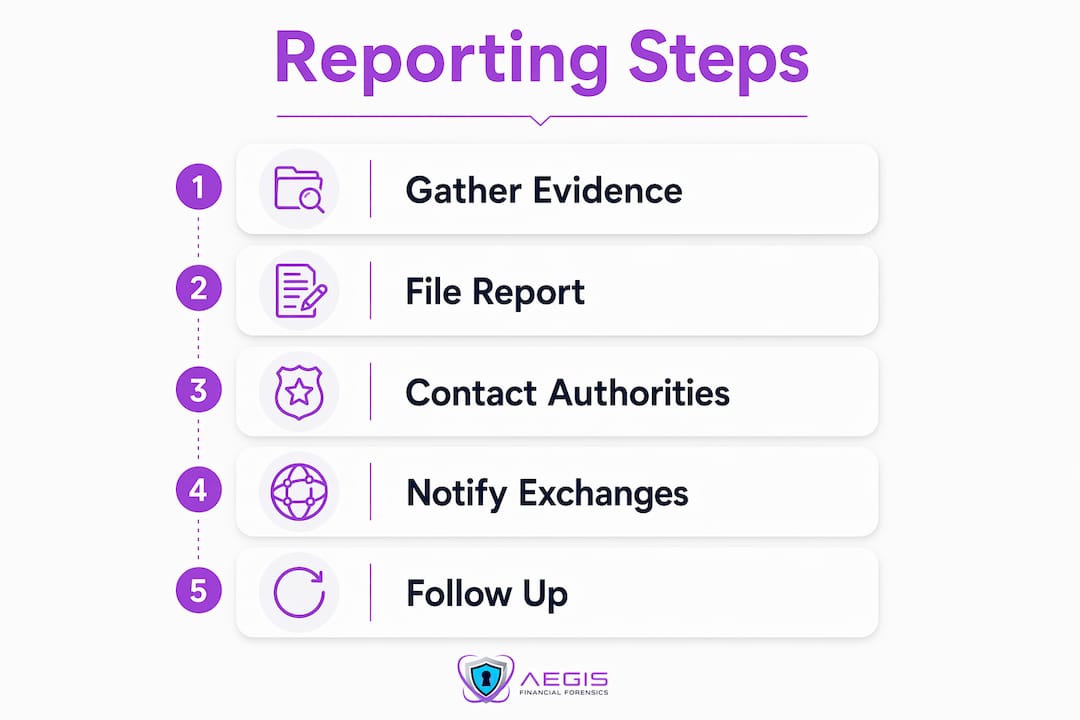
Following a structured sequence prevents critical omissions and strengthens the evidentiary record.
-
Stop all contact with the scammer immediately. Avoid paying any unlock, recovery, or fee requests. Block every communication channel the scammer used.
-
Secure your remaining assets. Move any funds still in compromised wallets to a new, unconnected wallet address before filing reports. Document this transfer with its transaction hash.
-
File your local police report. Bring your evidence folder in printed and digital form. Request a crime reference number before leaving. This number is required by most regulatory portals.
-
Submit your IC3 complaint. Attach your transaction hashes, wallet addresses, screenshots, and timeline. IC3 accepts attachments up to a defined file size limit; compress large files before uploading.
-
Notify the relevant exchanges. Email the compliance or fraud team directly, not general customer support. Include the destination wallet address, transaction hash, and the date and time of the transfer. Exchange compliance teams can intervene before funds are moved out permanently, making this one of the highest-priority contacts.
-
File with the FTC and SEC where applicable. Use the crime reference number from your police report in every submission.
-
Follow up systematically. Set calendar reminders to check case status every two weeks. Regulators and exchanges operate on their own timelines, but persistent, documented follow-up keeps your case active.
Pro Tip: Timing and thoroughness directly improve the chance of an asset freeze. Cases submitted within 24 hours of theft with complete transaction data give exchange compliance teams the best window to act before funds clear the platform.
Common challenges and what to expect when reporting crypto theft
Reporting crypto theft rarely produces immediate results. Understanding the obstacles ahead prevents further harm and keeps expectations grounded.
- Cross-border enforcement limits: Most crypto theft involves actors in multiple jurisdictions. National authorities, though limited in enforcement reach, are the only entities that can coordinate international asset recovery through legal channels. This process takes months, not days.
- Low immediate recovery rates: Reporting rarely returns your funds immediately, but it is crucial for investigation and sometimes results in successful recovery over time. Persistence matters.
- Secondary scams targeting victims: Scammers impersonate legitimate entities, including government agencies, to pressure victims into fake payments or revealing wallet keys. Any unsolicited contact offering recovery for an upfront fee is a scam. Check scam alerts regularly to recognize current impersonation tactics.
- Investigative backlogs: Law enforcement cybercrime units handle high case volumes. Your report may not receive active investigation status for weeks. This is normal and not a reason to stop following up.
- Reporting still matters beyond your case: Every report contributes to fraud intelligence databases. Investigators use aggregated data to identify scam networks, shut down operations, and prosecute organizers. Your report protects future victims even when it does not immediately recover your funds.
“Reporting crypto theft is not just about your individual case. Each report adds to a national intelligence picture that investigators use to identify criminal networks, trace fund flows, and build prosecutable cases. The victim who reports thoroughly today may be the reason a scam operation is dismantled tomorrow.”
Key Takeaways
Effective reporting after crypto theft requires organized evidence, parallel contact across multiple agencies, and persistent follow-up to maximize the chance of asset freezes and investigation.
| Point | Details |
|---|---|
| Build evidence first | Compile transaction hashes, wallet addresses, screenshots, and a timeline before filing any report. |
| Contact multiple channels | Report to local police, FBI IC3, FTC, SEC, and affected exchanges simultaneously for maximum impact. |
| Notify exchanges immediately | Exchange compliance teams can freeze destination accounts if contacted within hours of theft. |
| Expect a long process | Cross-border enforcement takes months; persistence and regular follow-up keep your case active. |
| Avoid secondary scams | Never pay upfront fees to recovery agents; verify any contact claiming to represent an official agency. |
What I’ve learned from watching victims navigate the reporting process
The most common mistake I see is victims waiting too long before contacting exchanges. They spend the first 48 hours in shock, searching for answers online, and by the time they reach a compliance team, the funds have already cleared the platform. The exchange window is real, and it closes fast.
The second pattern is under-documentation. Victims submit a paragraph describing what happened and expect investigators to fill in the gaps. That is not how forensic analysis works. Investigators need transaction hashes, wallet addresses, and a timeline they can map against blockchain data. Without those specifics, even the best crypto fraud investigation tools cannot reconstruct what happened.
The third issue is giving up after the first report goes unanswered. Law enforcement backlogs are real, but cases that receive regular, documented follow-up stay visible. Investigators notice the victims who are organized and persistent. Those are the cases that get prioritized when resources free up.
The enforcement landscape is improving. Agencies are building dedicated crypto crime units, and international cooperation frameworks are maturing. Victims who report thoroughly today are contributing to an intelligence base that makes future enforcement faster and more effective. That is not a consolation prize. It is a meaningful outcome.
— Escareno
How Aegisfinancialforensics supports victims in crypto theft investigations
Reporting to authorities is the required first step. Professional forensic investigation is what gives those reports the evidentiary weight to produce results.

Aegisfinancialforensics specializes in crypto fund recovery investigation, applying AI-driven blockchain intelligence and entity attribution analysis to trace stolen digital assets across networks. With over 1,500 satisfied clients and a track record involving more than $34 billion in illicit funds seized or recovered, Aegisfinancialforensics produces the forensic-grade documentation that law enforcement and exchanges require to act. Engaging a forensic specialist early, before evidence degrades or funds move further, gives your case the strongest possible foundation. Contact Aegisfinancialforensics to begin a professional asset tracing review of your case.
FAQ
What is the first step to report crypto theft?
File a report with your local police or cybercrime unit and obtain a crime reference number. That number is required by the FBI IC3, FTC, SEC, and most exchange compliance portals.
Can exchanges freeze stolen crypto funds?
Exchanges can freeze destination accounts if you contact their compliance team within hours of theft and provide transaction hashes and destination wallet addresses. The window closes once funds leave the platform.
Does reporting crypto theft guarantee recovery?
Reporting rarely results in immediate fund recovery, but it initiates the official investigation process and sometimes leads to successful recovery over time. Persistence and thorough documentation improve outcomes.
How do I avoid scams after crypto theft?
Never pay upfront fees to anyone claiming to recover your funds. Scammers impersonate government agencies and recovery firms to extract additional payments. Verify every contact through official agency websites before responding.
Should I contact a forensic specialist in addition to law enforcement?
Yes. Forensic specialists produce blockchain attribution reports and transaction graph analysis that give law enforcement the technical evidence needed to build a prosecutable case. Engaging a specialist early maximizes the evidentiary value of your report.