
How to Find a Reputable Blockchain Forensics Firm
A blockchain forensics firm is defined as a specialized investigative organization that traces cryptocurrency transactions across distributed ledgers to produce court-admissible evidence of financial crime. When you lose funds to a crypto scam or fraud, the firm you choose determines whether your case produces actionable intelligence or dead ends. The Daubert standard governs what forensic evidence U.S. federal courts accept, requiring testable, peer-reviewed, and reproducible methodologies. Aegisfinancialforensics has assisted with over $34 billion in illicit funds seized or recovered, serving more than 1,500 clients including major regulators and institutions. Knowing how to find a reputable blockchain forensics firm before you engage one is the single most important step you can take.
What qualifications define a reputable blockchain forensics firm?
Credentials separate genuine investigators from automated report vendors. A firm operating at the professional level must demonstrate documented, reproducible methodologies that hold up under cross-examination in federal proceedings. The Daubert standard requires that forensic methods be testable, peer-reviewed, and generally accepted within the scientific community. Any firm that cannot explain how its methodology meets this benchmark should not handle your case.
Certifications and professional standards
Certified forensic professionals typically hold credentials from recognized bodies such as the International Association of Computer Investigative Specialists (IACIS) or the SANS Institute’s GIAC program. Blockchain-specific certifications from organizations like the Blockchain Council or CipherTrace Certified Examiner programs signal focused technical training. These credentials are not guarantees of quality, but their absence is a red flag.

Transparency in methodology
A reputable firm explains its investigative process clearly, including which tracing techniques it applies, how it clusters wallet addresses, and how it documents the chain of custody. Firms that refuse to disclose their methodology or cite proprietary black-box systems cannot produce court-admissible evidence that survives legal scrutiny. Transparency is not optional in forensic work. It is the foundation of evidentiary credibility.
Distinguishing investigators from report generators
Automated blockchain reports without investigative analysis lack credibility and legal weight. Genuine forensic firms conduct detailed tracing, cluster analysis, and attribution work, then produce evidence-ready reports with narrative explanations, not just raw or templated data exports. Ask any prospective firm to show you a redacted sample report before you sign an engagement agreement.
Pro Tip: Request a written explanation of the firm’s methodology before signing any contract. If the firm cannot produce one, treat that as a disqualifying response.
What services should trusted blockchain investigation services offer?
The technical capabilities of a forensic firm determine the depth and legal utility of its findings. Clients should expect a defined set of investigative services, not a vague promise of “crypto recovery.”
Core forensic capabilities
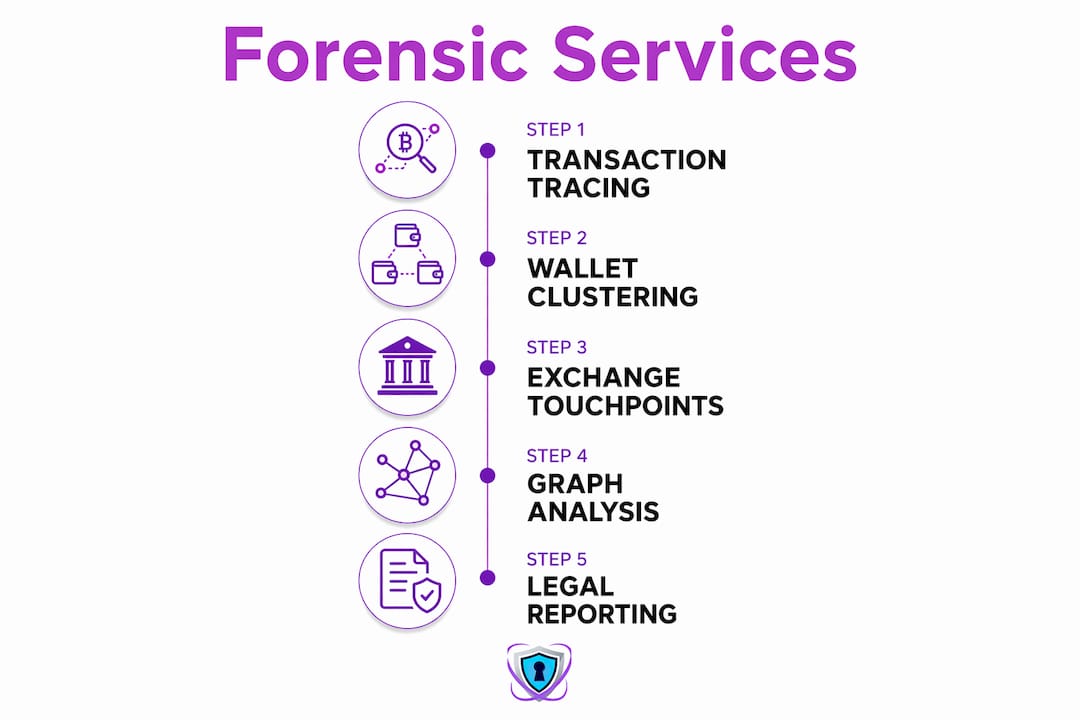
Key blockchain forensic services include multi-chain transaction tracing, wallet address clustering, exchange touchpoint analysis, and preparation of litigation-ready evidence reports. Integration of open-source intelligence (OSINT), Know Your Customer (KYC) data, and compliance monitoring tools significantly enhances the evidentiary value of findings. A firm that traces only one blockchain network is inadequate for cases involving cross-chain fund movement.
Transaction graph analysis visualizes how funds move through a network of addresses, identifying fan-out structures, peel chains, and consolidation points. Exchange identification pinpoints where stolen funds touched a regulated platform, creating a legal pathway to subpoena user records. These two capabilities together form the operational core of any serious stolen crypto tracing investigation.
Service categories at a glance
| Service category | What it delivers |
|---|---|
| Multi-chain transaction tracing | Follows funds across Bitcoin, Ethereum, and other networks |
| Wallet address clustering | Groups addresses controlled by the same entity |
| Exchange touchpoint analysis | Identifies regulated platforms where funds landed |
| OSINT and KYC integration | Enriches on-chain data with real-world identity signals |
| Litigation-ready evidence reports | Produces formatted documentation for court or regulatory use |
Pro Tip: Ask whether the firm’s reports have been accepted in prior legal proceedings. A firm with a track record of court-accepted deliverables is categorically more valuable than one without.
How to engage a blockchain forensics firm: practical steps
Engaging a trusted blockchain investigation service follows a structured process. Skipping steps creates gaps in evidence and reduces the probability of a useful outcome.
-
Conduct an initial case assessment. Reputable firms perform a go/no-go analysis, typically within 24 hours of receiving case details. This assessment determines whether a viable transaction trail exists. Honest firms decline cases where funds have entered untraceable mixers or privacy protocols that eliminate forensic pathways.
-
Gather and submit documentation. Provide transaction hashes, wallet addresses, exchange account records, communication logs with the fraudster, and any screenshots or contracts. The more complete your documentation, the faster and more accurate the investigation. Incomplete submissions extend timelines and increase costs.
-
Engage legal counsel in parallel. Forensic findings alone do not recover assets. Coordinated legal action such as Temporary Restraining Orders, subpoenas to exchanges, or regulatory referrals transforms forensic intelligence into enforceable outcomes. Retain an attorney with cryptocurrency litigation experience before or during the forensic engagement.
-
Clarify deliverables, timelines, and billing. Transparent cost structures and clear timelines prevent misunderstandings and build trust throughout the investigation. Confirm what the final report will contain, when it will be delivered, and what follow-up support the firm provides.
-
Collaborate actively during the investigation. Investigators may need additional information as the case develops. Prompt responses to requests accelerate the process. A multi-stakeholder approach involving victims, legal counsel, forensic experts, and law enforcement produces the most legally usable results.
-
Review findings and plan next steps. Once the report is delivered, review it with your attorney to determine which legal mechanisms apply: exchange subpoenas, civil litigation, or law enforcement referrals. The forensic report is the foundation, not the finish line.
Common pitfalls when hiring blockchain forensic firms
The crypto recovery space attracts fraudulent operators who exploit victims a second time. Recognizing the warning signs protects you from compounding your losses.
- Guaranteed recovery promises. No legitimate forensic firm guarantees asset recovery. Reputable firms provide forensic intelligence and regulator-ready evidence packets. Actual recovery depends on legal and enforcement action outside the firm’s direct control.
- Upfront fees with no deliverables defined. Legitimate firms specify exactly what you receive for your payment. Vague agreements with large upfront retainers and no defined scope are a primary fraud vector in this space.
- Automated reports without investigative analysis. Some operators generate templated blockchain reports using free public tools and charge professional rates for them. These reports lack credibility and will not survive legal scrutiny.
- No verifiable case history. Ask for references or redacted case summaries. A firm with no verifiable track record of prior investigations is an unacceptable risk for a high-stakes engagement.
- Pressure tactics and artificial urgency. Legitimate investigators do not pressure clients into immediate decisions. Urgency is a sales technique, not an investigative reality.
“The most dangerous firms in this space are not the obvious scammers. They are the ones that look credible, charge professional fees, and deliver automated reports dressed up as forensic analysis. The absence of a documented methodology is the clearest signal that you are not dealing with a genuine investigator.”
How to interpret forensic findings and act on them
Forensic investigation produces intelligence. Asset recovery requires converting that intelligence into legal action.
| Forensic output | Legal or enforcement application |
|---|---|
| Transaction trace report | Supports civil litigation and exchange subpoenas |
| Wallet attribution analysis | Identifies defendants for legal proceedings |
| Exchange touchpoint documentation | Enables KYC data requests via court order |
| Evidence package for regulators | Supports referrals to the SEC, FBI, or FinCEN |
| Chain of custody documentation | Preserves admissibility for trial |
Blockchain forensic findings must be paired with strategic legal action such as subpoenas, freezing orders, or regulatory measures to produce tangible outcomes. A forensic report that sits in a folder without legal follow-through recovers nothing. Coordinate with your attorney immediately upon receiving the report to determine which enforcement mechanisms apply to your jurisdiction and the location of the identified exchange touchpoints.
Law enforcement agencies including the FBI’s Internet Crime Complaint Center (IC3) and the Secret Service’s financial crimes units accept forensic evidence packages that meet evidentiary standards. Regulatory bodies such as the SEC and FinCEN have parallel referral pathways. Understanding which channel fits your case type is a decision your attorney and forensic firm should make together. Aegisfinancialforensics supports clients through this coordination process, ensuring that forensic evidence is formatted correctly for each intended legal or regulatory use.
Key Takeaways
Choosing a reputable blockchain forensics firm requires verified credentials, documented methodology, defined service capabilities, and a structured engagement process that connects forensic intelligence to legal action.
| Point | Details |
|---|---|
| Daubert standard compliance | Forensic methods must be testable, reproducible, and peer-reviewed to hold up in U.S. federal court. |
| Methodology transparency | Any firm that cannot explain its investigative process in writing is not suitable for legal-grade work. |
| Structured engagement process | Provide complete documentation, engage legal counsel in parallel, and clarify deliverables before work begins. |
| Avoid recovery guarantees | Legitimate firms deliver forensic intelligence; actual asset recovery depends on coordinated legal action. |
| Legal coordination is mandatory | Forensic reports must be paired with subpoenas, freezing orders, or regulatory referrals to produce results. |
What I’ve learned from working blockchain forensic cases
The biggest mistake clients make is treating forensic investigation as a standalone solution. They hire a firm, receive a report, and then wait for something to happen. Nothing happens, because forensic intelligence without legal action is inert. The report tells you where the money went. Your attorney and law enforcement determine whether you can get it back.
The second mistake is choosing a firm based on marketing claims rather than verifiable methodology. I have reviewed reports from firms that charged substantial fees and delivered nothing more than a public blockchain explorer printout with a logo on the cover. The Daubert standard exists precisely because courts recognized that not all “forensic” work is forensic. Apply the same skepticism a federal judge would.
Realistic timelines matter too. Complex multi-chain investigations involving mixer obfuscation or cross-jurisdictional exchange touchpoints take weeks, not days. Firms that promise fast results on complex cases are either oversimplifying or misleading you. Patience, combined with active collaboration and strong legal support, produces the best outcomes.
— Escareno
Aegisfinancialforensics: specialized blockchain forensic investigations
Aegisfinancialforensics specializes in cryptocurrency asset recovery investigations for individuals and businesses impacted by crypto scams and fraud. The firm’s five-step recovery process combines AI-driven intelligence with multi-chain tracing, wallet clustering, and litigation-ready evidence preparation. Aegisfinancialforensics works directly alongside legal counsel and law enforcement to ensure forensic findings translate into enforceable outcomes. With over 1,500 satisfied clients and a track record supporting more than $34 billion in illicit funds seized or recovered, the firm provides transparent process documentation and honest go/no-go assessments from the first contact. Explore the full range of blockchain forensic services to understand how a structured investigation can support your case.
FAQ
What is a blockchain forensics firm?
A blockchain forensics firm is an investigative organization that traces cryptocurrency transactions to produce court-admissible evidence of financial crime, supporting asset recovery and legal proceedings.
How do I verify a blockchain forensics firm’s credentials?
Request written documentation of the firm’s methodology, ask for redacted case samples, and confirm whether its reports have been accepted in prior legal proceedings under the Daubert standard.
Can a blockchain forensics firm guarantee asset recovery?
No legitimate firm guarantees recovery. Reputable firms provide forensic intelligence and evidence packets; actual asset recovery depends on coordinated legal and enforcement action.
What information should I provide when engaging a forensic firm?
Provide transaction hashes, wallet addresses, exchange account records, communication logs, and any contracts or screenshots related to the fraud. Complete documentation accelerates the investigation and improves accuracy.
How long does a blockchain forensic investigation take?
Timelines vary by case complexity. Simple single-chain traces may conclude in days, while multi-chain investigations involving mixer obfuscation or cross-jurisdictional exchange touchpoints typically require several weeks.