
Crypto Theft Litigation Support: A Complete Legal Guide
Crypto theft litigation support is the specialized legal and forensic assistance designed to help victims trace, freeze, and recover stolen cryptocurrency assets. The process combines blockchain forensic analysis with civil and criminal legal tools, including subpoenas, asset freezing orders, and DOJ forfeiture programs. Speed is the defining variable: hours and days determine whether stolen funds can still be traced before they are laundered or converted to fiat currency. Aegisfinancialforensics has assisted with over $34 billion in illicit funds seized or recovered, working alongside regulators, institutions, and individual victims to pursue every available legal avenue.
What is crypto theft litigation support and how does it work?
Crypto theft litigation support is the coordinated use of blockchain forensics and legal processes to identify, trace, and recover stolen digital assets. The industry term for this practice is “cryptocurrency litigation support,” and it covers everything from the first forensic trace of a stolen wallet to the final court order compelling an exchange to return funds. Victims who understand this process gain a realistic picture of what recovery actually requires.
The foundation of any litigation support effort is the blockchain’s public ledger. Every transaction is permanently recorded, which means forensic analysts can follow the movement of stolen funds across wallets, mixing services, and exchange deposits. This transparency is the single greatest advantage victims hold over thieves. The challenge is converting that on-chain trail into court-admissible evidence before the funds disappear into unregulated platforms.

Blockchain theft legal assistance typically involves three parallel tracks. The forensic track traces the stolen assets and documents the chain of custody. The civil track pursues claims for fraud, conversion, and unjust enrichment against identifiable defendants. The criminal track coordinates with law enforcement agencies, including the FBI’s Internet Crime Complaint Center (IC3) and the DOJ, to pursue seizure and restitution. All three tracks depend on each other, and the strongest cases run all three simultaneously.
How does blockchain forensic analysis support legal claims?
Blockchain forensic analysis produces court-admissible reports that trace stolen funds across public ledgers, linking transactions to regulated exchanges where legal action becomes possible. The analysis does not rely on speculation. It follows cryptographic transaction records that cannot be altered retroactively.
The core techniques forensic analysts use include:
- Transaction tracing: Following the movement of funds from the victim’s wallet through intermediate addresses to final deposit points.
- Wallet clustering: Grouping addresses controlled by the same entity based on co-spending patterns and behavioral signatures.
- Entity attribution: Identifying whether a receiving address belongs to a known exchange, mixer, or darknet service.
- De-mixing analysis: Reconstructing fund flows through coin-mixing services that attempt to obscure transaction origins.
- Evidentiary exports: Producing formatted reports with transaction graphs, attribution findings, and chain-of-custody documentation suitable for court submission.
The output of this process is a forensic report that legal counsel can attach to subpoenas, preservation letters, and civil complaints. Regulated exchanges with KYC and AML compliance frameworks respond to valid subpoenas by freezing accounts and disclosing account holder information. That disclosure is often the first moment a victim learns who stole their funds.
Pro Tip: Document every transaction hash, wallet address, and communication with the suspected thief immediately after the theft. This raw data forms the starting point for forensic analysis and significantly reduces the time needed to build an evidentiary report.
Forensic firms that specialize in cryptocurrency litigation support maintain relationships with major exchanges and law enforcement agencies. That network accelerates the process of issuing preservation letters before assets are moved or withdrawn. Time is the critical variable, and experienced forensic teams understand that the clock starts immediately after a theft is discovered.
What legal tools are available for recovering stolen crypto?
Civil and criminal legal mechanisms work in parallel to freeze assets and compel their return. Each tool has a specific function, and the most effective litigation support strategies deploy them in sequence based on where the stolen funds are located.
Civil legal tools include:
- Subpoenas to regulated exchanges: Legal counsel issues subpoenas to exchanges where stolen funds have been deposited, compelling disclosure of account holder identity and transaction records.
- Temporary restraining orders (TROs): Courts can issue emergency TROs to freeze assets before a defendant has the opportunity to withdraw or transfer them.
- Asset freezing injunctions: A more durable form of the TRO, these orders remain in place during litigation and prevent dissipation of the stolen funds.
- Civil complaints: Fraud, conversion, and unjust enrichment claims establish the legal basis for recovery and can be filed against identifiable defendants in federal or state court.
Criminal and regulatory tools include:
- IC3 complaints: Filing with the FBI’s Internet Crime Complaint Center creates an official record that law enforcement agencies use to initiate investigations and coordinate seizures.
- DOJ forfeiture and restitution programs: The DOJ’s Scam Center Strike Force, established in november 2025, has pursued major seizures from fraud operations. Victims who have filed timely reports may qualify for restitution from recovered funds.
- Preservation letters: Sent to exchanges before a subpoena is formally issued, these letters request that the exchange preserve account data and transaction records pending legal process.
Legal cooperation with exchanges is the mechanism that converts forensic findings into actual asset recovery. Exchanges that operate under KYC and AML obligations are legally required to respond to valid legal process. That compliance framework is the bridge between a forensic trace and a frozen account.
What are the realistic challenges of recovering stolen crypto?
Recovery through litigation support is possible, but outcomes depend on factors that victims cannot always control. The most important factor is where the stolen funds end up. Recovery chances are best when stolen assets reach regulated exchanges compliant with KYC and AML laws. Funds that move into self-hosted wallets or decentralized protocols are generally unrecoverable through legal means.
| Factor | Impact on recovery |
|---|---|
| Funds reach a regulated exchange | High recovery potential via subpoena and freeze |
| Funds converted to fiat at a compliant exchange | Moderate potential if account is identified quickly |
| Funds moved to a decentralized protocol | Low potential; no custodian to subpoena |
| Defendant is identifiable and solvent | Civil judgment is enforceable |
| Defendant is anonymous or offshore | Recovery depends entirely on law enforcement action |
Speed of action determines which row of that table applies to a given case. Early action after theft significantly improves chances of recovery before funds are laundered or converted to fiat. Delays of even a few days can allow thieves to move funds through multiple hops, reducing the probability that any single exchange holds traceable assets.
Recovery scams represent a serious secondary risk for victims. Genuine litigation support builds evidence for courts without promising certainty. Any service that guarantees recovery, promises to “hack back” stolen funds, or demands large upfront fees before conducting any forensic work is a scam. Victims who fall for recovery scams lose additional funds and often compromise the integrity of the original forensic trail.
Pro Tip: Before engaging any recovery service, verify that the firm can produce sample forensic reports, name the legal counsel they work with, and explain their specific process for engaging exchanges. Legitimate firms answer these questions directly.
The cost-benefit calculation for litigation support depends on the amount stolen, the identifiability of the defendant, and the jurisdiction. Cases involving large sums stolen from identifiable defendants at regulated exchanges present the strongest return on legal investment. Smaller thefts involving anonymous actors on decentralized platforms may not justify full civil litigation, though IC3 reporting and forensic documentation remain worthwhile.
How to engage crypto theft litigation support effectively
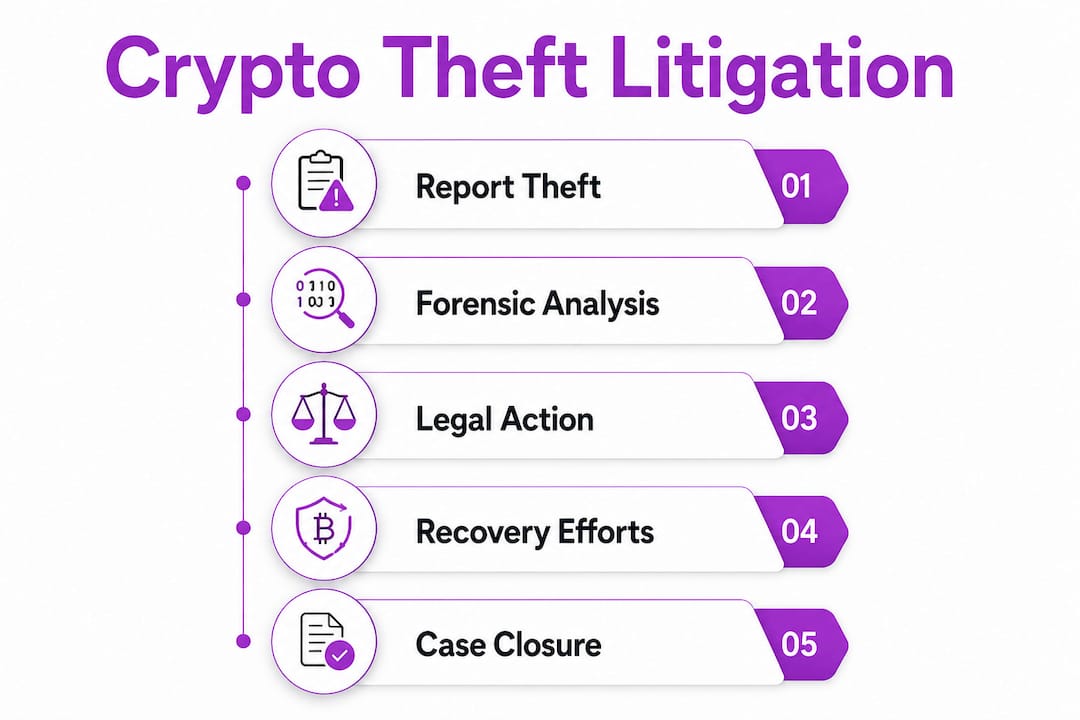
The first 48 hours after a theft are the most consequential. Victims who act within this window give legal and forensic teams the best possible starting conditions.
- File an IC3 complaint immediately. Filing IC3 complaints strengthens law enforcement action and forms the basis for investigations and civil claims. Record the complaint number for all subsequent legal filings.
- Contact a crypto-experienced attorney. General litigation attorneys rarely understand blockchain evidence standards or exchange subpoena procedures. Engage counsel with documented experience in cryptocurrency litigation support specifically.
- Preserve all documentation. Compile wallet addresses, transaction hashes, screenshots of communications, platform names, and any identifying information about the suspected thief. Organize this material chronologically before your first attorney meeting.
- Commission a forensic investigation. Legal counsel and forensic analysts should work together from the start. The forensic report informs which exchanges to subpoena, which courts have jurisdiction, and what legal claims are supportable.
- Contact the relevant exchange directly. If you know which exchange received the stolen funds, send a written preservation request immediately. Many exchanges have dedicated compliance teams that respond to victim reports before formal legal process is served.
- Report to additional authorities. Beyond IC3, contact authorities such as the FTC, your state attorney general, and relevant financial regulators. Multiple reports increase the probability of coordinated law enforcement action.
Victims should set realistic timeline expectations. Subpoena responses from exchanges typically take weeks. Court orders for asset freezes can be obtained on an emergency basis but require a compelling factual record. Full civil litigation from complaint to judgment can take one to three years. Forensic investigations, by contrast, can produce preliminary findings within days, which is why commissioning them immediately is the highest-priority action.
Key Takeaways
Crypto theft litigation support succeeds when blockchain forensic analysis, legal process, and law enforcement cooperation are coordinated immediately after theft, before stolen funds leave regulated platforms.
| Point | Details |
|---|---|
| Speed determines outcome | Hours matter; early forensic and legal action prevents funds from leaving traceable platforms. |
| Forensic reports enable legal action | Court-admissible blockchain analysis links stolen funds to exchange accounts, supporting subpoenas and freezes. |
| Regulated exchanges are the recovery point | KYC/AML-compliant exchanges respond to valid subpoenas, making them the critical intervention point. |
| IC3 filing is the first step | Filing with the FBI’s IC3 creates the official record that supports both criminal and civil recovery efforts. |
| Recovery scams are a real threat | Legitimate litigation support builds evidence and engages courts; no credible firm guarantees recovery outcomes. |
The forensic-legal partnership is what actually moves cases forward
Working in this field, the pattern I see most often is victims who waited too long before engaging both a forensic analyst and an attorney simultaneously. Most people contact a lawyer first, then wait weeks for a referral to a forensic firm. By then, the funds have moved through three additional hops and the exchange deposit that could have been frozen is long gone.
The cases that result in actual recovery share one characteristic: the forensic investigation and the legal process started within 48 hours of each other. The forensic report tells the attorney which exchange to subpoena. The attorney’s preservation letter tells the exchange to hold the account before the subpoena arrives. That sequence only works when both teams are operating in parallel, not in series.
The other pattern worth naming directly is the secondary victimization from recovery scams. Victims who have already lost significant funds are psychologically primed to believe that a service promising fast results is legitimate. The warning sign is always the same: a guarantee. No forensic analyst and no attorney can guarantee recovery, because recovery depends on where the funds went and whether the defendant is identifiable. Any firm that tells you otherwise is the second theft.
The regulatory environment is improving. The DOJ’s Scam Center Strike Force and increasing KYC enforcement at major exchanges have made the legal pathway more viable than it was three years ago. Victims who engage qualified forensic and legal support now have a genuinely functional system to work within, provided they act quickly and document everything from the first moment.
— Escareno
How Aegisfinancialforensics supports crypto theft victims
Aegisfinancialforensics provides forensic investigation and litigation support services specifically built for victims of crypto theft, combining AI-driven blockchain tracing with court-ready evidentiary reporting. The firm’s analysts trace stolen funds across networks, identify exchange deposit points, and produce the forensic documentation that legal counsel needs to issue subpoenas and pursue asset freezes.
With over 1,500 satisfied clients and a track record supporting major regulators and institutions, Aegisfinancialforensics delivers the forensic foundation that makes crypto fund recovery legally actionable. The team coordinates directly with legal counsel and law enforcement to accelerate every stage of the recovery process. Victims seeking to understand their recovery potential can request a consultation through Aegisfinancialforensics to evaluate the forensic and legal options available in their specific case.
FAQ
What is crypto theft litigation support?
Crypto theft litigation support is the coordinated use of blockchain forensic analysis and legal processes, including subpoenas, asset freezes, and civil or criminal claims, to trace and recover stolen cryptocurrency assets.
How do I report crypto theft to authorities?
File a complaint with the FBI’s IC3 immediately after the theft, then report to the FTC and your state attorney general. These reports form the official record that supports both criminal investigations and civil recovery claims.
Can stolen cryptocurrency actually be recovered?
Recovery is possible when stolen funds reach regulated, KYC-compliant exchanges where subpoenas can compel account disclosure and asset freezes. Funds held in self-hosted wallets or decentralized protocols are generally unrecoverable through legal means.
How do I avoid crypto recovery scams?
Any service that guarantees recovery or promises to hack back stolen funds is a scam. Legitimate crypto asset recovery services build forensic evidence and engage courts without promising specific outcomes.
How quickly should I act after crypto theft?
Act within 48 hours. Early action before funds are laundered or converted to fiat significantly improves recovery chances, and preservation letters to exchanges must be sent before account holders withdraw or transfer assets.