
Crypto Exchange Breach Recovery Process: 2026 Guide
The crypto exchange breach recovery process is the systematic set of actions victims take after losing funds to a hack, covering asset protection, evidence preservation, and coordination with exchanges and law enforcement. Speed determines outcomes here. Victims who act within the first few hours preserve more options than those who wait days. This guide covers every phase of post-breach response, from locking down accounts to working with forensic investigators, and flags the scams that target victims during their most vulnerable moments.
What immediate steps should you take after a crypto exchange breach?
The first 60 minutes after detecting a breach are the most operationally critical. Exchanges provide withdrawal freezes and account locks that can stop further unauthorized fund movements. Triggering these tools immediately limits losses before an attacker can route funds off-platform.
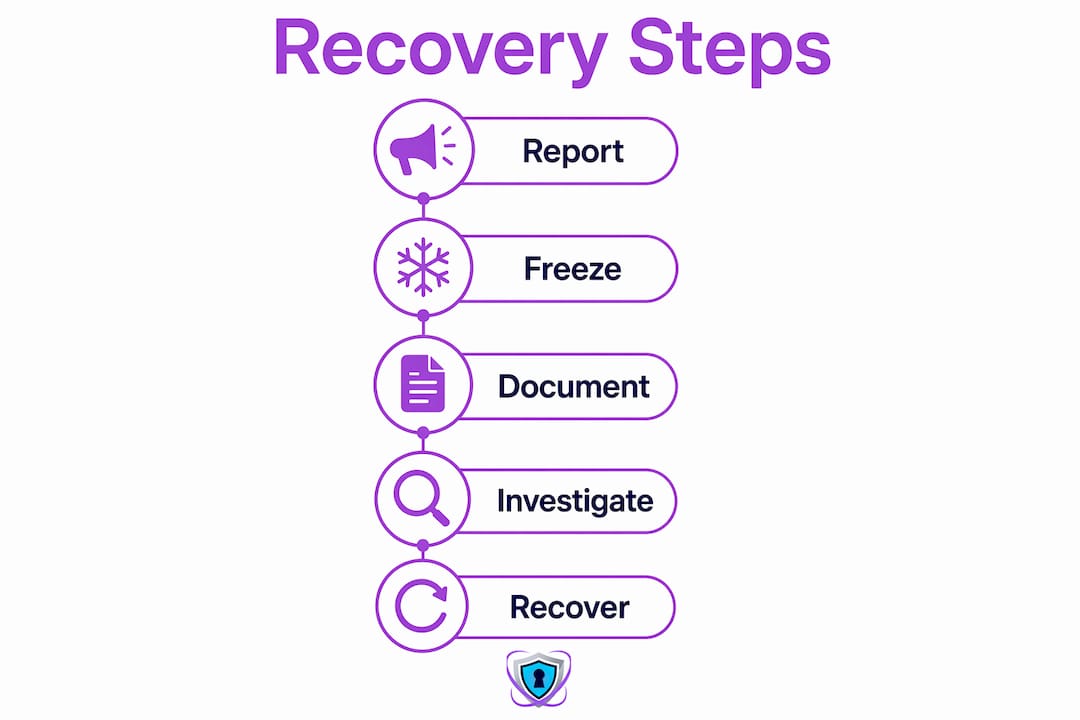
Follow these steps in order:
- Contact the exchange’s security or support team and request an immediate account freeze or withdrawal suspension.
- Reset your password from a clean, uncompromised device. Do not use the same network the breach occurred on.
- Enable or reinforce two-factor authentication using an authenticator app rather than SMS, which is vulnerable to SIM-swap attacks.
- Force-logout all active sessions through your account security settings to cut attacker access immediately.
- Transfer remaining funds to a new wallet on a clean device before the attacker can return.
- Document everything in real time: transaction IDs, withdrawal hashes, IP addresses, and timestamps.
Pro Tip: Screenshot your account activity log before resetting anything. Some exchanges purge session logs after a password reset, and that data is critical for your recovery claim.
The order of these steps matters. Resetting a password before freezing withdrawals can alert an attacker who still has session access, giving them time to drain remaining balances.
What documentation and evidence do you need for the recovery process?
Strong evidence is the single factor that most separates successful recovery claims from failed ones. Forensic evidence like IP logs, withdrawal hashes, and device fingerprints is time-sensitive. Exchanges retain this data only briefly, and losing it permanently reduces your ability to pursue recovery or legal action.
Collect and preserve the following:
- Local police report number: Required by most exchanges to initiate a formal investigation.
- IC3.gov complaint: The FBI’s Internet Crime Complaint Center accepts crypto theft reports and creates a federal record.
- Transaction hashes and wallet addresses: Every unauthorized transaction has an on-chain identifier that forensic analysts can trace.
- Screenshots of account activity: Capture login history, withdrawal records, and any security alerts received.
- Device fingerprints and IP logs: These identify the attacker’s access point and are essential for attribution.
- All exchange communications: Save every email, chat, and notification related to the breach.
Pro Tip: File your IC3 complaint and police report on the same day as the breach. Exchanges treat time-stamped official reports as verification of your claim, which accelerates their internal audit process.
| Evidence Type | Why It Matters |
|---|---|
| Police report number | Verifies the breach to exchanges and opens a law enforcement record |
| IC3.gov complaint | Creates a federal filing that supports legal action and exchange cooperation |
| Transaction hashes | Allows forensic tracing of stolen funds across the blockchain |
| IP logs and device fingerprints | Identifies attacker access points for attribution analysis |
| Exchange communications | Documents the timeline and exchange’s awareness of the incident |
Preserving chain of custody for digital evidence is challenging but essential for civil litigation. Every piece of data must be captured, dated, and stored in a way that proves it has not been altered.
How do crypto exchanges handle breach reports?
Exchanges follow structured internal procedures when a breach is reported. A 72-hour structured response improves containment and regulatory compliance. That window includes pausing withdrawals, auditing logs, notifying legal teams, and managing public communications carefully.
What exchanges can do for victims:
- Freeze accounts and flag wallet addresses associated with the attacker if funds have not yet been withdrawn.
- Conduct internal security audits to determine how the breach occurred and whether exchange-side vulnerabilities were involved.
- Cooperate with law enforcement by providing transaction records when served with a valid legal request.
- Re-verify your identity through KYC before processing any recovery claim, even for long-established accounts.
What exchanges cannot do:
- Reverse confirmed blockchain transactions. Once a transfer is confirmed on-chain, it is permanent.
- Guarantee recovery of funds already moved to external wallets.
- Act without official documentation, including a police report and identity verification.
Submitting wallet addresses, transaction hashes, and police reports promptly improves the chances of a successful freeze. Centralized exchanges with KYC requirements can freeze stolen funds if the attacker’s assets arrive before withdrawal. After 48 hours, the probability of a successful freeze drops sharply as attackers move funds through mixing services or cross-chain bridges.
What scams and pitfalls should you avoid during breach recovery?
The period immediately after a breach is when victims are most vulnerable to secondary fraud. Claims promising 100% recovery or requiring advance fees are fraudulent. Recovery scams specifically target breach victims with fake software licenses or “hacker recovery” services that claim to reverse blockchain transactions.
Common fraud patterns to recognize:
- Upfront fee demands: Legitimate forensic investigators do not require full payment before delivering results.
- Guaranteed recovery promises: No entity can guarantee fund recovery. Blockchain transactions are irreversible.
- Fake “hacker” services: These claim to hack back the attacker’s wallet. They take fees and disappear.
- Unverified software licenses: Fraudsters sell tools that allegedly trace or recover crypto. None work as advertised.
- Social media impersonators: Fake accounts posing as exchange support staff or recovery specialists.
“Users must be skeptical about entities claiming guaranteed recovery, as these often lead to secondary victimization through scams. The only verified channels for reporting and recovery are official exchange support, local law enforcement, and the IC3. Any third party demanding payment upfront before delivering results warrants immediate scrutiny.”
Check any recovery service against known scam alerts before engaging. Defense-in-depth security, including withdrawal locks and managing your digital footprint, reduces exposure before a breach occurs. Single defenses do not stop all attacks. Layered controls are the standard.
What legal and investigative actions support fund recovery?
Legal and forensic channels offer the most credible path to recovering stolen funds, though outcomes depend heavily on case size and evidence quality. Law enforcement recovery efforts are more likely successful in large thefts where perpetrators are identified. Most individual cases below $100,000 do not result in recovered funds through government channels alone.
The investigative sequence that produces results:
- File a local police report on the day of the breach. This creates the official record exchanges require.
- Submit an IC3.gov complaint with all transaction data, wallet addresses, and breach timelines.
- Engage a blockchain forensic investigator to trace stolen funds through chain hops, peel chains, and wallet clusters. Aegisfinancialforensics has assisted with over $34 billion in illicit funds seized or recovered using AI-driven intelligence and on-chain attribution methods.
- Consult a legal expert specializing in digital asset law to assess civil litigation options against identifiable parties.
- Maintain chain-of-custody documentation for all evidence gathered, ensuring it meets evidentiary standards for court use.
Pro Tip: Ask your forensic investigator for evidentiary exports formatted for law enforcement submission. Reports prepared in court-ready formats significantly reduce the time it takes for agencies to act on your case.
Legal cooperation in crypto recovery requires coordinating between forensic findings and law enforcement timelines. Forensic investigators can trace stolen crypto across multiple networks, identify exchange deposit addresses, and produce attribution reports that support both criminal and civil proceedings.
Key Takeaways
The crypto exchange breach recovery process succeeds when victims act within hours, preserve forensic evidence before it is purged, and engage verified investigators rather than fraudulent recovery services.
| Point | Details |
|---|---|
| Speed is the primary variable | Freeze accounts and collect evidence within the first hour to preserve recovery options. |
| Official documentation is required | A police report and IC3 complaint are prerequisites for exchange cooperation and legal action. |
| Evidence has an expiration date | IP logs, session data, and device fingerprints are purged quickly; capture them immediately. |
| Scams target breach victims directly | Any service promising guaranteed recovery or demanding upfront fees is fraudulent. |
| Forensic investigators improve outcomes | Professional blockchain tracing and court-ready evidentiary exports strengthen legal cases. |
What I’ve learned about breach recovery that most guides won’t tell you
Most victims lose their best recovery window not because they acted too slowly, but because they acted on the wrong things first. I’ve seen clients spend the first 48 hours arguing with exchange support chat bots while forensic evidence expired in the background. The exchange conversation matters, but it is not the most time-sensitive task. Capturing IP logs, session data, and on-chain transaction records before they are purged is.
The second pattern I see repeatedly is victims who contact a “recovery specialist” they found through a social media ad before they file a police report. That sequence is backward and costly. Official channels must come first. A police report and IC3 complaint create the legal foundation that every subsequent action depends on. Without them, forensic findings have no formal home to land in.
The third thing most guides understate is the role of pre-breach security hygiene. Withdrawal locks with strict user controls are one of the most underused protective tools available. They create a time delay on large withdrawals that can interrupt an attacker’s operational window. Victims who had these enabled before a breach consistently report smaller losses than those who did not.
Realistic expectations matter here. Recovery is possible, but it is not guaranteed, and the probability scales with case size, evidence quality, and how quickly professional investigators are engaged. The clients who recover the most are the ones who treated the first hour like a forensic scene, not a customer service complaint.
— Escareno
Aegisfinancialforensics: professional support for crypto breach victims
When a breach occurs, the quality of your forensic investigation determines what recovery is possible.

Aegisfinancialforensics specializes in crypto fund recovery investigations using AI-driven blockchain forensics, on-chain attribution, and evidentiary exports built for law enforcement submission. With over 1,500 clients served and more than $34 billion in illicit funds traced or recovered, Aegisfinancialforensics brings the technical depth and legal coordination that breach victims need. The team works directly with law enforcement agencies and legal counsel to build cases that hold up in court. Engaging professional forensic support early in the process produces better outcomes than waiting until evidence has expired.
FAQ
What is the first step in the crypto exchange breach recovery process?
Contact your exchange immediately to freeze withdrawals and lock your account. File a local police report and an IC3.gov complaint on the same day to create the official documentation exchanges require.
Can stolen cryptocurrency be recovered?
Recovery is possible but not guaranteed. Centralized exchanges can freeze stolen funds if the attacker’s assets are still on-platform, but confirmed blockchain transactions cannot be reversed.
How long does forensic evidence remain available after a breach?
IP logs, session data, and device fingerprints are retained by exchanges only briefly. Capturing this data within the first 24 hours is critical to preserving your ability to pursue recovery or legal action.
How do I identify a fraudulent recovery service?
Any service that promises 100% fund recovery or demands an upfront fee before delivering results is a scam. Use only verified forensic investigators and official exchange and law enforcement channels.
Does case size affect recovery outcomes?
Yes. Law enforcement recovery efforts succeed most often in large thefts where perpetrators are identified. Cases below $100,000 rarely result in government-recovered funds, making professional forensic support and civil litigation the more practical paths.