
How to Build Crypto Fraud Case Evidence That Holds Up
Crypto fraud case evidence is defined as the documented record of on-chain transaction data, off-chain communications, and corroborating financial records that establish misrepresentation, intent, and loss in a legal proceeding. Victims of cryptocurrency scams face a specific challenge: the blockchain is public and permanent, yet the people behind fraudulent wallets often remain anonymous. The good news is that blockchain’s immutability works in your favor when you know what to collect and how to preserve it. This guide covers the exact evidence categories, collection methods, and legal strategies that give fraud victims the strongest possible foundation for recovery.
What types of evidence are crucial in building a crypto fraud case?
Crypto fraud case evidence falls into two primary categories: on-chain data and off-chain documentation. Both are required. Neither alone is sufficient to prove misrepresentation, intent, and loss.
On-chain evidence
On-chain evidence lives permanently on the blockchain and is publicly verifiable. The transaction hash (TXID) is the single most important piece of on-chain evidence. Without the TXID and the associated wallet addresses, law enforcement and forensic firms cannot trace or verify any transaction. Every transfer you made to a fraudulent platform should be documented with its TXID, the sending and receiving wallet addresses, the timestamp, and the amount in both cryptocurrency and USD equivalent at the time of transfer.

Blockchain explorers such as Etherscan, Blockchain.com, and BscScan allow anyone to verify this data independently. Investigators use these records to map fund flows, identify mixing or layering activity, and locate where assets moved after leaving your wallet. A complete evidence types list includes wallet cluster attribution, entity labeling, and peel chain analysis, all of which require the original TXID as the starting point.
Off-chain evidence
Off-chain evidence includes full emails with headers, chat logs from platforms like WhatsApp or Telegram, screenshots of investment dashboards, website records, and any promotional materials the fraudster sent you. Screenshots alone are insufficient. Courts and arbitration panels require original digital formats with intact metadata to establish authenticity and prevent tampering challenges.
Specific off-chain items to collect include:
- Full email threads exported with complete headers showing sender IP addresses and routing data
- Chat logs exported in their native format, not just screenshots
- Archived or cached versions of the fraudulent website, including Terms of Service pages
- Whitepapers, pitch decks, or investment prospectuses provided by the fraudster
- Account statements or withdrawal records from the fraudulent platform
- Any wire transfer or bank records connected to the scheme
Pro Tip: Use the Wayback Machine at archive.org to capture and preserve a timestamped snapshot of any fraudulent website before it goes offline.
Securities fraud claims require a structured evidence record connecting specific misrepresentations to your documented loss. That means pairing the fraudster’s written promises with your account statements showing the resulting financial damage.
How to gather and preserve crypto fraud evidence effectively
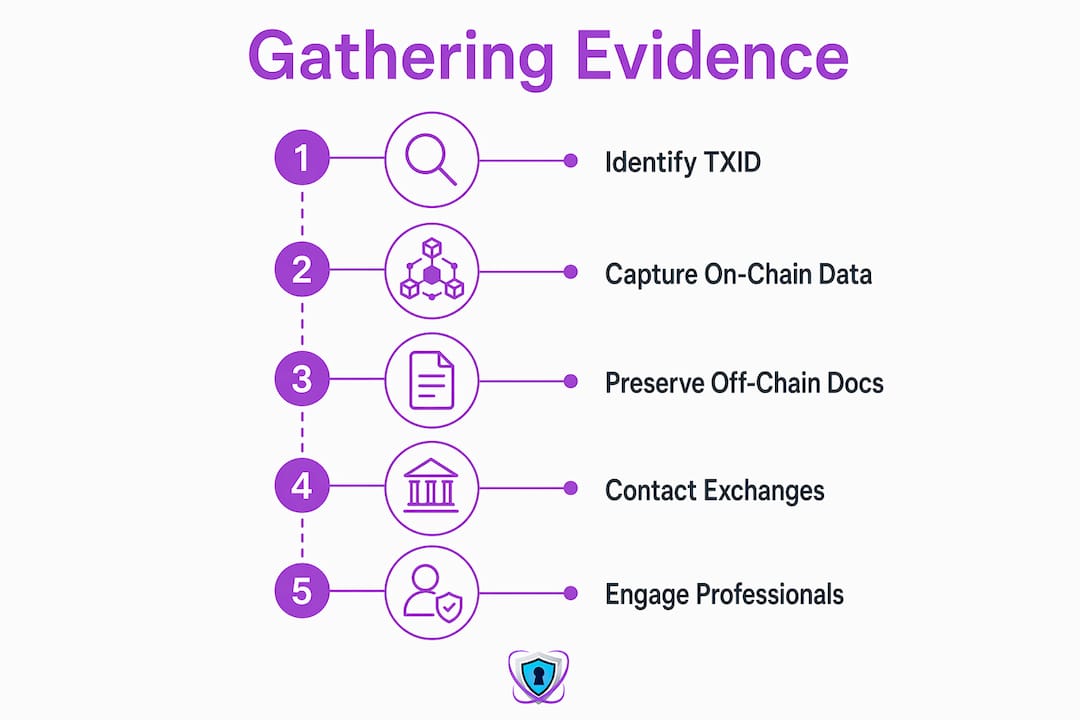
Systematic collection and strict chain of custody are the two requirements that determine whether your evidence holds up in court or arbitration. Preserving chain of custody for crypto evidence ensures data integrity and admissibility. Proper documentation and storage prevent challenges to authenticity and tampering allegations.
Follow this collection sequence immediately after identifying fraud:
- Document all transaction hashes. Open a blockchain explorer and record every TXID associated with your transfers. Copy the full transaction details into a spreadsheet with columns for date, time, TXID, sending address, receiving address, amount, and USD value.
- Export all communications. Download full email threads with headers from your email client. Export chat histories in their native file format. Do not rely on screenshots as your primary record.
- Archive web pages. Use archive.org or a browser-based page capture tool to save the fraudulent platform’s pages, including the homepage, investment terms, and any pages showing your account balance.
- Capture and organize screenshots. Take screenshots as secondary records only, with visible timestamps and URLs in the browser bar.
- Maintain a chronological evidence log. Create a master document listing every piece of evidence, its file name, where it is stored, and when it was collected. This log is your chain of custody record.
- Store evidence in multiple secure locations. Use encrypted cloud storage and a local encrypted drive. Never store evidence only on a device that could be lost or seized.
- Report to the FBI IC3 immediately. Early reporting to IC3 and notification of involved exchanges improve recovery outcomes. Assets reported within hours can sometimes be frozen; delayed action reduces recovery chances significantly.
Pro Tip: Contact the compliance or fraud department of any exchange that received your funds directly. Provide the TXID and request a voluntary hold. Some exchanges will act on this without a court order if the request arrives quickly.
The table below summarizes the evidence categories, their sources, and their legal function:
| Evidence Type | Source | Legal Function |
|---|---|---|
| Transaction hash (TXID) | Blockchain explorer | Verifies and traces fund movement |
| Wallet addresses | On-chain records | Identifies sending and receiving parties |
| Full emails with headers | Email client export | Proves misrepresentation and intent |
| Chat logs (native format) | Messaging app export | Documents fraudster communications |
| Archived web pages | archive.org or capture tool | Preserves fraudulent claims and terms |
| KYC records from exchanges | Subpoena or voluntary disclosure | Identifies real-world identity of wallet holders |
| Account statements | Platform records or screenshots | Quantifies financial loss |
Professional crypto fraud investigation tools extend this process by applying entity attribution, de-mixing analysis, and cross-chain tracing that go well beyond what a blockchain explorer shows.
How do you identify reachable defendants in a crypto fraud case?
The most common reason civil litigation fails in crypto fraud cases is not weak evidence. It is suing the wrong party. Many crypto fraud operators are anonymous and effectively judgment-proof, but exchanges and intermediaries often hold assets that courts can reach.
The strategic priority is locating defendants who are identifiable, solvent, and within a court’s jurisdiction. That means focusing on:
- Regulated exchanges. If your funds passed through a licensed exchange, that exchange holds Know Your Customer (KYC) data on the wallet owner. A subpoena or court order can compel disclosure of that identity information.
- FINRA-registered broker-dealers. FINRA arbitration against registered broker-dealers who facilitated investments often reaches solvent, regulated parties faster than court litigation against anonymous token issuers.
- Payment processors and fiat on-ramps. Any service that converted your fiat currency into crypto holds transaction records and identity data that can be subpoenaed.
- Early asset freezing. Blockchain analytics can follow asset flows across addresses and exchanges, but recovering assets requires cooperation from regulated exchanges where identity information can be subpoenaed. The window for freezing assets is narrow. Once funds move to a non-custodial wallet or cross into a privacy coin, recovery becomes substantially harder.
Legal professionals consistently identify solvent defendants and FINRA arbitration as the two most productive paths for investors defrauded through registered intermediaries. The underlying token issuer may be untouchable, but the regulated firm that sold the product often is not.
What are the common challenges in building crypto fraud evidence?
Speed is the defining variable in crypto fraud evidence collection. The clock starts the moment you suspect fraud, not when you confirm it. Off-chain evidence degrades quickly: websites go offline, chat accounts get deleted, and fraudsters scrub their digital footprint within days of detection.
“Victims who act within the first 24–48 hours of identifying fraud preserve significantly more recoverable evidence and assets than those who wait for legal counsel before taking any steps. The evidence you collect before contacting a lawyer is often the most valuable evidence your lawyer will ever see.”
Several specific challenges require direct responses:
- Mandatory arbitration clauses. Arbitration clauses in exchange Terms of Service can block lawsuits, but they may be bypassed if claims seek public injunctive relief or if adequate notice of the clause was not given. Review the Terms of Service of every platform involved before filing any claim.
- International jurisdiction. Fraudsters operating from offshore jurisdictions complicate enforcement. Focus on the regulated entities in your jurisdiction that touched the funds, not the offshore operator.
- Uncooperative exchanges. Some exchanges will not act without a court order. File a Suspicious Activity Report and notify the FBI IC3 to create a formal record that supports future subpoenas.
- Evidence tampering risk. Never alter, annotate, or edit any original evidence file. Work from copies. Store originals in read-only format.
- Filing Suspicious Activity Reports (SARs) based on AML red flags helps escalate potential fraud to authorities even without proof of criminality. Reporting suspicion can initiate investigations that uncover broader fraud networks.
Organizing evidence chronologically from the first contact with the fraudster to the last transaction is the most effective way to present a coherent case. A crime timeline reconstruction turns a collection of documents into a narrative that courts and arbitrators can follow.
Key Takeaways
Building crypto fraud case evidence requires immediate action, systematic collection of both on-chain and off-chain records, and a legal strategy focused on reachable, solvent defendants.
| Point | Details |
|---|---|
| TXID is the foundation | Every on-chain claim starts with the transaction hash; collect it first. |
| Off-chain evidence needs metadata | Screenshots alone fail; export emails and chats in native formats with headers. |
| Speed determines recovery | Assets reported within hours can be frozen; delays reduce recovery chances significantly. |
| Target solvent defendants | Focus on regulated exchanges and FINRA-registered intermediaries, not anonymous operators. |
| Chain of custody is non-negotiable | Document every piece of evidence with source, date, and storage location to ensure admissibility. |
What I’ve learned from working crypto fraud cases
The single most damaging mistake victims make is waiting. They wait for certainty that they have been defrauded. They wait until they have spoken to a lawyer. They wait until the loss feels large enough to justify action. By the time most victims act, the fraudster’s website is gone, the Telegram account is deleted, and the funds have moved through three exchanges and two privacy mixers.
The second mistake is treating the blockchain as the whole case. On-chain tracing tells you where the money went. Off-chain evidence tells you why it went there and who sent it. Courts need both. A transaction hash proves a transfer happened. An email promising guaranteed returns proves why you made that transfer. Without the email, the TXID is just a number.
The third mistake is targeting the wrong defendant. I have seen victims spend months building a case against an anonymous wallet operator with no assets and no jurisdiction. The better path is almost always through the regulated intermediary: the exchange, the broker-dealer, or the payment processor that touched the funds. These entities have assets, legal counsel, and compliance obligations that make them responsive to legal pressure.
Professional forensic support changes the outcome in complex cases. Aegisfinancialforensics has assisted with over $34 billion in illicit funds seized or recovered, working with more than 1,500 clients including major regulators and institutions. That scale of experience means the firm recognizes fund flow patterns, entity attribution signals, and legal coordination strategies that individual victims cannot replicate alone. The evidence you build in the first 48 hours shapes everything that follows. Build it correctly.
— Escareno
Aegisfinancialforensics: professional support for crypto fraud victims
Victims of cryptocurrency fraud face a narrow window to preserve evidence and freeze assets before they move beyond recovery. Aegisfinancialforensics provides forensic investigation services specifically designed for this window, combining AI-driven blockchain analytics with legal coordination to trace stolen funds across networks and exchanges.

Aegisfinancialforensics has assisted with over $34 billion in illicit funds seized or recovered across more than 1,500 cases, working directly with regulators and institutions. The firm’s crypto fund recovery investigation service covers on-chain tracing, entity attribution, evidentiary exports, and coordination with legal counsel. For victims who need to trace stolen crypto across multiple networks or exchanges, professional forensic support significantly improves both evidence quality and recovery outcomes.
FAQ
What is crypto fraud case evidence?
Crypto fraud case evidence is the documented record of on-chain transaction data, off-chain communications, and financial records that prove misrepresentation, intent, and loss in a legal or arbitration proceeding.
What is the most important piece of on-chain evidence?
The transaction hash (TXID) is the most important piece of on-chain evidence. Without it, law enforcement and forensic firms cannot trace or verify any transaction.
How quickly should victims act after discovering crypto fraud?
Victims should act within 24–48 hours of identifying fraud. Assets reported to the FBI IC3 and involved exchanges within hours can sometimes be frozen; delayed action reduces recovery chances significantly.
Can victims recover funds if the fraudster is anonymous?
Recovery is possible by targeting regulated intermediaries such as exchanges and FINRA-registered broker-dealers that processed the funds. These entities hold KYC data and assets that courts can reach through subpoenas and asset freezing orders.
Do arbitration clauses block crypto fraud lawsuits?
Mandatory arbitration clauses in exchange Terms of Service can complicate legal recourse, but they may be bypassed if claims seek public injunctive relief or if adequate notice of the clause was not provided to the victim.