

How Scammers Launder Stolen Crypto: 2026 Guide
Cryptocurrency money laundering is the process by which scammers conceal the criminal origin of stolen digital assets through a deliberate sequence of blockchain transactions. Understanding how scammers launder stolen crypto is the first line of defense for any investor holding digital assets. The core methods include wallet smurfing, mixers and tumblers, peel chains, cross-chain bridges, and cash-out via low-KYC exchanges. Real cases like the AudiA6 laundering service, which processed over $389 million in illicit transactions, and operational data from Global Ledger confirm that laundering begins within hours of theft, not days.
What are the main crypto laundering techniques used by scammers?
Scammers rely on a defined toolkit of crypto laundering techniques, each designed to break the traceable link between stolen funds and a cash-out point. No single method is used in isolation. Stacked layering techniques are stronger risk indicators than any single method alone, which means investigators look for combinations, not individual actions.
Wallet smurfing and peel chains
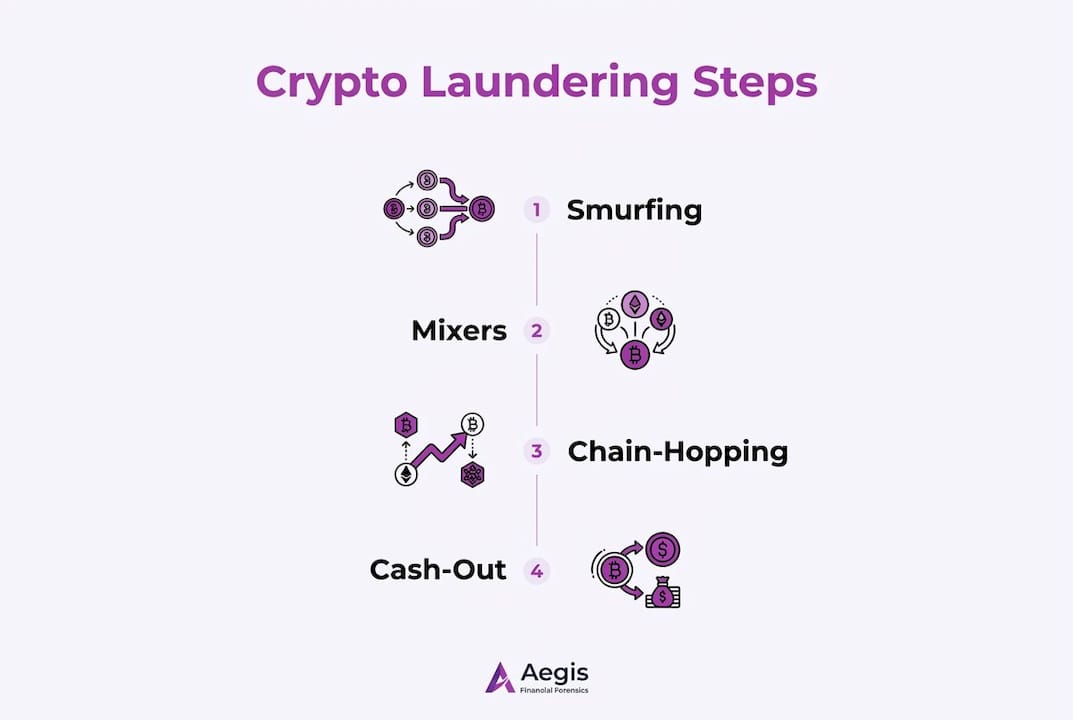
Smurfing splits a large stolen balance into many smaller transfers across dozens of wallets. This mirrors the classic financial crime tactic of structuring cash deposits below reporting thresholds. Peel chains extend this further: a scammer sends most of a balance to a new wallet, peels off a small amount to a cash-out address, and repeats the process across hundreds of hops. Each hop adds a layer of distance from the original theft address.

Mixers, tumblers, and privacy coins
Mixers and tumblers pool funds from multiple users and redistribute equivalent amounts to new addresses, breaking the direct transaction trail. Privacy coins like Monero use cryptographic techniques to hide sender, receiver, and amount at the protocol level. Investigators apply signature analysis to identify mixer outputs, but privacy coin transactions require specialized de-mixing tools and are significantly harder to attribute.
Chain-hopping and cross-chain bridges
Chain-hopping moves funds across different blockchains, such as from Ethereum to BNB Chain to Solana, exploiting gaps in cross-chain visibility. Nearly half of stolen crypto funds are transferred via cross-chain bridges, with $2.01 billion moved through bridges in 2025 alone, more than through mixers and privacy protocols combined. That volume reflects a deliberate shift by criminal actors toward bridge-based obfuscation because most analytics tools still struggle with cross-chain attribution.
Low-KYC exchanges and cash-out
The final step converts crypto into fiat or stablecoins through exchanges with weak or absent Know Your Customer controls. Decentralized exchanges (DEXs) are also used to swap tokens before the final cash-out, as the Lazarus Group playbook demonstrates: stolen assets are converted to ETH or BTC, run through mixers, chain-hopped, and then exited through low-KYC venues.
| Technique | Purpose | Tracing difficulty |
|---|---|---|
| Wallet smurfing | Splits large balances into small transfers | Moderate |
| Peel chains | Creates long hop sequences to obscure origin | Moderate to high |
| Mixers and tumblers | Pools and redistributes funds to break trails | High |
| Privacy coins | Hides sender, receiver, and amount at protocol level | Very high |
| Cross-chain bridges | Moves funds across blockchains to exploit visibility gaps | High |
| Low-KYC exchange cash-out | Converts crypto to fiat with minimal identity verification | Moderate |
Pro Tip: If you receive a transaction from an address that has interacted with a known mixer or bridge protocol, treat it as a high-risk indicator regardless of the amount involved.
How do scammers execute a layered laundering process?
Layering is not a single action. It is a deliberate sequence where each technique compounds the obfuscation created by the previous one. The Institute for Financial Integrity describes crypto layering as the combination of smurfing, peel chains, mixers, chain swaps, privacy coins, and low-KYC cash-out into a single operational pipeline.
The AudiA6 case is the clearest recent illustration. The service, charged by the United States Secret Service, laundered 10,333 BTC, approximately $389.7 million, by accepting deposits from darknet markets and other illicit sources and charging a fee of up to 5% for concealment. Blockchain analysis traced 393.39 BTC, roughly $19.2 million, directly to illicit source addresses, demonstrating that even sophisticated layering leaves forensic artifacts.
Speed is the other critical variable. Hackers transfer 76% of illicit funds before public disclosure of a theft, with an average of 10.6 days from theft to final deposit points. That timeline means the window for intervention is narrow. Defenders who wait for a public announcement before acting have already lost most of that window.
A typical laundering sequence follows this pattern:
- Theft and initial dispersion. Stolen funds are immediately split across multiple wallets to prevent a single freeze order from capturing the full balance.
- Peel chain execution. Funds are moved through dozens or hundreds of wallet hops, with small amounts peeled off at each stage.
- Mixer or bridge introduction. Remaining funds enter a mixer or cross-chain bridge to break the on-chain trail.
- Privacy coin conversion. A portion is converted to Monero or another privacy coin to further obscure attribution.
- DEX token swaps. Assets are swapped on decentralized exchanges to change token identity before final exit.
- Cash-out via low-KYC venue. Final conversion to fiat or stablecoins occurs through an exchange with minimal identity verification.
Pro Tip: The presence of three or more of these stages in a single transaction cluster is a strong indicator of professional laundering, not opportunistic theft. Report to a forensic service immediately rather than waiting to confirm.
What challenges do investigators face in tracing laundered cryptocurrency?
Tracing laundered cryptocurrency requires combining on-chain data analysis with off-chain intelligence, and each laundering technique introduces a specific obstacle. Federal investigators use on-chain clustering, signature analysis, timing correlation, and metadata analysis as core tracing methods. Each step in the layering sequence is designed to defeat one or more of these techniques.
Clustering groups wallet addresses controlled by the same entity based on co-spending patterns and behavioral signatures. Mixers disrupt clustering by introducing funds from unrelated wallets. Cross-chain bridges break the chain-specific data model that most analytics tools rely on. Privacy coins remove the transaction graph entirely at the protocol level. The chain-hop investigation workflow required to follow funds across multiple blockchains demands tools with broad chain coverage and real-time bridge monitoring.
Off-chain enrichment is where many investigations succeed or fail. Exchange KYC data, subpoenas, IP logs, and wallet ownership proofs connect on-chain addresses to real-world identities. Preserving provenance artifacts like signing logs and wallet interaction records strengthens recovery cases significantly. Without that off-chain layer, on-chain clustering alone rarely produces actionable attribution.
| Tracing step | Method | Key obstacle |
|---|---|---|
| Address clustering | Co-spending and behavioral analysis | Mixers break co-spend patterns |
| Bridge tracking | Cross-chain data correlation | Visibility gaps between chains |
| Privacy coin analysis | De-mixing and timing correlation | Protocol-level obfuscation |
| Identity attribution | Exchange KYC subpoenas | Offshore or non-compliant exchanges |
| Evidence preservation | Signing logs and wallet proofs | Delayed reporting destroys artifacts |
The role of cryptocurrency tracing software is to automate clustering and bridge monitoring at scale, but human forensic judgment remains necessary to interpret cumulative patterns and build evidentiary exports suitable for legal proceedings.
How can investors protect themselves from crypto laundering scams?
Scam prevention in crypto starts with recognizing the behavioral signatures of laundering before funds disappear entirely. The most effective protection combines early detection, rapid response, and professional forensic engagement.
Key red flags that indicate laundering activity include:
- Unsolicited transfer requests from wallets that have previously interacted with known mixers or bridge protocols
- Pressure to move funds quickly to a new wallet or exchange, which mirrors the speed-first operational model scammers use
- Requests to convert to privacy coins or use specific DEXs before withdrawing
- Platforms with no KYC requirements that promise fast, anonymous transactions
- Wallet addresses flagged by blockchain analytics tools as high-risk or sanctioned
Speed in response is the single most important factor. Because criminal layering begins within hours of theft, investors who suspect a compromise must act before public disclosure, not after. Contacting a forensic tracing service within the first 24 hours preserves the most evidence and keeps the most recovery options open.
Preserving evidence is equally critical. Combining on-chain clustering with off-chain evidence such as KYC records, wallet signing logs, and transaction screenshots gives investigators the strongest possible foundation. Investors should document every interaction, save all communications, and avoid moving remaining funds without forensic guidance, as unauthorized transfers can contaminate the evidence chain.
Pro Tip: Before engaging any recovery service, review the scam alerts published by forensic firms. Recovery scams targeting theft victims are a documented secondary fraud category.
Key Takeaways
Scammers launder stolen crypto through a deliberate sequence of smurfing, peel chains, mixers, cross-chain bridges, and low-KYC cash-out, and early forensic intervention is the most effective countermeasure.
| Point | Details |
|---|---|
| Layering is sequential, not isolated | Scammers combine multiple techniques in sequence, making cumulative patterns the strongest risk signal. |
| Speed is the critical variable | Hackers move 76% of illicit funds before public disclosure, leaving a narrow window for intervention. |
| Cross-chain bridges dominate | $2.01 billion moved through bridges in 2025, surpassing mixers as the primary obfuscation method. |
| Off-chain evidence is decisive | KYC records, signing logs, and wallet proofs are what convert on-chain clustering into legal attribution. |
| Act within 24 hours | Reporting to a forensic service within the first day preserves the most evidence and recovery options. |
The sophistication gap is widening faster than most investors realize
What I have observed across hundreds of blockchain forensic investigations is a consistent pattern: the gap between how fast scammers move and how fast victims respond keeps growing. Most investors still treat crypto theft as a slow-moving problem, something to report after confirming the loss, consulting a lawyer, and then searching for a recovery firm. By that point, the funds have already passed through three or four layering stages.
The AudiA6 case is instructive not because of its scale, but because of its commercial structure. This was not a lone actor. It was a fee-based service with a customer base, advertising concealment for up to 5% of the laundered amount. That commercialization of laundering infrastructure means the barrier to entry for scammers has dropped significantly. Any actor with stolen funds can now outsource the entire laundering process.
The regulatory and analytical landscape is catching up, but unevenly. Blockchain analytics tools have improved cross-chain attribution considerably, and law enforcement agencies are increasingly using on-chain data as primary evidence rather than supplementary material. What has not kept pace is investor education on the operational reality of how laundering works. Most guides describe the techniques in isolation. The actual risk comes from their combination.
My consistent advice to investors is this: treat your wallet security with the same discipline you apply to a brokerage account. Maintain signing logs. Document every transaction. Know which forensic services you would contact before you ever need them. The clock starts at the moment of theft, not the moment you notice it.
— Escareno
How Aegisfinancialforensics traces and recovers stolen digital assets
Investors who have experienced theft or suspect active laundering of their funds need forensic expertise, not generic advice.

Aegisfinancialforensics specializes in blockchain forensics and asset tracing, applying AI-driven intelligence and cross-chain analysis to follow stolen funds through every layer of obfuscation. With over 1,500 satisfied clients and more than $34 billion in illicit funds assisted in seizure or recovery, Aegisfinancialforensics brings both the technical depth and law enforcement relationships that complex cases require. The firm’s forensic investigators work with a proven five-step recovery process, from initial triage through evidentiary export, giving clients a clear path from theft to recovery action. Contact Aegisfinancialforensics to begin a case assessment.
FAQ
What is the most common method scammers use to launder crypto?
Cross-chain bridges are currently the dominant laundering method, with $2.01 billion moved through them in 2025, surpassing mixers and privacy protocols. Scammers typically combine bridges with peel chains and low-KYC cash-out venues for maximum obfuscation.
How fast do scammers move stolen crypto after a theft?
Scammers transfer 76% of illicit funds before public disclosure of the theft, with an average of 10.6 days from theft to final deposit points. This makes the first 24 hours the most critical window for forensic intervention.
Can stolen cryptocurrency be traced after it goes through a mixer?
Tracing is possible but significantly harder. Investigators use signature analysis, timing correlation, and off-chain KYC data to de-mix transactions and attribute addresses to real-world entities.
What evidence should I preserve if my crypto is stolen?
Preserve wallet signing logs, transaction screenshots, all communications with the suspected scammer, and any exchange KYC records. This off-chain evidence is what connects on-chain clustering to legal attribution.
What is the difference between smurfing and peel chains in crypto laundering?
Smurfing splits a large balance into many small transfers sent simultaneously to different wallets. Peel chains move funds sequentially through a long chain of wallets, peeling off small amounts at each hop. Both techniques are designed to obscure the origin address, but peel chains create a longer traceable sequence.