

How Corporate Crypto Theft Happens: 2026 Guide
Corporate crypto theft is defined as unauthorized access to a company’s digital asset accounts, typically achieved by exploiting compromised internal credentials, multisignature wallet vulnerabilities, or prolonged infiltration campaigns. Understanding how corporate crypto theft happens is no longer optional for executives and security teams. In march 2026, attackers drained 50.9 BTC from Bitcoin Depot settlement accounts over three days, totaling $3.665 million. The 2025 Bybit breach resulted in $1.46 billion in ETH lost in under 15 minutes through a multisignature delegatecall exploit. Both incidents reveal a consistent pattern: attackers do not break through the front door. They walk in through the internal IT environment.
What are the common attack vectors in corporate crypto theft?
Corporate crypto theft begins where corporate IT security is weakest. Settlement accounts embedded in standard IT environments receive far less hardening than customer-facing wallets, making admin credential theft the most direct path to asset outflows. The Bitcoin Depot breach followed exactly this pattern: attackers obtained internal credentials and moved funds without triggering immediate alerts.
The primary attack vectors fall into four categories:
- Credential compromise. Attackers target administrative accounts within corporate IT systems. Once inside, they access settlement or custody wallets directly, bypassing customer-facing security layers entirely.
- Phishing and social engineering. Key holders and multisignature signers receive targeted communications designed to extract credentials or trick them into approving fraudulent transactions. These campaigns are often tailored to specific individuals based on prior reconnaissance.
- Multisignature wallet exploits. Attackers abuse Ethereum’s
delegatecallmechanism to overwrite wallet storage slots, effectively seizing control despite multi-party approval requirements. The Bybit exploit used this exact method. - Insider threats and long-term infiltration. Advanced threat actors spend months mapping governance structures, oracle dependencies, and access controls before executing a theft. This reconnaissance phase is often invisible to standard security monitoring.
Private key management failures drove $1.8 billion in exchange and custodial losses in 2025 alone. That figure reflects a structural shift: DeFi protocol attacks have declined, while custodial and exchange-layer breaches have increased sharply.
Pro Tip: Require out-of-band verification for any credential reset or permission change in systems that touch digital asset custody. A phone call to a known number costs seconds. A compromised admin account costs millions.

How do attackers bypass multisignature and other advanced security mechanisms?
Multisignature wallets are designed to require approval from multiple independent parties before any transaction executes. The security model assumes that compromising one signer is insufficient to authorize a transfer. That assumption fails when the signing interface itself is compromised.
The Bybit exploit demonstrated this failure precisely. Attackers manipulated the transaction display so that signers saw a legitimate-looking request. The underlying transaction, however, contained a delegatecall instruction that overwrote the wallet’s storage, transferring ownership to an attacker-controlled address. Signers approved a malicious transaction without realizing it because the user interface showed them incomplete or falsified data. This is called blind signing.
The table below contrasts wallet security models and their key failure points:
| Security model | Intended protection | Primary failure point |
|---|---|---|
| Standard multisig wallet | Requires M-of-N approvals | UI compromise enables blind signing |
| Hardware signing device | Isolates key from networked systems | Displays limited transaction context |
| Multi-party computation (MPC) | Eliminates single key exposure | Governance layer still vulnerable to social engineering |
| Hot wallet with access controls | Fast transaction execution | Credential theft bypasses all controls |
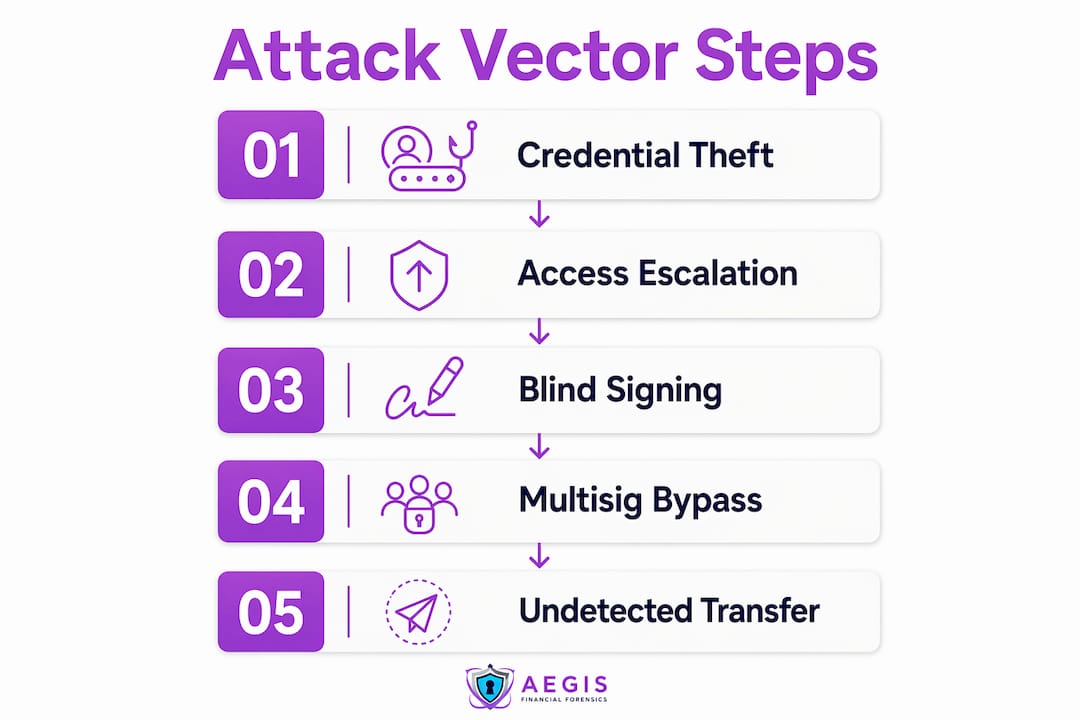
The absence of an independent validation layer between the signing interface and execution is the core architectural weakness. When no system independently reconciles what the UI displays with what the transaction actually instructs, signers cannot detect manipulation. Enterprise custody failures consistently trace back to this missing layer.
Pro Tip: Deploy a transaction verification service that independently decodes and displays raw transaction parameters before any signer approves. If the decoded output does not match the UI display, reject the transaction immediately.
Why is timely detection so difficult in corporate crypto theft?
Detection latency is one of the most damaging aspects of corporate cryptocurrency fraud. The Bitcoin Depot theft ran for three full days before security teams flagged the anomaly. By that point, 50.9 BTC had already moved through multiple addresses. Standard IT security monitoring does not natively track blockchain outflow patterns, which means unusual transaction bursts go unnoticed unless a dedicated monitoring layer exists.
Several factors compound this detection gap:
- Blockchain monitoring is not standard in corporate IT. Most security information and event management (SIEM) platforms monitor network traffic, login events, and file access. They do not parse on-chain transaction data.
- Gradual draining avoids threshold alerts. Attackers move funds in increments that stay below automated alert thresholds, spreading activity across multiple sessions or days.
- Post-theft laundering obscures the trail quickly. Stolen funds move through mixers, cross-chain bridges, and high-volume exchanges within hours of the initial theft. Each hop reduces the probability of recovery.
- Incident response protocols are often not crypto-specific. Corporate teams trained on data breach response may not know how to preserve on-chain evidence or initiate a know-your-transaction (KYT) trace immediately.
Detection gaps stem from limited blockchain monitoring within corporate IT, allowing multi-day unauthorized transfers before incident response begins. Every hour of delay narrows the recovery window, because laundering techniques used post-theft are specifically designed to fragment and obscure fund flows.
Pro Tip: Configure real-time KYT alerts tied directly to your custody wallet addresses. Set burst-transfer thresholds that trigger an immediate freeze protocol, not just a notification.
What tactics do state-sponsored actors use in long-term infiltration campaigns?
State-sponsored threat actors represent the most sophisticated end of the corporate crypto theft spectrum. These groups do not rely on opportunistic credential theft. They conduct multi-month reconnaissance campaigns that map every governance dependency, oracle connection, and access control within a target organization before executing a single transaction.
The Bybit breach, attributed to the Lazarus Group, is the clearest recent example. The attackers combined social engineering with zero-day exploits to compromise signing infrastructure, then executed the $1.46 billion theft in under 15 minutes. State-sponsored actors were responsible for 74% of crypto thefts in 2025. That concentration of losses in a single threat category demands a specific defensive posture, not a generic one.
The operational pattern of these campaigns includes:
- Extended pre-attack reconnaissance. Attackers study internal governance documents, personnel roles, and system architecture for months before acting.
- Social engineering of key personnel. Targeted phishing, fake job offers, and impersonation attacks focus on individuals with signing authority or system access.
- Zero-day exploit deployment. Vulnerabilities unknown to the target organization are used to compromise signing devices or custody infrastructure without triggering existing detection rules.
- Rapid post-theft laundering. Funds move through mixers, cross-chain bridges, and centralized exchange accounts within minutes of the initial transfer, exploiting the detection gap described above.
The shift from DeFi protocol exploits to centralized custodianship attacks reflects a deliberate strategic choice by advanced threat actors. DeFi protocols have matured their security posture. Custodial exchanges and corporate treasury operations have not kept pace.
What practical measures can corporate executives implement to prevent crypto theft?
Prevention requires layered controls across custody architecture, personnel practices, and monitoring infrastructure. No single control is sufficient against the attack vectors described above.
- Adopt institutional custody architecture. Separate hot, warm, and cold wallet tiers with granular permission controls. Use multi-party computation (MPC) wallets for high-value cold storage to eliminate single-point key exposure.
- Deploy an independent transaction validation layer. Implement a system that decodes raw transaction parameters independently of the signing interface. Signers must see and confirm the decoded output before approval.
- Implement real-time KYT monitoring. Connect custody wallet addresses to a know-your-transaction service that flags anomalous outflows, burst transfers, and interactions with flagged addresses in real time.
- Conduct regular credential audits. Audit all accounts with access to settlement systems and custody infrastructure quarterly. Revoke dormant credentials immediately and enforce hardware-based multi-factor authentication.
- Train key holders on social engineering. Personnel with signing authority are high-value targets. Conduct quarterly simulation exercises covering phishing, impersonation, and fake transaction approval scenarios.
- Build a crypto-specific incident response protocol. Coordinate with legal counsel and blockchain forensic specialists before an incident occurs. When theft happens, tracing stolen assets through laundering chains requires immediate action, not a planning meeting.
Pro Tip: Run a tabletop exercise simulating a multisig blind-signing attack. Most security teams discover their response protocol has no step for freezing on-chain activity or initiating a KYT trace. Fix that gap before an attacker finds it.
Key takeaways
Corporate crypto theft succeeds primarily because attackers exploit credential weaknesses and blind-signing vulnerabilities in environments where blockchain-specific monitoring does not exist.
| Point | Details |
|---|---|
| Credential compromise is the primary entry point | Settlement accounts in standard IT environments are less hardened than customer-facing wallets. |
| Blind signing defeats multisig protections | Without an independent validation layer, signers approve malicious transactions without realizing it. |
| Detection latency multiplies losses | The Bitcoin Depot theft ran three days before detection, allowing full fund movement and laundering. |
| State-sponsored actors dominate large-scale theft | Groups like Lazarus conduct months of reconnaissance before executing high-value attacks in minutes. |
| Prevention requires layered, crypto-specific controls | MPC custody, real-time KYT, and independent transaction validation each address a distinct failure point. |
The blind spot most corporate security teams still carry
The most persistent misunderstanding I encounter in corporate crypto security is the belief that multisignature approval is a complete defense. Executives see “requires three approvals” and conclude the system is safe. The Bybit breach should have ended that assumption permanently. It did not.
What the Bybit exploit actually demonstrated is that the signing ceremony itself is the attack surface. Attackers do not need to steal keys. They need signers to approve a transaction they cannot fully read. That is a user interface problem, a governance problem, and an operational security problem simultaneously. Technical controls alone cannot solve it.
The organizations that recover fastest from crypto theft incidents are the ones that treated blockchain forensics as a standing capability, not an emergency procurement. They already have crypto fraud investigation tools integrated, KYT alerts configured, and a forensic partner on retainer. When the clock starts, they are already moving. Every other organization is still writing the incident ticket.
Corporate leaders who wait for a breach to build these capabilities will find that the recovery window closes faster than any procurement cycle. The technical sophistication of state-sponsored actors is not decreasing. The defensive gap between what most corporate custody environments deploy and what these attackers can defeat is still wide. Closing it requires treating crypto security as a distinct operational discipline, not a subset of general IT security.
— Escareno
Aegisfinancialforensics: forensic response when corporate crypto theft occurs
When a corporate crypto theft incident occurs, the first 24 hours determine whether recovery is possible.

Aegisfinancialforensics specializes in the exact failure modes described in this article: credential compromise, multisig exploits, and multi-chain laundering chains. The firm has assisted with over $34 billion in illicit funds seized or recovered, working with major regulators and institutional clients across more than 1,500 cases. Aegisfinancialforensics deploys AI-driven blockchain intelligence to trace stolen assets across networks, including through mixer obfuscation and cross-chain bridge hops. For organizations that have experienced a theft or want to assess their current exposure, the crypto fund recovery investigation service provides both immediate incident response and long-term forensic support.
FAQ
What is a crypto exchange hack?
A crypto exchange hack is unauthorized access to an exchange’s custody infrastructure, typically through credential theft, smart contract exploits, or social engineering of key personnel. The Bybit breach in 2025, which resulted in $1.46 billion in ETH losses, is the largest recent example.
How does blind signing enable corporate crypto theft?
Blind signing occurs when a transaction signer approves a request without seeing the full decoded parameters. Attackers exploit this by manipulating the signing interface to display a legitimate-looking transaction while the underlying instruction executes a malicious contract call.
Why do corporate settlement accounts get targeted?
Corporate settlement accounts sit within standard IT environments and receive less security hardening than customer-facing wallets. Credential theft at the admin level bypasses customer-facing controls entirely and grants direct access to asset outflows.
How long does it typically take to detect corporate crypto theft?
Detection timelines vary, but the Bitcoin Depot breach ran for three full days before security teams identified the anomaly. Standard SIEM platforms do not monitor on-chain transaction data, which is the primary reason detection is delayed.
Can stolen corporate crypto be recovered after laundering?
Recovery is possible but time-sensitive. Blockchain forensics specialists use on-chain attribution, de-mixing analysis, and exchange cooperation to trace funds through laundering chains. The probability of recovery decreases significantly with each hour of delay after the initial theft.