
How Forensic Experts Build Fraud Cases: A Clear Guide
Forensic accounting is defined as the application of accounting techniques to legal proceedings, and it is the foundation of how forensic experts build fraud cases. Forensic experts compile, analyze, and report financial data to support legal prosecution, bridging the gap between raw financial records and court-admissible evidence. The process is methodical: investigators trace transactions, authenticate documents, detect anomalies, and synthesize findings into reports that can withstand legal scrutiny. Fraudulent schemes cause serious financial harm, with individual losses reaching $250,000 in some cases and public corruption frauds exceeding millions. Understanding how this process works gives fraud victims and investigators a clear picture of what a credible case actually requires.
How forensic experts build fraud cases: the core process
Forensic fraud investigation is the structured discipline of converting financial data into legal evidence. The industry term is forensic accounting, and it operates at the intersection of accounting, auditing, and law. Investigators do not simply review numbers. They reconstruct financial histories, identify deceptive patterns, and produce findings that meet the evidentiary standards of civil and criminal courts.
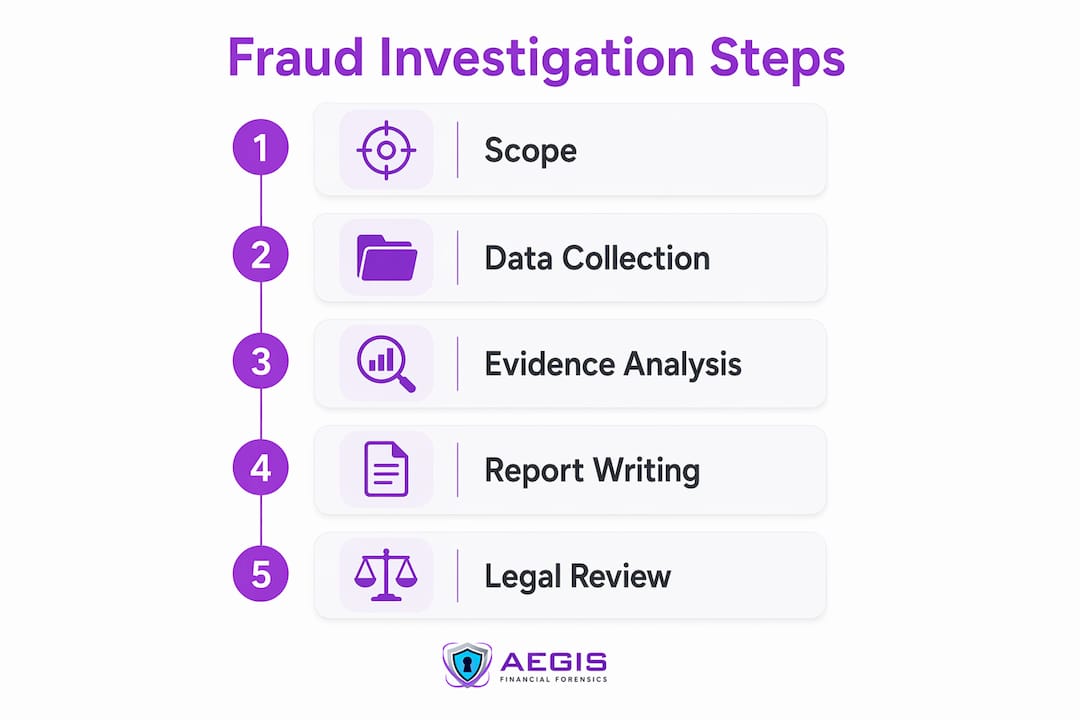
The process begins with scope definition. Investigators identify the suspected fraud type, the time period involved, and the financial systems affected. From that baseline, they collect source documents, including bank statements, contracts, invoices, and digital records. Every item collected enters a documented chain of custody, which preserves its admissibility as evidence. Maintaining chain of custody for crypto evidence is especially critical when digital assets are involved, since blockchain transactions require specialized handling to remain legally valid.

The final output of any forensic investigation is a written report. That report must be factually accurate, logically structured, and written in language a judge or jury can follow. The strength of a fraud case depends as much on how evidence is communicated as on what the evidence shows.
What are the key forensic investigation techniques used to detect fraud?
Forensic investigators use a defined set of techniques to detect fraud across financial records, digital systems, and physical documents. Each technique targets a different layer of the fraudulent activity.
The core techniques include:
- Chronological transaction review: Investigators organize all financial records in time sequence. This reveals gaps, reversals, and timing anomalies that suggest manipulation.
- Data analytics and pattern recognition: Large datasets are analyzed for statistical outliers. Unusual payment frequencies, round-number transactions, and duplicate entries are common fraud indicators.
- Document authentication: Contracts, invoices, and change orders are verified for authenticity. Altered dates, forged signatures, and mismatched formatting are examined closely.
- Fund flow tracing: Investigators follow money from its source through every transfer to its destination. This technique is especially important in cryptocurrency cases, where tracing stolen crypto requires blockchain-specific analysis tools.
- AI and machine learning analysis: Automated tools process large volumes of transactional data faster than manual review. AI and machine learning enable real-time anomaly detection, reducing false positives and flagging suspicious activity with greater accuracy.
Pro Tip: Document every data source before analysis begins. Investigators who establish a clean evidence baseline early avoid disputes over data integrity later in legal proceedings.
The choice of technique depends on the fraud type. Billing fraud calls for invoice analysis. Embezzlement cases require payroll and expense audits. Cryptocurrency scams demand on-chain transaction analysis and entity attribution across blockchain networks.
How do forensic experts establish legal evidence standards in fraud cases?
Forensic evidence must meet specific legal thresholds before it can influence a court outcome. The standards differ between civil and criminal proceedings, and investigators must understand both.
Civil fraud cases require proof by a preponderance of the evidence, meaning the evidence must show that fraud is more likely than not. Criminal cases require proof beyond a reasonable doubt, a significantly higher bar. This distinction shapes how investigators document their findings and what level of certainty they communicate in their reports.
The four steps for establishing admissible forensic evidence are:
- Compile the documentation baseline. Gather all contracts, invoices, communications, and financial records. Organizing documents chronologically is the critical first step before any formal analysis begins.
- Identify material misrepresentation. Investigators must show that a false statement of fact was made, that the victim relied on it, and that it caused financial harm. This is the legal core of most fraud claims.
- Prepare a court-ready report. The report must follow a logical structure, cite specific evidence, and avoid speculative language. Courts reject reports that conflate opinion with fact.
- Deliver expert witness testimony. Forensic accountants serve as expert witnesses who translate complex financial findings into testimony that judges and juries can understand. Their ability to communicate clearly is as important as their technical findings.
“Effective forensic testimony combines technical accuracy with clear communication tailored to judges and juries unfamiliar with complex financial matters.”
The distinction between fraud and a contract dispute also matters legally. Fraud involves intentional deception, while a contract breach may not trigger criminal proceedings. Investigators must establish intent, not just financial harm, to support a fraud charge.
What practical steps do forensic experts take to organize and interpret fraud evidence?
Evidence organization is where investigations succeed or fail. Investigators who collect evidence without a structured workflow produce reports that are difficult to defend in court.
The first step is building a chronological timeline. Every transaction, communication, and document is placed in sequence. This timeline reveals cause-and-effect relationships that random document review would miss. A payment made before a contract was signed, for example, becomes a significant red flag only when the timeline is visible.
Red flags guide the investigation’s direction. Unlicensed contractors and pressure to bypass permits are documented indicators of fraudulent intent. Out-of-state license claims and permit evasion predict both the direction of the investigation and the evidentiary strategy needed to prove intent. Investigators treat these signals as early evidence, not background context.
Pro Tip: Document the payment method used in every transaction. Payments made by credit card carry stronger consumer protections than those made by cryptocurrency or gift cards, which directly affects recovery feasibility.
Electronic payment methods like cryptocurrency complicate asset recovery because they lack the dispute protections available through traditional banking. Documenting payment methods early allows investigators to assess recovery options before resources are committed to channels that may yield nothing.
| Evidence Type | Investigation Purpose | Recovery Impact |
|---|---|---|
| Contracts and invoices | Establish agreed terms and identify deviations | High: proves material misrepresentation |
| Bank and transaction records | Trace fund flow and identify diversions | High: supports asset recovery claims |
| Communications (email, text) | Demonstrate intent and knowledge | Medium: establishes deceptive intent |
| Cryptocurrency transaction logs | Trace on-chain movement of digital assets | Variable: depends on chain coverage |
| Licensing and permit records | Identify red flags predicting fraudulent intent | Medium: supports intent argument |
The final step is synthesis. Investigators convert their findings into a coherent narrative that explains what happened, how it happened, and what the financial impact was. This narrative becomes the backbone of the legal case.
How is emerging technology transforming forensic fraud investigations?
Technology has changed the speed and scale at which forensic investigators can work. Tasks that once required weeks of manual review now take hours with the right analytical tools.
The key technological advances reshaping fraud investigations include:
- Real-time anomaly detection: AI systems monitor transaction streams continuously and flag deviations from established patterns without waiting for a human reviewer to spot them.
- Automated verification: Machine learning tools cross-reference large document sets, identifying inconsistencies in invoices, contracts, and payment records faster than manual comparison allows.
- Continuous learning algorithms: These systems improve over time by learning from confirmed fraud cases, which reduces false positives and increases the precision of future detections.
- Blockchain analytics: Specialized tools trace cryptocurrency transactions across multiple networks, identifying wallet clusters, de-mixing patterns, and entity attribution that manual analysis cannot achieve at scale. Aegisfinancialforensics applies AI-driven intelligence across blockchain networks to support crypto fraud investigations with the depth and speed that complex cases require.
- Internal control integration: Technology is now embedded in ongoing monitoring systems, not just post-incident investigations. This shift moves fraud detection from reactive to proactive.
The practical result is that investigators can now handle cases involving thousands of transactions across multiple jurisdictions without losing analytical precision. Scale no longer limits the depth of a forensic investigation.
Key Takeaways
Forensic experts build fraud cases by combining structured evidence collection, legal documentation standards, and technology-driven analysis into a court-ready investigation.
| Point | Details |
|---|---|
| Evidence collection is foundational | Organize contracts, invoices, and communications chronologically before any formal analysis begins. |
| Legal standards shape the process | Civil cases require a preponderance of evidence; criminal cases require proof beyond a reasonable doubt. |
| Intent must be established | Fraud requires proving intentional deception, not just financial harm or contract breach. |
| Payment method affects recovery | Cryptocurrency and gift card payments carry weaker fraud protections than credit card transactions. |
| Technology accelerates detection | AI and machine learning enable real-time anomaly detection and reduce false positives at scale. |
What I’ve learned about building fraud cases that most guides skip
The hardest part of building a fraud case is not finding the evidence. It is proving that what you found was intentional. I have worked through cases where the financial irregularities were obvious but the legal argument collapsed because investigators could not demonstrate that the other party knew what they were doing was wrong. That distinction between fraud and a bad business decision is where most cases are won or lost.
The second thing I have seen underestimated consistently is documentation timing. Investigators who wait until a case is formally opened to start organizing records lose critical context. The sequence in which documents were created, received, and acted upon tells a story that the documents themselves cannot tell in isolation. Starting the documentation baseline on day one is not procedural caution. It is the difference between a case that holds up and one that does not.
Clear communication to non-technical audiences also matters more than most technical practitioners admit. A forensic report that is technically accurate but written for accountants will not move a jury. The best investigators I have encountered write their reports as if explaining the case to an intelligent person who has never seen a balance sheet. That discipline forces clarity and usually reveals gaps in the analysis that jargon would have hidden.
The future of this field belongs to investigators who combine technical depth with communication skill and who treat technology as a tool, not a substitute for judgment. AI detects anomalies. Investigators decide what those anomalies mean.
— Escareno
Forensic fraud investigation support from Aegisfinancialforensics
Financial fraud cases are complex, and the evidence trail does not wait. Aegisfinancialforensics works with individuals and organizations affected by crypto scams and financial fraud, applying blockchain forensics and AI-driven analysis to trace stolen digital assets and build documented cases for recovery.

With over 1,500 clients served and more than $34 billion in illicit funds assisted through seizure or recovery, Aegisfinancialforensics brings institutional-grade forensic capability to cases of every scale. The team’s crypto fund recovery process follows a structured five-step methodology, from initial evidence collection through final reporting. Investigators who need support with fraud awareness and case preparation can access resources and direct consultation through the Aegisfinancialforensics platform.
FAQ
What does a forensic expert do in a fraud case?
A forensic expert collects, analyzes, and presents financial evidence to support legal proceedings. Their role includes transaction tracing, document authentication, and expert witness testimony in civil and criminal courts.
How is forensic accounting different from regular accounting?
Forensic accounting applies accounting techniques to legal processes, producing evidence that meets court admissibility standards. Regular accounting focuses on financial reporting, not legal evidentiary requirements.
What evidence do forensic investigators collect first?
Investigators prioritize contracts, invoices, bank records, and communications, organized in chronological order. This documentation baseline establishes the timeline needed to prove material misrepresentation.
Can forensic experts recover cryptocurrency lost to fraud?
Forensic experts can trace cryptocurrency transactions across blockchain networks using entity attribution and de-mixing analysis. Recovery feasibility depends on chain coverage, transaction timing, and the platforms involved.
What is the difference between fraud and a contract dispute?
Fraud requires proving intentional deception, while a contract dispute involves a failure to perform agreed terms without necessarily proving intent. This distinction determines whether a case proceeds as a civil claim or a criminal matter.