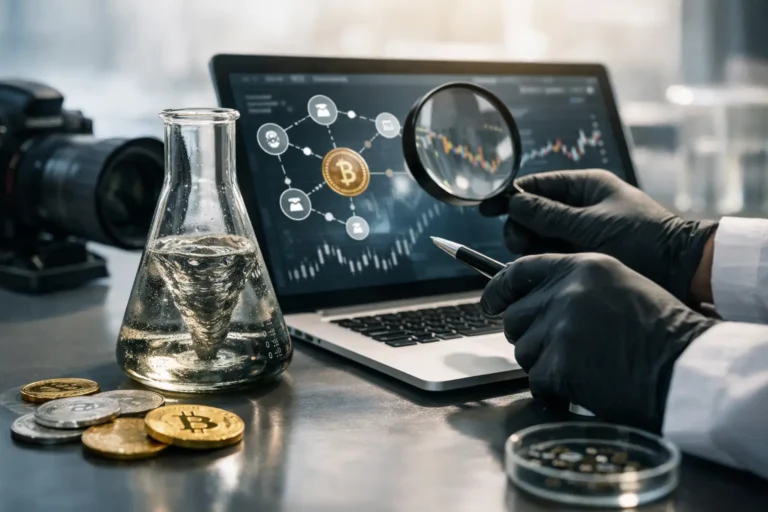

Steps to Tracing Stolen Crypto Assets: 2026 Guide
Crypto asset tracing is defined as the systematic process of following digital currency flows across blockchain ledgers to identify the origin, path, and current location of stolen funds. The steps tracing stolen crypto assets involve collecting transaction evidence, applying forensic analysis techniques such as address clustering and entity attribution, and coordinating with centralized exchanges and law enforcement within narrow recovery windows. Blockchain’s immutable public ledger makes every transaction permanently recorded, which is why stolen crypto is traceable even when criminals attempt to obscure their tracks. Forensic analysts, KYC-compliant exchanges, and regulatory bodies including the Financial Action Task Force all play defined roles in this process. Acting within hours of a theft, not days, determines whether recovery is possible.
1. What are the initial steps to start tracing stolen crypto assets?
The first action after a crypto theft is to collect every piece of on-chain evidence before it becomes harder to reconstruct. Victims should document the following without delay:
- Victim wallet addresses and all associated transaction hashes
- Exact timestamps of the unauthorized transactions
- Token types and amounts transferred
- Screenshots of wallet interfaces, exchange accounts, and any communications with suspected fraudsters
- Device logs and browser history that may establish the attack vector
Preserving transaction hashes and wallet addresses is critical for forensic tracing and eventual legal action. Failure to capture internal transactions or event logs can break a trace on EVM-compatible networks such as Ethereum.
Once evidence is secured, victims should use a public blockchain explorer, such as Etherscan for Ethereum or Blockchain.com for Bitcoin, to verify the transaction details independently. This confirms the first destination wallet after the victim’s address, which is the starting point for the full trace. Filing a police report at this stage creates an official record that forensic teams and exchanges will require later.

Pro Tip: Record the block number and block timestamp alongside the transaction hash. Block-level data anchors the timeline precisely and strengthens the evidentiary chain when investigators reconstruct the crime sequence.
2. How forensic analysts trace stolen crypto assets on the blockchain
Blockchain tracing converts pseudonymous wallet addresses into actionable leads by bridging on-chain transaction data with off-chain identity information. Forensic analysts follow the fund flow hop by hop, mapping each address the stolen assets touch across one or more blockchains.
The core analytical techniques include:
- Address clustering: Grouping wallets that share common inputs or behavioral patterns to identify wallets controlled by the same entity
- Flow pattern matching: Recognizing transaction structures such as peel chains or fan-out distributions that indicate deliberate fund dispersal
- Entity attribution: Cross-referencing wallet addresses against labeled databases that tag known exchanges, mixers, darknet markets, and threat actor clusters
- Behavioral analysis: Examining transaction timing, gas fee patterns, and output amounts to distinguish automated laundering scripts from manual transfers
Analysts track asset conversions across tokens and chains, including swaps through decentralized exchanges and wrapped asset bridges. Cross-chain tracing is difficult because asset movement through bridges does not always expose transaction mapping, requiring specialized APIs or heuristics to follow funds between chains. Privacy-focused chains such as Monero and tools like CoinJoin introduce additional complexity by obscuring sender and receiver relationships.
Pro Tip: Multi-chain trace protocols that correlate transaction timing and output amounts across different blockchains can reconstruct fund flows even when bridge transactions obscure direct links. Aegisfinancialforensics applies AI-driven intelligence to this correlation process, reducing investigative blind spots across networks.
3. What role do centralized exchanges play in tracing and recovering stolen crypto?
Centralized exchanges are the most critical intersection points in any crypto recovery effort because they link pseudonymous blockchain addresses to verified real-world identities through KYC protocols. When stolen funds reach a deposit address at a centralized exchange, investigators have a direct path to identifying the account holder.
The timeline for exchange cooperation determines recovery outcomes. The table below illustrates how fund status and timing affect recovery probability:
| Fund status at exchange | Time since theft | Recovery probability |
|---|---|---|
| Funds in deposit wallet, not yet moved | Under 24 hours | High |
| Funds in exchange account, withdrawal pending | 24–72 hours | Moderate |
| Funds withdrawn to external wallet | Over 72 hours | Low |
| Funds converted and withdrawn | Over 72 hours | Very low |
Major exchanges may facilitate fast-freeze windows of 24–72 hours if funds are identified in deposit accounts, enabling law enforcement to act before withdrawal. Recovery odds drop sharply once funds leave exchange wallets. Investigators must contact the exchange’s abuse or legal team with a formal police report, the forensic trace report, and the specific deposit address identified on-chain. Subpoenas and mutual legal assistance treaty requests accelerate KYC disclosure in cross-border cases.
4. How criminals launder stolen crypto and how this affects tracing
Criminals rarely move stolen funds directly to a cash-out point. Stolen funds typically move through 3–7 intermediary hops across multiple blockchains with cross-chain bridges, complicating tracing efforts significantly. That layering is deliberate and designed to exhaust investigator resources and time.
Common laundering tactics investigators encounter include:
- Relay wallet rotation: Funds pass through a series of freshly generated wallets, each holding assets briefly before forwarding them, to dilute the transaction trail
- Cross-chain bridging: Assets move from Ethereum to Tron, BNB Chain, or other networks where the investigator’s toolset may have weaker coverage
- Mixer and CoinJoin use: Funds are pooled with other transactions to obscure the direct link between input and output addresses
- Layering through DeFi protocols: Swaps on decentralized exchanges convert one token to another, changing the asset fingerprint without touching a KYC checkpoint
Some laundering circuits rotate upwards of $110 million over 90-day periods using relay wallets and bridges. That scale demonstrates that these are not improvised methods but structured operational workflows. Investigators counter these tactics by correlating transaction timing and output amounts across chains, identifying the statistical signature of automated laundering even when direct address links are broken. Understanding how scammers launder stolen crypto is a prerequisite for building a trace that survives these obfuscation layers.
Pro Tip: When a trace goes cold at a bridge transaction, analysts should examine the destination chain for deposits of equivalent value within a narrow time window, typically 5–15 minutes after the bridge initiation. Amount and timing correlation frequently re-establishes the trail.
5. What are the legal and procedural steps to recover stolen crypto?
Forensic tracing produces evidence. Forensic reports enable subpoenas and exchange action but do not secure refunds directly. Recovery requires a coordinated legal process that runs in parallel with the forensic investigation.
The procedural sequence follows this order:
- File a formal police report with the relevant law enforcement agency, attaching all preserved on-chain evidence and the forensic trace report.
- Engage a forensic investigator to produce a court-admissible report documenting the full transaction trail, entity attribution findings, and identified exchange endpoints.
- Submit an exchange abuse report directly to the identified centralized exchange, referencing the police report number and the specific deposit address holding stolen funds.
- Pursue a freezing order or injunction through civil courts if the exchange is unresponsive or if the jurisdiction requires judicial authorization before the exchange will act.
- Issue subpoenas or mutual legal assistance treaty requests to compel KYC disclosure from exchanges operating in foreign jurisdictions.
- Present ownership claims in court once assets are frozen, supported by the forensic chain-of-custody documentation.
Legal measures such as freezing orders, subpoenas, and court injunctions complement forensic tracing by enabling exchanges or custodians to freeze or seize stolen assets. Courts decide restitution and disposal of seized crypto after ownership claims and legal evaluation. Maintaining a clean chain of custody for crypto evidence throughout this process is what separates admissible forensic reports from documents that courts reject.
Key Takeaways
Effective crypto asset tracing requires immediate evidence preservation, forensic blockchain analysis, exchange cooperation within 24–72 hour freeze windows, and coordinated legal action to convert a trace into a recovery.
| Point | Details |
|---|---|
| Act within hours | Exchange fast-freeze windows of 24–72 hours are the primary recovery opportunity. |
| Preserve all evidence | Transaction hashes, wallet addresses, and device logs form the evidentiary foundation for legal action. |
| Follow the full chain | Address clustering and entity attribution track funds across multi-hop and cross-chain laundering routes. |
| Engage law enforcement early | Police reports unlock exchange cooperation, subpoenas, and court-ordered freezing actions. |
| Tracing is not recovery | Forensic reports provide evidence; legal coordination with exchanges and courts completes the recovery. |
The uncomfortable truth about tracing stolen crypto
The most common mistake victims make is treating a forensic trace report as a recovery guarantee. It is not. Tracing establishes where funds went. Recovery requires that those funds still sit in a reachable location, that law enforcement acts within the exchange’s freeze window, and that the legal process moves faster than the criminal’s withdrawal schedule.
In practice, the 24–72 hour window is unforgiving. Investigators who receive a case three days after the theft are often working against a trail that has already exited every accessible exchange. That reality does not make tracing pointless. It makes the first hours after a theft the most operationally significant period in the entire recovery effort.
What I have observed consistently is that victims who document everything immediately, engage a forensic team within 24 hours, and file a police report the same day give investigators the best possible foundation. Victims who wait, hoping the situation resolves itself, almost always arrive too late for exchange cooperation.
The evolution of laundering tactics, particularly the use of cross-chain bridges and automated relay wallet rotation, means that static tracing methods fail. Adaptive methods that correlate timing, amounts, and behavioral patterns across chains are now the baseline requirement, not an advanced capability. Aegisfinancialforensics applies exactly this kind of multi-chain, AI-assisted analysis to every investigation, which is why the firm has contributed to tracing over $34 billion in illicit funds seized or recovered.
Collaboration between victims, forensic experts, and law enforcement is not optional. It is the mechanism by which a trace becomes a recovery.
— Escareno
How Aegisfinancialforensics supports stolen crypto investigations
Aegisfinancialforensics provides end-to-end blockchain forensics and asset recovery investigation services for individuals and businesses affected by crypto theft and fraud. The firm’s five-step recovery process covers evidence collection, multi-chain forensic tracing, entity attribution, exchange coordination, and legal evidence preparation.

With over 1,500 satisfied clients and a track record that includes major regulators and institutions, Aegisfinancialforensics delivers forensic-grade reports that hold up in legal proceedings. The team’s AI-driven intelligence covers cross-chain movements, mixer activity, and relay wallet structures that standard tools miss. Clients who need a full crypto fund recovery investigation or want to understand their options after a theft can access Aegisfinancialforensics’s blockchain forensics services directly. Time is the critical variable. Engaging early maximizes the probability of a successful outcome.
FAQ
What are the first steps to take after crypto is stolen?
Immediately document all transaction hashes, wallet addresses, and timestamps, then file a police report and contact a forensic investigator. Acting within 24 hours gives law enforcement the best chance to trigger exchange freeze protocols.
Why is stolen crypto traceable on the blockchain?
Blockchain ledgers are immutable public records that permanently log every transaction, making it possible to follow fund flows hop by hop across addresses and networks. Entity attribution techniques then link pseudonymous addresses to real-world identities at exchange KYC checkpoints.
How do criminals try to hide stolen crypto?
Criminals use relay wallet rotation, cross-chain bridges, mixers, and DeFi token swaps to obscure the origin and destination of stolen funds. Documented laundering circuits have moved over $110 million in 90-day periods using these layered techniques.
Can stolen crypto be recovered after it leaves an exchange?
Recovery becomes significantly harder once funds exit a centralized exchange, because the direct link to a KYC-verified identity is lost. Investigators can continue tracing across chains, but legal enforcement options narrow considerably without an exchange holding the assets.
What does a forensic trace report actually do?
A forensic trace report documents the full on-chain transaction trail and provides the evidentiary basis for subpoenas, freezing orders, and court proceedings. The report itself does not freeze or return funds; law enforcement and legal action must follow to convert the evidence into a recovery.