
Legal Cooperation in Crypto Recovery: A Complete Guide
Legal cooperation is the critical mechanism that transforms blockchain transaction data into enforceable legal actions capable of recovering stolen cryptocurrency assets across borders. Without it, even the most detailed forensic trace stops at a wallet address. The role of legal cooperation in crypto recovery spans court orders, regulated exchanges, law enforcement agencies, and private forensic teams working in coordinated parallel. Victims who contact legal advisers quickly and provide transaction hashes gain access to remedies like worldwide freezing orders and Norwich Pharmacal disclosure orders that no blockchain tool alone can produce.
How do legal mechanisms convert blockchain tracing into recovery actions?
Blockchain traceability alone is insufficient for recovery. Credible recovery relies on legal evidence packages and formal authority-backed pressure on custodians. The legal tools that convert tracing into action fall into two primary categories: asset freezing orders and disclosure orders.
Interim proprietary injunctions and worldwide freezing orders are court-issued commands that prevent a defendant or exchange from moving, dissipating, or transferring identified assets. Courts grant these on an urgent basis when a victim can demonstrate a traceable proprietary claim and a real risk of asset dissipation. Speed is the defining factor. Assets on a blockchain move in seconds, and a freezing order filed a week late is often a freezing order filed too late.

Norwich Pharmacal orders compel third parties, typically exchanges, to disclose account information identifying unknown wrongdoers or tracing assets before freezing actions are possible. Courts require that the third party is more than a passive witness. The exchange must have been involved, even innocently, in the wrongdoing by facilitating the transaction. Disclosure must also be necessary and proportionate compared to other available evidence sources.
The practical steps for obtaining these remedies include:
- Preserve all transaction records, wallet addresses, and communication logs immediately after the incident.
- Obtain a forensic blockchain trace identifying the destination exchange and wallet cluster.
- Instruct legal counsel to prepare a freezing or disclosure application with supporting evidence.
- File the application on an urgent or without-notice basis where asset dissipation risk is high.
- Serve the order on the relevant exchange compliance team with a formal legal demand.
Pro Tip: Provide your legal team with transaction hashes, not just screenshots. Courts and exchanges require on-chain evidence, and hashes allow forensic verification that screenshots cannot provide.
The legal basis matters as much as the evidence. A police report, for example, gives exchanges a formal justification to maintain a voluntary hold while court proceedings advance. Without that official legal basis, exchanges face regulatory and liability risks that make them reluctant to act unilaterally.
What is the role of regulated exchanges and law enforcement in effective crypto recovery?
Regulated exchanges provide the pivotal jurisdictional point where courts can freeze assets and identify holders through KYC records. Tracing alone does not return funds. Recovery becomes feasible only when stolen assets reach an exchange capable of obeying court orders. Unregulated or offshore wallets present a fundamentally different and far more difficult enforcement problem.
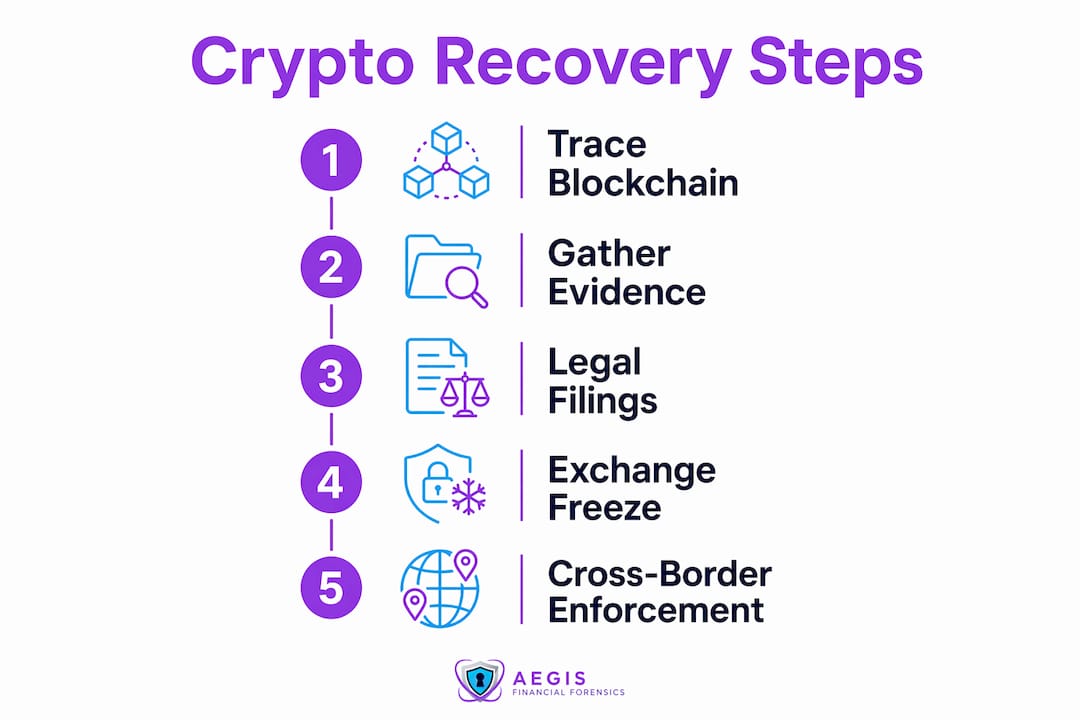
Law enforcement involvement is not optional. A police report and active law enforcement cooperation legally justify exchange freezes and open paths for subpoenas and international enforcement. Victims who treat law enforcement as a secondary step risk losing the freeze entirely, because exchanges require official legal bases to comply and maintain holds over time.
The sequence of coordinated steps that produces the best outcomes:
- File a police report immediately and obtain a case reference number for exchange communications.
- Submit a formal victim report to the relevant financial regulator, such as the SEC, FCA, or ASIC.
- Provide law enforcement with the forensic trace, including wallet attribution and exchange identification.
- Request that law enforcement issue a preservation letter or subpoena to the identified exchange.
- Pursue parallel civil proceedings to obtain a freezing or disclosure order enforceable against the exchange.
INTERPOL Purple Notices represent a critical instrument for cross-border coordination. Purple Notices increase asset tracing and coordinated enforcement by linking investigations across jurisdictions, enabling parallel investigations and exchange of information that support multi-agency crypto fraud enforcement. This is particularly relevant when stolen assets cross multiple national boundaries before reaching a custodial exchange.
“Recovery feasibility depends on assets reaching exchanges able to obey court orders, as tracing alone doesn’t return funds.” — Digital Asset Law
The Ghana-UK operation between the Economic and Organised Crime Office and the UK National Crime Agency illustrates this principle in practice. Early administrative freezes combined with international coordination, Europol collaboration, and shared blockchain evidence effectively stopped outflows and enabled multi-agency recovery. The 14-day freeze power, combined with exchange reporting obligations, proved decisive in preventing asset dissipation.
What challenges arise in cross-border enforcement and legal cooperation?
Cross-border enforcement is where many technically sound recovery efforts fail. Obtaining a court order in one jurisdiction does not guarantee its recognition or enforcement in another. This gap between legal success and practical recovery defines the central challenge of international crypto law.
| Challenge | Impact | Mitigation |
|---|---|---|
| Default judgment recognition | Many jurisdictions refuse to enforce foreign default judgments | Pursue summary judgments or tailored orders designed for cross-border recognition |
| Asset movement timing | Assets move before enforcement reaches the destination exchange | File freezing applications on an urgent, without-notice basis |
| Jurisdictional gaps | Offshore or unregulated wallets fall outside court reach | Focus enforcement on regulated exchange endpoints |
| Local counsel absence | Orders drafted without local input may be unenforceable | Engage local counsel in each target jurisdiction early |
Enforcement differences between default and summary judgments across jurisdictions significantly impact recoverability. Planning enforcement strategy at the drafting stage, not after a judgment is obtained, substantially improves success rates. Court orders must be drafted with enforcement in mind, and local counsel must be involved early for effective asset recovery across jurisdictions.
Timing bottlenecks represent the most operationally damaging risk. Stolen crypto assets can move through multiple wallets, cross chains, and reach a new exchange within hours. A coordinated approach that runs evidentiary tracing and criminal reporting in parallel reduces this timing risk. Waiting on one workstream to complete before starting another allows asset loss that no subsequent legal action can reverse.
Pro Tip: Engage local counsel in every jurisdiction where the stolen assets have been traced before filing your primary court application. A freezing order that cannot be recognized abroad is a freezing order that protects nothing.
Multi-jurisdictional coordination, while complex, produces materially better outcomes than single-jurisdiction proceedings. The crypto fraud investigation tools available to forensic teams now allow rapid identification of exchange endpoints across multiple chains, giving legal teams the jurisdictional intelligence needed to file in the right courts simultaneously.
How can individuals and businesses practically engage legal cooperation for crypto asset recovery?
The first 48 hours after a crypto theft or fraud determine the realistic scope of recovery. Speed, documentation quality, and the composition of the response team are the three variables that matter most. Victims who act within this window with a multidisciplinary team consistently achieve better outcomes than those who pursue a single-track approach.
Assembling the right team requires three distinct competencies working together. Legal counsel prepares court applications and manages exchange communications. Forensic investigators produce the on-chain attribution evidence that courts and exchanges require. Funding specialists, where litigation funding is available, provide the capital to sustain complex multi-jurisdictional proceedings. No single professional covers all three.
The practical steps for engaging legal cooperation effectively:
- Report the incident to law enforcement immediately and preserve the case reference number.
- Engage a forensic investigator to produce a blockchain trace with exchange attribution within 24–48 hours.
- Instruct legal counsel to prepare a freezing or disclosure application using the forensic trace as evidence.
- Contact the identified exchange compliance team directly with the police report and legal demand.
- Avoid any recovery service that demands upfront payment to a personal wallet or guarantees specific recovery amounts.
Legitimate recovery involves structured forensic and legal work, not guarantees or personal wallet payments. Recovery scams specifically target victims of crypto fraud, offering false promises of fund return in exchange for advance fees. Legal coordination provides the structural protection against these secondary victimizations by grounding every action in court processes and documented evidence.
The chain of custody for crypto evidence is a technical requirement that many victims overlook. Courts require that forensic evidence be collected, preserved, and presented in a format that meets evidentiary standards. A forensic trace that cannot survive cross-examination is a forensic trace that cannot support a freezing order.
Key Takeaways
Legal cooperation converts blockchain forensic data into enforceable court orders, exchange freezes, and cross-border recovery actions that no single tool or authority can achieve alone.
| Point | Details |
|---|---|
| Legal tools are essential | Freezing orders and Norwich Pharmacal orders are the primary instruments that translate tracing into recovery. |
| Law enforcement is not optional | A police report provides the legal basis exchanges require to maintain asset holds and comply with subpoenas. |
| Regulated exchanges are the enforcement point | Recovery is feasible only when assets reach exchanges that can obey court orders and verify identity through KYC. |
| Cross-border planning starts at drafting | Court orders must be designed for international recognition from the outset, with local counsel involved early. |
| Speed and parallel workstreams determine outcomes | Running forensic tracing and legal reporting simultaneously prevents asset dissipation during the critical early window. |
Why legal coordination is the variable most victims underestimate
The cases I have seen fail share a common pattern. Victims obtain an excellent forensic trace, identify the destination exchange with precision, and then wait. They wait for law enforcement to act. They wait for the exchange to respond voluntarily. They wait for a single legal process to complete before starting the next. By the time a court application is filed, the assets have moved through three additional wallets and landed on an unregulated platform in a jurisdiction with no mutual legal assistance treaty.
The legal landscape for crypto recovery is genuinely improving. Courts in the UK, Singapore, the United States, and Hong Kong have all issued freezing and disclosure orders against exchanges in recent years, and exchanges are increasingly responsive to properly documented legal demands. But the window for effective action remains narrow. The forensic trace, the police report, and the court application need to move in parallel, not in sequence.
What I find most underappreciated is the drafting quality of the initial court order. An order that does not anticipate enforcement in a foreign jurisdiction, that uses terminology unrecognized by a target country’s courts, or that fails to specify the exact assets subject to the freeze, creates delay that costs victims their recovery. Legal foresight at the drafting stage is not a luxury. It is the difference between a freeze that holds and one that dissolves on appeal.
Blockchain tracing is a necessary condition for recovery. It is not a sufficient one. The legal architecture built around that trace determines whether the evidence becomes a recovered asset or a detailed record of a loss.
— Escareno
How Aegisfinancialforensics supports coordinated crypto asset recovery
Aegisfinancialforensics operates at the intersection of blockchain forensics and legal coordination, providing the evidentiary foundation that courts, exchanges, and law enforcement require to act. The team traces stolen assets across networks, produces court-ready forensic reports, and works alongside legal counsel to support freezing and disclosure applications in multiple jurisdictions.
Clients include individual fraud victims, institutional investors, and regulatory bodies. Aegisfinancialforensics has assisted with over $34 billion in illicit funds seized or recovered, working with more than 1,500 clients across complex cross-border cases. The crypto fund recovery investigation service covers the full forensic and legal coordination workflow, from initial trace to exchange engagement. For victims seeking a structured, evidence-backed recovery assessment, Aegisfinancialforensics provides the forensic and coordination expertise that transforms a blockchain trace into a recovery action.
FAQ
What is the role of legal cooperation in crypto recovery?
Legal cooperation converts blockchain forensic traces into enforceable court orders, exchange freezes, and disclosure demands that compel third parties to identify and hold stolen assets. Without legal coordination, tracing data has no enforcement mechanism.
What is a Norwich Pharmacal order in crypto cases?
A Norwich Pharmacal order compels an exchange or other third party to disclose account information identifying the holder of a wallet linked to fraud. Courts require that the third party was involved in the wrongdoing, even innocently, and that disclosure is necessary and proportionate.
Why do victims need law enforcement involvement in crypto recovery?
Exchanges require an official legal basis, such as a police report or subpoena, to maintain asset holds and comply with freezing demands. Victims who skip law enforcement risk losing the freeze as exchanges cannot act unilaterally without formal legal justification.
How does cross-border enforcement affect crypto recovery?
Court orders obtained in one jurisdiction may not be recognized or enforced in another. Engaging local counsel early and drafting orders with international enforcement in mind significantly improves the chance that a freeze holds across borders.
How can victims avoid crypto recovery scams?
Legitimate recovery relies on structured forensic work, court processes, and documented evidence. Any service demanding upfront payment to a personal wallet or guaranteeing specific recovery amounts is a recovery scam, not a legitimate legal service.