

Benefits of Blockchain Asset Tracing for Fraud Victims
Blockchain asset tracing is the process of following digital transactions on an immutable public ledger to uncover the movement and ownership of cryptocurrency assets. The benefits of blockchain asset tracing extend well beyond simple transaction lookup: they include verifiable evidence for court proceedings, real-time audit readiness, and strategic leverage that traditional fiat tracing cannot replicate. With global fraud losses projected at $5.5 trillion by 2026, the forensic discipline of blockchain tracing has become a foundational tool for individuals and businesses seeking recovery and compliance.
1. Benefits of blockchain asset tracing for fraud detection and evidence gathering
Blockchain’s immutable ledger records every transaction permanently and publicly. That permanence gives investigators a verifiable, data-driven record that replaces speculation with documented fact. On Bitcoin, Ethereum, and most public chains, all transactions are permanently visible; the challenge is expert interpretation of what those records mean.

Forensic analysts use wallet clustering analysis to group addresses controlled by the same actor. They then combine on-chain analytics with off-chain intelligence, including KYC records, corporate filings, and OSINT sources, to attribute wallets to real-world identities. That multi-source methodology forms the evidentiary foundation for court applications such as freezing injunctions.
Key investigative capabilities include:
- Transaction path mapping: Tracing funds hop by hop across wallets to establish a clear movement narrative.
- Entity attribution: Linking pseudonymous addresses to named individuals or organizations using combined on-chain and off-chain data.
- De-mixing analysis: Identifying funds that passed through coin mixers by analyzing input and output patterns.
- Fan-out structure detection: Recognizing when stolen funds are split across many wallets to obscure origin.
Pro Tip: Preserve the original transaction hash, the victim wallet address, and the timestamp of the fraudulent transfer before contacting any exchange. These three data points anchor the entire forensic trace.
2. How blockchain tracing improves audit readiness and compliance
Blockchain traceability reduces investigation times from days to seconds in compliance audit scenarios. That speed advantage comes directly from the ledger’s tamper-evident structure: every record is cryptographically sealed and cannot be altered without detection.
For businesses, the compliance benefits are concrete:
- Tamper-evident audit trails eliminate disputes over whether a transaction occurred and when.
- Automated documentation through smart contracts reduces manual record-keeping errors and accelerates regulatory reporting.
- Supply chain transparency allows enterprises to verify asset provenance at any point in the chain without relying on counterparty self-reporting.
- Dispute resolution becomes faster because the ledger provides an objective, shared record that all parties can verify independently.
Blockchain tracing also improves audit readiness by providing tamper-proof trails that simplify regulatory compliance and reduce dispute costs. Regulators increasingly accept blockchain-derived evidence in formal proceedings, which means businesses that maintain on-chain records gain a structural advantage during examinations. Aegisfinancialforensics applies this principle directly in its compliance-focused blockchain mapping work for institutional clients.
3. What legal leverage does blockchain asset tracing provide?
Tracing clearly identifies targets and asset locations, which enables legal practitioners to pursue court-ordered freezing injunctions, including Mareva injunctions, with documented justification. Without a trace report, courts have no objective basis to freeze assets held in pseudonymous wallets.
Detailed trace reports demonstrate dissipation risk, a legal standard required to obtain emergency freezing orders. They show that funds are actively moving and that delay will result in irreversible loss. That documented urgency is what converts a fraud complaint into an enforceable court order.
Tracing is not recovery. It creates strategic evidence that can force settlements and assist legal processes, but recovery requires subsequent legal actions and cooperation with regulated exchanges and custodians. The distinction matters: victims who treat a trace report as the end of the process often miss the legal steps that actually return funds.
Tracing evidence also pressures adversaries into settlements by removing opportunities to hide illicit activity. When a counterparty knows that investigators have mapped every wallet in their network, the incentive to negotiate increases substantially. Limitations remain: jurisdictional gaps, custodian cooperation requirements, and time-sensitive action windows all constrain what tracing evidence can achieve without coordinated legal strategy.
Key legal applications of trace evidence include:
- Freezing injunctions: Court orders preventing asset dissipation, supported by documented transaction paths.
- Evidence admissibility: Professionally prepared trace reports meet evidentiary standards for civil and criminal proceedings.
- Settlement leverage: Documented attribution removes the adversary’s ability to deny ownership or claim ignorance.
- Asset location: Identifying which exchanges or custodians hold the traced funds, enabling targeted legal requests.
4. Technical challenges and limitations of blockchain asset tracing
Obfuscation tactics complicate tracing in ways that require specialized expertise to address. Mixers, privacy coins, and chain-hopping techniques are specifically designed to break the transaction trail that forensic analysts rely on. Attribution is probabilistic, and timing is critical: delays severely limit recovery options if funds reach uncooperative or offshore entities.
The most common obfuscation methods investigators encounter include:
- Coin mixers: Services that pool funds from multiple users and redistribute them, obscuring the link between input and output addresses.
- Cross-chain bridges: Protocols that move assets between blockchains, creating representation challenges that require specialized cross-chain forensics.
- Peel chains: A technique where funds are moved through a long sequence of wallets, each passing a slightly reduced amount, to exhaust investigative resources.
- Privacy coins: Cryptocurrencies with built-in cryptographic obfuscation that makes transaction amounts and addresses non-public by default.
Cross-chain tracing requires a multi-disciplinary approach that combines technology with investigative acumen. No single analytical tool resolves all cross-chain scenarios; analysts must correlate timing, amounts, and behavioral patterns across multiple networks simultaneously.
Pro Tip: Speed is the most underestimated factor in tracing. The clock starts immediately after a theft. Every hour that passes increases the probability that funds cross into a jurisdiction where legal cooperation is unavailable.
5. Operational advantages for businesses using blockchain tracing
Businesses that integrate blockchain tracing into their risk management programs gain operational advantages beyond fraud response. The asset traceability benefits extend to vendor verification, internal audit efficiency, and regulatory examination preparation. Knowing that every asset movement is permanently recorded changes how compliance teams approach documentation.
Cost reduction is a direct operational benefit. Fewer intermediaries are needed to verify asset provenance when the ledger itself serves as the authoritative record. Dispute resolution costs fall because the objective record eliminates the need for lengthy document production and counterparty negotiation. For enterprises operating across multiple jurisdictions, the ability to produce a single, verifiable transaction history simplifies cross-border regulatory reporting substantially.
Aegisfinancialforensics works with businesses to build blockchain tracing into compliance programs before incidents occur, not only after. Proactive tracing infrastructure means that when an incident does happen, the forensic baseline already exists, which accelerates both the investigation and the legal response.
6. How to approach blockchain asset tracing for maximum effectiveness
Early forensic expert involvement preserves vital documentation, improves investigative scope, and enhances evidentiary coherence. Experts recommend engagement as soon as possible, not after litigation has already begun. Waiting reduces the quality and completeness of the evidence that can be collected.
The most effective approach follows a structured sequence:
- Document immediately: Record victim wallet addresses, transaction hashes, timestamps, and the specific blockchain network before taking any other action.
- Engage forensic specialists early: Bring in qualified analysts before contacting exchanges or legal counsel, so the forensic strategy informs all subsequent steps.
- Combine blockchain analysis with legal strategy: Trace reports are most effective when prepared in coordination with legal practitioners who understand admissibility requirements.
- Cooperate with regulated custodians: Exchanges and custodians operating under AML/KYC obligations can provide off-chain identity data that completes the attribution picture.
- Use professionally structured reports: Reports designed for evidentiary standards, not internal summaries, are what courts and regulators accept. Format and methodology documentation matter as much as the findings themselves.
The steps to tracing stolen crypto follow a defined forensic methodology that preserves chain of custody and supports downstream legal action. Deviating from that methodology, even with accurate findings, can undermine admissibility.
Pro Tip: Never move funds out of a victim wallet before a forensic analyst has documented its full transaction history. Any movement after the incident can complicate the chain of custody and create ambiguity about which transactions are fraudulent.
Key takeaways
Blockchain asset tracing provides fraud victims and businesses with verifiable, court-ready evidence that traditional fiat tracing cannot produce, making early forensic engagement the single most important factor in successful recovery.
| Point | Details |
|---|---|
| Immutable ledger advantage | Blockchain records are permanent and tamper-evident, providing objective evidence for legal proceedings. |
| Early engagement is critical | Forensic experts should be engaged immediately after an incident to preserve evidence and maximize recovery options. |
| Tracing is not recovery | A trace report creates legal leverage and identifies targets; actual recovery requires coordinated legal action. |
| Obfuscation requires expertise | Mixers, cross-chain bridges, and peel chains demand specialized forensic methods, not general analytics tools. |
| Compliance benefits are measurable | Blockchain traceability reduces investigation times and audit costs while strengthening regulatory reporting. |
The case for treating tracing as a first response, not a last resort
Blockchain asset tracing is one of the most powerful investigative tools available to fraud victims today. I have seen cases where a complete transaction map was built within 48 hours of a theft, giving legal counsel the documentation needed to obtain a freezing order before funds left the jurisdiction. I have also seen cases where victims waited weeks, by which point the funds had moved through three chains and two mixers, and the attribution confidence dropped to a level that no court would act on.
The technology is genuinely transformative. AI-driven clustering and automated entity attribution have compressed what once took weeks into hours. But the human analyst judgment that interprets those outputs, contextualizes the behavioral patterns, and structures the findings for legal use is irreplaceable. Automation accelerates the work; it does not replace the expertise.
The most important shift I would encourage any fraud victim or compliance officer to make is this: treat tracing as a first response, not a remediation step. The businesses and individuals who recover assets are almost always the ones who engaged forensic specialists within the first 24–72 hours. The window is real, and it closes fast.
— Escareno
Aegisfinancialforensics: forensic tracing and crypto recovery services
Aegisfinancialforensics specializes in crypto fund recovery investigations for individuals and businesses affected by cryptocurrency fraud. The firm’s forensic methodology combines AI-driven blockchain analytics with rigorous legal-standard reporting, covering Bitcoin, Ethereum, and cross-chain scenarios.
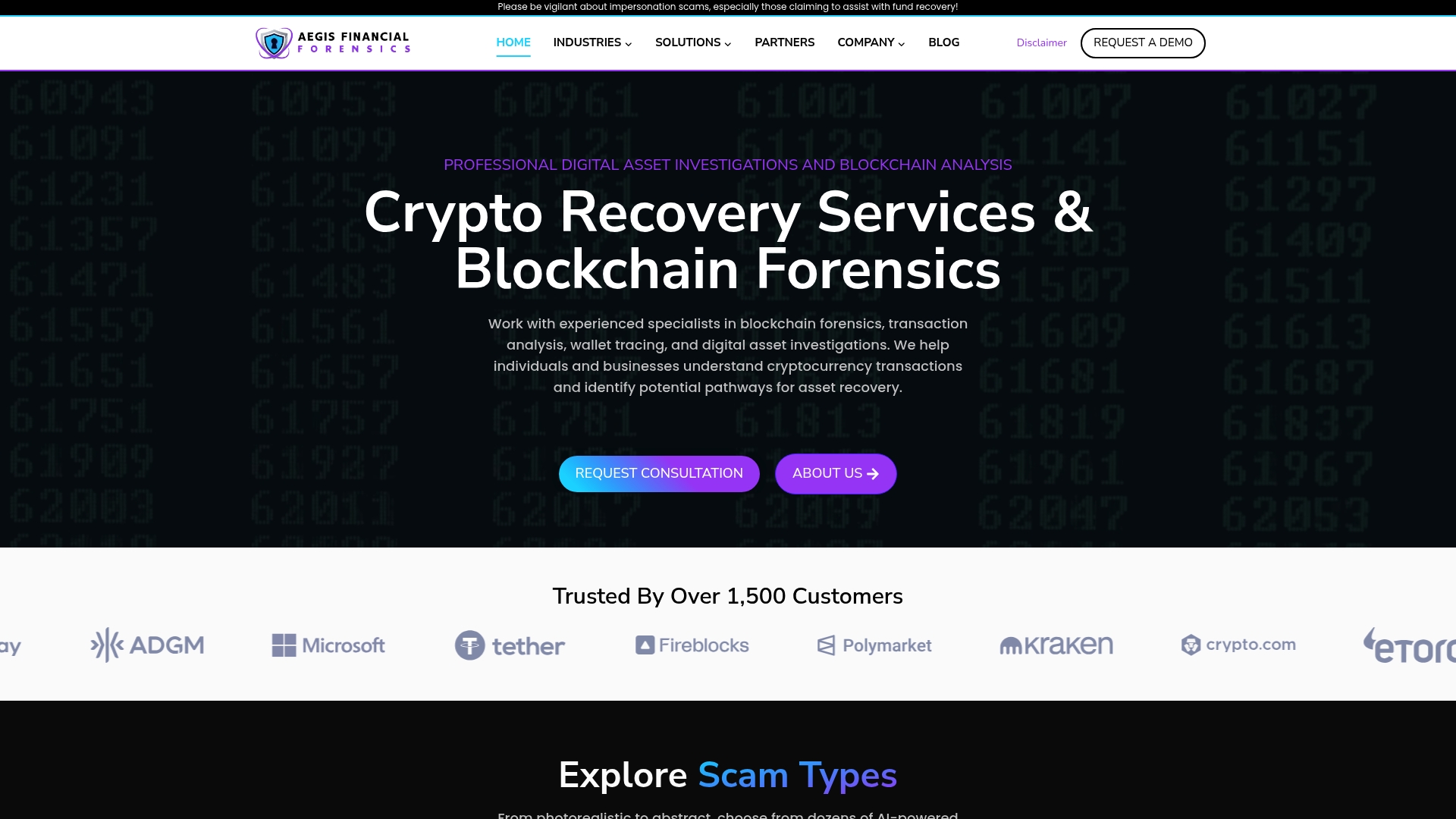
Over 1,500 clients, including major regulators and institutions, have relied on Aegisfinancialforensics to trace and recover assets across complex fraud cases, with more than $34 billion in illicit funds seized or recovered. Early expert involvement is the single greatest factor in recovery success. Aegisfinancialforensics offers confidential consultations to assess your case, define the forensic scope, and identify the legal pathways most likely to produce results. Contact the team to begin a forensic recovery assessment before the recovery window closes.
FAQ
What is blockchain asset tracing?
Blockchain asset tracing is the forensic process of following cryptocurrency transactions across an immutable public ledger to identify the movement, ownership, and destination of digital assets. It combines on-chain analytics with off-chain intelligence to build court-ready evidence.
What is post-hack asset tracing?
Post-hack asset tracing is the forensic investigation conducted after a cryptocurrency theft or exchange breach to map where stolen funds moved and identify the wallets or entities that received them. Speed is critical: delays allow funds to reach uncooperative jurisdictions where legal recovery becomes impractical.
What are the main benefits of forensic asset tracing for fraud victims?
Forensic asset tracing produces verifiable transaction evidence, identifies the location of stolen funds, and creates the legal documentation needed to pursue freezing injunctions and settlements. It replaces speculation with data-driven facts that courts and regulators accept.
How does blockchain tracing differ from traditional fiat asset tracing?
Blockchain tracing operates on a permanently visible public ledger that requires no subpoena to access, unlike bank records in fiat tracing. The challenge is expert interpretation of pseudonymous addresses, not access to the underlying data.
Can blockchain asset tracing guarantee fund recovery?
Tracing identifies targets and creates legal leverage but does not guarantee recovery. Actual recovery requires subsequent legal action, custodian cooperation, and jurisdictional access to the entities holding the traced funds.