

The Role of AI in Criminal Crypto Tracing
AI in criminal crypto tracing is defined as the use of machine learning, graph analytics, and agentic AI systems to identify, track, and support the recovery of assets involved in cryptocurrency crimes. The role of AI in criminal crypto tracing has become central to modern blockchain forensics, particularly as criminal operations grow more sophisticated. AI-enabled crypto scams now generate $3.2 million per operation on average in 2026, nearly five times higher than non-AI scams. That scale makes manual investigation impractical. AI does not replace investigators. It gives them the speed and pattern recognition to work at the scale that modern crypto crime demands.
How does AI detect suspicious cryptocurrency activity?
AI detects suspicious cryptocurrency activity by applying supervised and unsupervised machine learning models to transaction data at a scale no human analyst can match. Supervised models are trained on labeled datasets of known fraud patterns, including peel chains, fan-out structures, and layering sequences. Unsupervised models identify anomalous wallet behavior without prior labels, which is critical when criminals use novel obfuscation methods.

Graph analytics map complex relationships among wallets, exchanges, bridges, and actors to surface suspicious clusters. A single transaction may look ordinary in isolation. Mapped across thousands of connected addresses, it reveals a coordinated laundering network. This is how AI in cryptocurrency detection moves beyond simple rule-based filters.
AI also targets specific laundering techniques:
- Mixers and tumblers: AI models detect the statistical signatures of mixed outputs, including timing patterns and denomination clustering.
- Peel chains: Algorithms trace the sequential stripping of funds across hundreds of intermediate wallets.
- Cross-chain transfers: AI monitors bridge activity to flag assets moving between blockchains to obscure origin.
- Structuring: Machine learning identifies transaction amounts deliberately kept below reporting thresholds.
Explainable AI, known as XAI, addresses a critical gap in this process. XAI improves trust by providing clear justifications for flagged transactions, which reduces false positives and supports legal and compliance acceptance of AI findings. Without explainability, a flagged wallet is just an accusation. With it, investigators get a documented rationale they can present in court.
Pro Tip: When evaluating any AI-driven blockchain tracing tool, ask specifically whether it produces XAI outputs. A system that cannot explain why it flagged a wallet creates legal risk, not legal support.
What is agentic AI and how does it change crypto investigations?
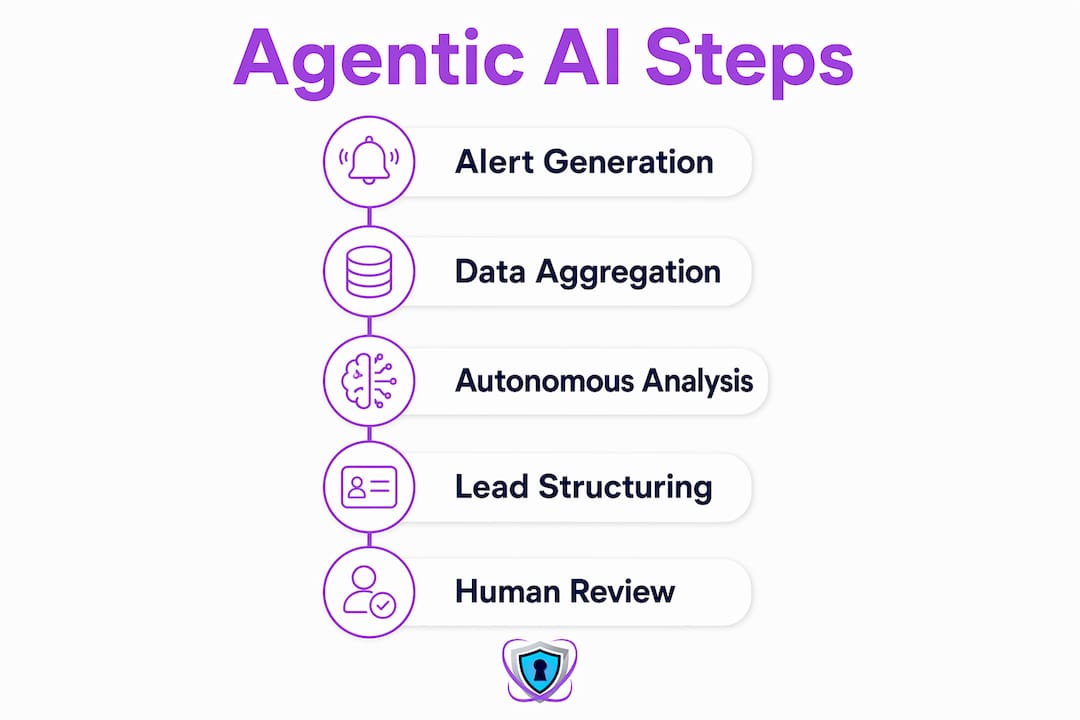
Agentic AI is defined as an AI system that executes multi-step investigative tasks autonomously, rather than simply displaying data for a human to interpret. The shift from dashboards to agentic AI marks the most significant operational change in crypto crime investigation in 2026. Analysts no longer spend time manually pulling transaction histories and cross-referencing wallet clusters. The AI agent does it.
Agentic AI reduces investigation time from 10 minutes to 2 minutes per alert by automating routine crypto tracing workflows. That is an 80% reduction in time per case. For compliance teams processing thousands of alerts monthly, that efficiency gain is operationally decisive.
The transition changes analyst roles in four concrete ways:
- From operator to orchestrator: Analysts set investigative parameters and review AI outputs rather than executing each step manually.
- Alert triage: Agentic AI handles low-complexity cases automatically, escalating only ambiguous or high-risk alerts to human review.
- Preliminary tracing: The AI conducts end-to-end mini investigations, generating a structured summary before a human analyst opens the case.
- Interaction logging: Some agentic systems interact with on-chain data sources and generate intelligence reports with full audit trails.
Agentic AI systems maintain human control through auditable, transparent outputs that prevent false conclusions in high-stakes investigations. This is not automation for its own sake. It is a governance model where AI handles volume and humans handle judgment.
Pro Tip: Treat agentic AI outputs as structured leads, not conclusions. Every AI-generated investigation summary should be reviewed by a qualified analyst before any enforcement or legal action is initiated.
What are the limitations of AI in criminal crypto tracing?
AI provides investigative leads, not legal attribution. This distinction is the most important limitation for any organization relying on blockchain tracing tools for enforcement or recovery purposes. A machine learning model can identify that a wallet received funds from a known fraud address. It cannot prove who controls that wallet.
IRS-CI states that tracing blockchain funds requires identity and custody evidence beyond transaction visualization for successful asset recovery. That means KYC records, IP logs, device data, and exchange subpoenas must accompany any AI-generated lead before a case reaches a court or regulator.
“Modern crypto forensics is as much about identity and custody governance as about transaction tracing. Legal attribution focus is critical. AI can map the money. Only off-chain evidence can prove who moved it.”
Additional limitations investigators must account for include:
- Privacy coins: Monero and similar assets use cryptographic obfuscation that limits AI’s ability to trace transaction flows.
- Cross-chain complexity: Bridges and wrapped tokens create attribution gaps that current AI models handle inconsistently.
- AI hallucination: Language model components in some agentic systems can generate plausible but incorrect investigative summaries.
- Model opacity: Without XAI outputs, AI risk scores are difficult to defend in court or regulatory proceedings.
False positives and negatives remain persistent challenges. AI must be paired with human investigation and off-chain evidence collection to produce conclusions that hold up under legal scrutiny.
How does AI support the recovery of stolen crypto assets?
AI supports stolen crypto recovery by ranking wallets according to risk scores and recovery potential, which allows investigators to prioritize the addresses most likely to hold accessible funds. Machine learning models identify abnormal wallet behavior and token activity, separating noise from intent across millions of transactions. That prioritization is what makes recovery feasible when funds have passed through dozens of intermediate addresses.
The practical recovery workflow integrates AI outputs with off-chain evidence at every stage. Successful crypto tracing requires combining AI-generated leads with off-chain evidence such as KYC records, IP logs, and device data to build admissible cases. Investigators who rely on on-chain analysis alone produce leads. Those who combine it with off-chain attribution markers produce prosecutable cases.
Key applications of AI in the recovery process include:
- Risk-scored wallet identification: AI ranks addresses by probability of criminal control and asset accessibility.
- Entity attribution: Clustering algorithms group wallets likely controlled by the same actor, reducing the address set investigators must pursue.
- Exchange flagging: AI identifies when stolen funds reach a regulated exchange, triggering a time-sensitive subpoena window.
- Compliance escalation: AI assists compliance teams in vetting transactions and escalating suspicious cases before funds are withdrawn.
Chain of custody documentation is non-negotiable throughout this process. Chain of custody for every AI-generated output must be maintained to preserve legal admissibility. Courts and regulators require documented processes showing how evidence was collected, analyzed, and preserved.
| Recovery stage | AI contribution | Human requirement |
|---|---|---|
| Initial triage | Automated alert scoring and clustering | Analyst review of flagged wallets |
| Fund tracing | Graph analytics across chains and bridges | Off-chain evidence collection |
| Entity attribution | Wallet clustering and exchange identification | KYC subpoenas and legal cooperation |
| Case preparation | Structured investigative summaries | Chain of custody documentation |
Aegisfinancialforensics applies this integrated model across its recovery engagements, combining AI-driven analytics with forensic investigation and legal coordination to build cases that meet evidentiary standards.
How will AI’s role in crypto law enforcement evolve?
AI’s role in crypto law enforcement is moving from a detection aid to a specialized investigative partner, with models being trained for specific crime categories rather than general transaction monitoring. Bridge tracing, phishing attribution, and beneficial ownership mapping each require distinct model architectures. General-purpose AI tools handle broad detection. Specialized models handle the edge cases where most criminal activity now concentrates.
Regulatory and court demands for traceability are increasing. Jurisdictions across North America, Europe, and Asia are developing evidentiary standards that require documented AI methodologies, not just outputs. Investigators who cannot explain how their AI reached a conclusion will face admissibility challenges.
Emerging priorities for AI development in this field include:
- Specialized models for bridge tracing, phishing cluster attribution, and beneficial ownership mapping.
- Ongoing analyst certification in AI-enhanced forensic methods to maintain governance standards.
- Regulatory alignment with anti-money laundering frameworks that require explainable risk scoring.
- Human governance structures that define when AI conclusions require mandatory human review before action.
The industry consensus is clear: AI is a partner tool, not an autonomous decision-maker. Investigators who treat AI outputs as final conclusions create legal exposure. Those who use AI to accelerate and focus human judgment produce results that hold up under scrutiny.
Key Takeaways
AI in criminal crypto tracing accelerates detection and supports recovery, but legal attribution always requires off-chain evidence and human validation alongside AI-generated leads.
| Point | Details |
|---|---|
| AI speeds up investigation | Agentic AI reduces alert investigation time from 10 minutes to 2 minutes per case. |
| XAI is legally necessary | Explainable AI outputs are required for compliance acceptance and court admissibility. |
| Off-chain evidence is mandatory | IRS-CI confirms that identity and custody evidence must accompany any on-chain tracing for legal recovery. |
| Agentic AI changes analyst roles | Analysts shift from manual operators to orchestrators who govern and validate AI outputs. |
| AI alone cannot attribute control | Machine learning identifies suspicious wallets; only off-chain evidence proves who controls them. |
AI is a force multiplier, not a verdict
Working in blockchain forensics, the most consistent mistake I see is treating an AI risk score as a conclusion. It is not. It is the starting point of an investigation, not the end of one.
AI dramatically improves the efficiency of crypto crime investigation. The shift from manual dashboard analysis to agentic workflows is real, and the time savings are operationally significant. But the cases that result in actual asset recovery and successful prosecution are always the ones where AI-generated leads were followed by rigorous off-chain evidence collection, documented chain of custody, and legal coordination.
The analysts who produce the best outcomes are not the ones who trust AI most. They are the ones who understand AI outputs deeply enough to know when to push further. That means understanding what a clustering algorithm can and cannot infer, knowing when a risk score reflects genuine anomaly versus model limitation, and maintaining the investigative discipline to build a case that survives legal challenge.
AI-enhanced threats are also evolving. The same tools that help investigators trace criminal funds are being used by criminals to generate more convincing scams and more complex obfuscation structures. Staying effective requires continuous learning, not just access to better software.
The future of crypto crime investigation is collaborative. AI handles volume, speed, and pattern recognition. Human analysts handle judgment, legal integrity, and the off-chain work that turns a lead into a recovery. Neither works without the other.
— Escareno
Aegisfinancialforensics: AI-enhanced crypto recovery for real cases
Aegisfinancialforensics combines AI-driven blockchain analytics with forensic investigation and legal coordination to trace and recover stolen digital assets.

The firm’s five-step recovery process integrates on-chain graph analysis, entity attribution, and off-chain evidence collection into a documented workflow that meets evidentiary standards. With over $34 billion in illicit funds seized or recovered across more than 1,500 cases, Aegisfinancialforensics applies the same integrated model used by major regulators and institutions. If you need professional support tracing stolen crypto assets, the crypto fund recovery team at Aegisfinancialforensics is available to assess your case. You can also review the firm’s crypto fraud investigation tools to understand the full scope of its analytical capabilities.
FAQ
What is the role of AI in criminal crypto tracing?
AI in criminal crypto tracing refers to the use of machine learning, graph analytics, and agentic AI to detect suspicious transactions, map wallet networks, and generate investigative leads for law enforcement and recovery teams.
Can AI alone recover stolen cryptocurrency?
AI cannot recover stolen cryptocurrency on its own. Legal recovery requires off-chain evidence such as KYC records and device logs, combined with AI-generated leads, to establish identity and custody for court or regulatory proceedings.
What is agentic AI in crypto investigations?
Agentic AI is a system that executes multi-step investigative tasks autonomously, reducing alert investigation time from 10 minutes to 2 minutes per case while maintaining auditable outputs for human review.
Why is Explainable AI important in crypto tracing?
Explainable AI provides documented justifications for flagged transactions, which reduces false positives and makes AI findings acceptable to compliance teams and courts.
How does AI help trace funds through mixers and cross-chain bridges?
AI detects the statistical signatures of mixed outputs and monitors bridge activity across blockchains, flagging assets that move through obfuscation layers. Human analysts then use those leads to pursue off-chain attribution evidence.