
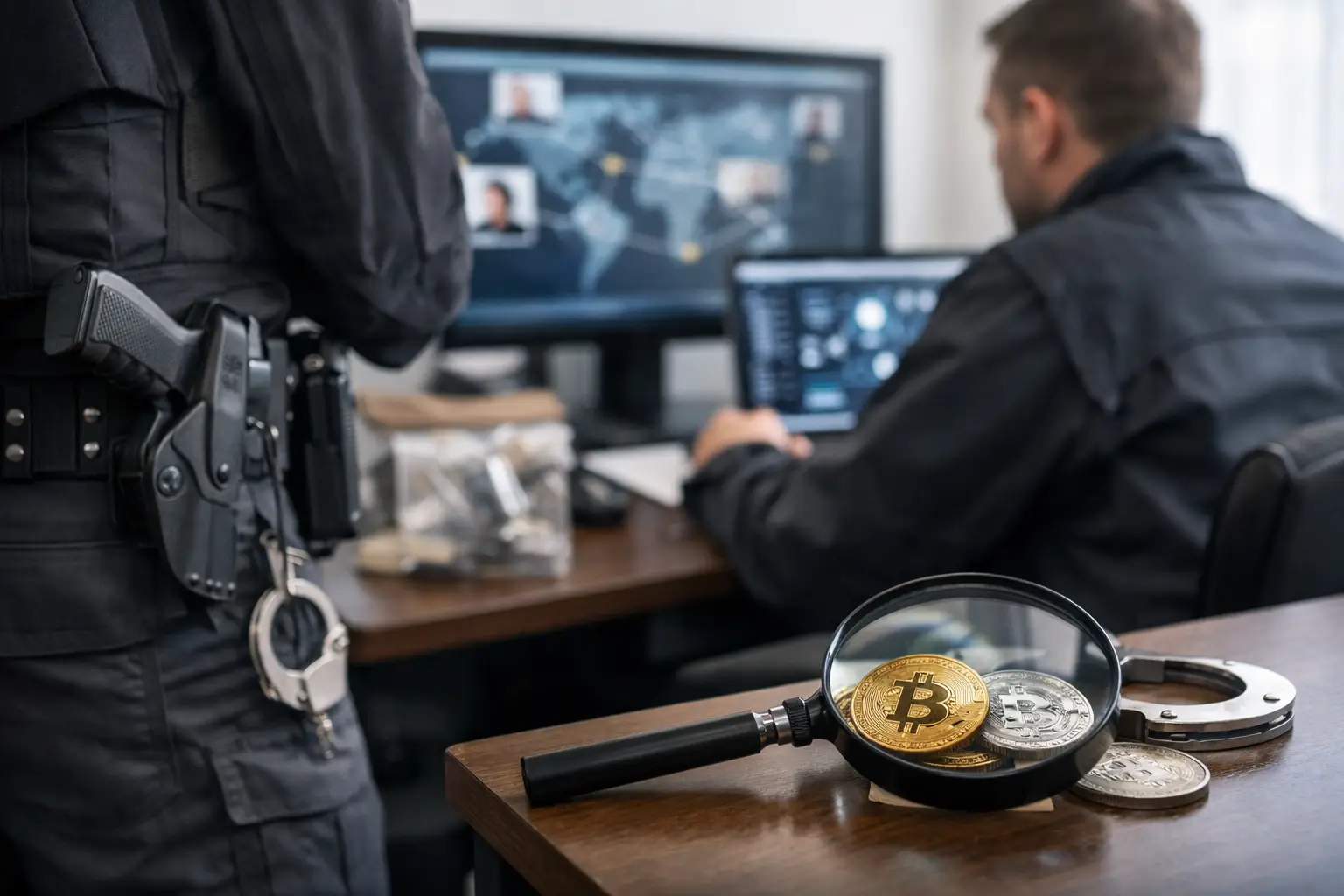
Law Enforcement Crypto Case Examples That Matter
A ransomware payment leaves a victim organization in minutes. Moving from that payment to a defensible seizure can take months of attribution work, legal process, exchange coordination, and evidence preservation. The following law enforcement crypto case examples show what effective blockchain investigation looks like when the objective is not merely to identify an address, but to disrupt criminal operations, protect victims, and support action in court.
Why crypto cases turn on operational speed
Public blockchains preserve transaction history, but transparency is not the same as attribution. Investigators must establish who controlled relevant wallets, distinguish criminal proceeds from unrelated funds, identify exposure to regulated services, and document every analytical conclusion in a form that prosecutors, courts, and international counterparts can evaluate.
The strongest cases connect on-chain evidence to off-chain facts: victim reports, ransomware notes, exchange records, device evidence, IP logs, communications, corporate records, and financial intelligence. A wallet cluster may establish a compelling lead. It does not, by itself, prove the identity or intent of the person behind it.
Speed matters because illicit assets can move through cross-chain bridges, decentralized exchanges, instant-exchange services, mixers, and nested accounts before they reach a point where a freeze is possible. The goal is to identify viable intervention points early while preserving a clear evidentiary record of the funds’ path.
Law enforcement crypto case examples and the methods behind them
Colonial Pipeline: tracing a ransomware payment to seizure
The 2021 Colonial Pipeline ransomware incident remains a defining example of how a cryptocurrency investigation can support rapid disruption. After the attack, the company paid approximately 75 bitcoin to a wallet associated with the DarkSide ransomware operation. The payment became a starting point for tracing activity rather than the end of the investigation.
Federal investigators followed the movement of the bitcoin through the blockchain and obtained legal authority to seize cryptocurrency from a wallet used to hold part of the proceeds. The Department of Justice later announced the recovery of 63.7 bitcoin, then valued at roughly $2.3 million.
The operational lesson is often misstated as “blockchain tracing recovered the funds.” Tracing was essential, but recovery required more: timely victim reporting, investigators able to interpret transactions, attribution to infrastructure under criminal control, judicial process, and access to the wallet’s private key. Every one of those elements mattered.
For ransomware response teams, the case reinforces a practical priority. Preserve the demand note, payment address, transaction ID, wallet information, communications, and exact payment timing immediately. Those facts enable clustering, service exposure analysis, and comparisons with known threat infrastructure. Delay can turn a traceable payment into a more fragmented and expensive recovery effort.
Bitfinex: following stolen assets across years and services
The Bitfinex theft illustrates a different challenge: persistence. In 2016, hackers stole nearly 120,000 bitcoin from the exchange. The assets did not disappear. They moved through a long sequence of wallets and services over several years, creating an extensive transaction history that investigators could analyze alongside conventional evidence.
In 2022, the Department of Justice announced the seizure of approximately 94,000 bitcoin tied to the theft, valued at about $3.6 billion at the time. The case demonstrated that time can work in both directions. Criminals may assume that multiple hops, dormant wallets, and delayed liquidation reduce the chance of attribution. Yet each transaction can create additional records and additional points of contact with identifiable services.
The analytical work in a case of this scale cannot rest on a visual transaction path alone. Investigators need entity attribution, wallet-clustering logic, transaction chronology, value calculations at relevant dates, and an auditable methodology for separating suspected proceeds from other holdings. They also need to account for changes in asset value without confusing appreciation with newly acquired criminal proceeds.
This is where case management becomes more than administrative convenience. Large, multi-year investigations generate thousands of addresses, transactions, exhibits, subpoenas, contacts, and analytical decisions. A system that preserves source data, analyst notes, chain of custody, and investigative milestones reduces the risk that critical context is lost when a case changes hands.
Harmony and Lazarus Group: cross-chain tracing against state-linked actors
The June 2022 theft from Harmony’s Horizon bridge exposed the difficulty of pursuing funds tied to sophisticated, state-linked actors. Attackers took approximately $100 million in digital assets and used laundering techniques that included asset swaps and movement through services intended to obscure provenance.
In 2023, the Department of Justice announced the seizure of more than $30 million in cryptocurrency connected to the theft and attributed the activity to North Korea-linked Lazarus Group actors. The action showed that cross-chain movement and laundering infrastructure increase investigative complexity, but they do not eliminate opportunities for intervention.
Cross-chain cases require investigators to follow economic value as well as individual assets. A stolen token may be swapped for ether, bridged to another network, exchanged into stablecoins, broken into smaller amounts, and deposited through multiple services. The evidence must explain those transitions precisely. A credible tracing narrative identifies the source transaction, the swap or bridge event, the destination asset and network, subsequent movement, and the rationale for linking each stage.
These cases also require disciplined language. Analysts should distinguish confirmed facts from assessed attribution, record confidence levels, and avoid treating proximity to a sanctioned entity as proof of criminal control. That discipline protects the integrity of the case and makes intelligence more useful for sanctions, regulatory, and criminal proceedings.
Helix: proving a laundering service’s criminal function
Not every crypto case begins with a high-profile theft. The Helix matter centered on an alleged bitcoin mixing service used to launder criminal proceeds. In 2021, its operator pleaded guilty to a money laundering conspiracy charge after federal authorities alleged that Helix processed more than 350,000 bitcoin, including funds associated with darknet markets.
The broader significance is the focus on service-level behavior. A mixer, exchange, bridge, or payment processor is not assessed solely by the technology it uses. Investigators examine transaction patterns, customer activity, exposure to known illicit infrastructure, communications, marketing, internal records, and whether the service knowingly facilitated the movement or concealment of criminal proceeds.
De-mixing analysis is particularly valuable in these matters, but it has limits. It can identify likely pathways, recurring counterparties, timing relationships, amount patterns, and points where value re-enters a traceable environment. It should not be presented as mathematical certainty when the underlying activity supports only a probabilistic conclusion. The right standard depends on the legal question, the available corroboration, and the burden of proof.
What these cases require from an investigative program
The cases above involve different offenses, assets, and adversaries. Their operational requirements are remarkably consistent. Agencies and financial crime teams need broad blockchain coverage because criminal funds do not respect a single-network workflow. They need high-quality attribution intelligence because an address is actionable only when its relationship to a person, service, or threat actor can be explained. And they need processes that move intelligence into disruption.
That last requirement is frequently the gap. A trace that ends in a report may be useful for understanding exposure, but it will not freeze an account. Effective intervention requires identifying the receiving service, preparing a clear evidentiary package, using the appropriate legal or emergency channel, documenting communications, and following through with the relevant law enforcement, exchange, or regulatory counterpart.
For cross-border cases, investigators should expect differences in record retention, legal thresholds, response times, and asset-control procedures. An offshore service may not respond to the same request format or timeline as a U.S. virtual asset service provider. Early coordination with prosecutors and international partners is often more valuable than a late-stage request after the funds have moved again.
Aegis Financial Forensics supports this operating model by bringing blockchain tracing, de-mixing analysis, visualization, case management, and threat intelligence into one investigative environment. The purpose is operational clarity: help teams translate complex asset movement into court-ready evidence and timely opportunities for freezes, seizures, or recovery.
Build cases that can survive scrutiny and move funds
A useful crypto investigation should answer four questions with precision: What happened to the assets? Why does the evidence link those movements to the suspected offense or actor? Where can the funds be interrupted now? What records will allow another investigator, prosecutor, or court to verify the analysis?
The answer will vary by case. A fresh ransomware payment may justify an urgent preservation request. A years-old theft may call for painstaking reconstruction across thousands of transactions. A sanctions or terrorism-financing inquiry may demand a higher level of attribution discipline and interagency coordination. Treating each matter as a transaction-tracing exercise alone misses the point.
The best time to prepare for a crypto seizure is before the next payment, breach, or fraud report arrives. Build the workflows, intelligence coverage, evidentiary standards, and disruption relationships that allow an investigative lead to become timely action when public safety is at stake.