

Internal Audit After Crypto Theft: A 2026 Guide
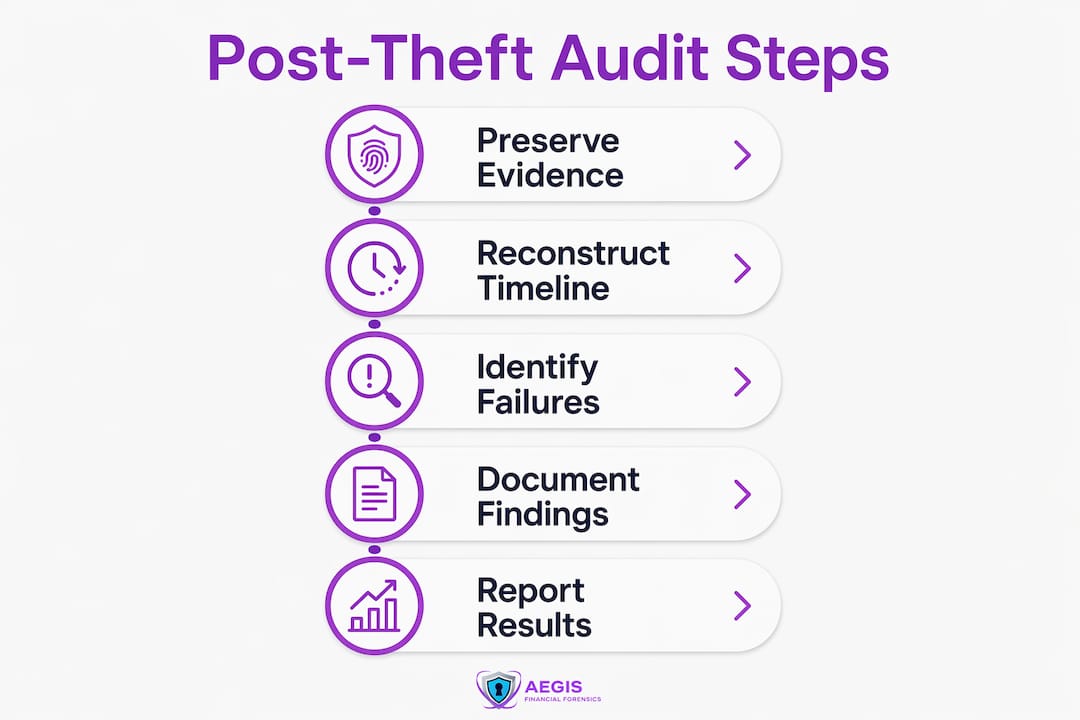
An internal audit after crypto theft is a systematic, evidence-driven review that reconstructs how digital assets were stolen, identifies control failures, and produces defensible findings for regulators, insurers, and law enforcement. The process goes far beyond tallying losses. It applies forensic standards such as NIST SP 800-61r2 to preserve evidence integrity, maps on-chain and off-chain transaction flows, and delivers a court-ready report that supports both recovery and remediation. FBI-led operations have demonstrated that advanced tracing capabilities now result in prosecutions with prison sentences up to 11 years. Organizations that conduct a rigorous post-theft audit process gain the strongest position for asset recovery and future incident prevention.
What does an internal audit after crypto theft actually require?
The post-theft audit process formally known as a post-incident forensic review combines blockchain intelligence, internal controls assessment, and evidentiary documentation into one structured workflow. The goal is not simply to confirm that funds are gone. The goal is to produce a reconstruction precise enough to satisfy a federal court, a cyber insurer, or a financial regulator.
Three disciplines converge in every credible audit. First, digital forensics captures and preserves system artifacts before they degrade. Second, blockchain tracing follows stolen assets across wallets, exchanges, mixers, and cross-chain bridges. Third, internal controls review identifies the governance failures that made the theft possible. Organizations that skip any one of these disciplines produce incomplete findings that fail under legal or regulatory scrutiny.

Preparatory steps before starting the post-theft audit
Preserving evidence before anything else
The first 24 hours after discovery determine whether the audit will produce admissible findings. Early system disruptions such as re-imaging servers or resetting credentials without forensic guidance frequently destroy critical evidence. Investigators must capture raw blockchain metadata, transaction hashes, system memory images, and log files before any remediation activity begins.
Every digital artifact requires a cryptographic hash at the moment of capture. Immutable, timestamped files aggregated into a single forensic package meet the regulatory acceptance standard for most jurisdictions. Screenshots alone do not meet this standard and will not support an insurance claim or court filing.
Key preparatory actions include:
- Isolate affected systems without powering them down, to preserve volatile memory containing session tokens and encryption keys.
- Document all wallet addresses controlled by the organization, including hot wallets, cold storage addresses, and any smart contract addresses.
- Capture raw transaction logs from blockchain explorers and internal systems with timestamps intact.
- Establish chain of custody by logging every access to digital evidence with user identity, timestamp, and stated reason, as chain of custody protocols require for court admissibility.
- Engage legal counsel immediately to place the investigation under attorney-client privilege before interviewing any internal personnel.
Pro Tip: Retain outside forensic counsel before notifying internal IT teams. Premature internal access to compromised systems, even with good intentions, creates chain of custody gaps that insurers and courts will challenge.
Regarding internal suspects, experts recommend discreet investigation under attorney-client privilege before any confrontation. Alerting a suspected insider prematurely risks evidence tampering or destruction, which can permanently impair the investigation.
How to reconstruct the technical and financial timeline
Timeline reconstruction is the analytical core of any crypto theft investigation. Court-ready audits employ methodologies that attribute theft to specific threat actors within hours by mapping every transaction from the point of compromise to the final loss destination.
The reconstruction follows a defined sequence:
- Identify the initial compromise point. Determine whether the attacker gained access through a phishing attack, SIM swap, malware, a smart contract exploit, or a compromised private key. Each entry method leaves distinct artifacts in system logs and on-chain data.
- Map victim-controlled wallet addresses. Catalog every address the organization controlled at the time of the incident, including multisig signers and contract deployer addresses.
- Trace outbound movements. Follow stolen funds through each hop: direct transfers, exchange deposits, mixer inputs, and cross-chain bridge transactions. Blockchain tracing tools identify entity attribution at each step, flagging known exchange clusters and sanctioned addresses.
- Analyze smart contract calls. For DeFi-related thefts, reconstruct each contract interaction to identify the exploit method, the sequence of calls, and the exact block at which control was lost.
- Build the complete timeline. Align on-chain events with off-chain system log entries to produce a minute-by-minute account from initial access to final asset movement.
The table below summarizes the key data sources used at each reconstruction stage.
| Reconstruction Stage | Primary Data Source | Key Artifact |
|---|---|---|
| Initial compromise | System and IAM logs | Login anomalies, privilege escalation events |
| Wallet identification | Internal records, blockchain explorer | Address list, transaction history |
| Fund movement tracing | Blockchain tracing tools | Transaction hashes, hop addresses |
| Smart contract analysis | On-chain call data | Function signatures, exploit transactions |
| Timeline finalization | Combined on-chain and off-chain logs | Chronological event sequence |
For organizations auditing cryptocurrency exchanges, the tracing phase also covers order book manipulation, API key abuse, and withdrawal approval bypasses. Each of these attack vectors leaves a distinct signature in exchange-level logs that a trained investigator can correlate with on-chain outflows. Aegisfinancialforensics applies AI-driven intelligence across these data sources to accelerate entity attribution and reduce the time to a defensible timeline. Teams can review the full stolen crypto tracing methodology for a step-by-step breakdown of this process.
How to identify control failures that enabled the theft
Control failure analysis answers the question every board, regulator, and insurer asks: why did existing safeguards not prevent this? Audit review of multisig processes, emergency timelocks, and governance policy exceptions reveals exactly where enforcement broke down.
The most common internal control failures fall into three categories:
- Key management failures. Single-person key control, weak separation of duties, and insecure key backups are the most frequently exploited weaknesses. Social engineering and SIM swap attacks succeed precisely because these structural flaws exist.
- Privileged access gaps. Review identity and access management logs for unauthorized privilege escalation, dormant admin accounts, and deployment approvals that bypassed standard review. Each anomaly is a potential contributing cause.
- Governance and policy exceptions. Identify any transaction approvals, multisig overrides, or policy waivers that occurred in the period before the theft. Attackers frequently exploit exception processes that lack adequate oversight.
Pro Tip: Separate primary root causes from contributing factors in writing. A smart contract bug is a primary cause. Inadequate monitoring that allowed the exploit to run undetected for hours is a contributing factor. Conflating the two produces remediation plans that fix symptoms rather than causes.
An effective post-incident audit separates primary root causes such as smart contract bugs from contributing factors such as lax operational controls. This distinction matters because remediation resources are finite. Fixing the primary cause eliminates the vulnerability; addressing contributing factors reduces the probability of future exploitation. Both are necessary, but they require different owners and timelines. Teams seeking a structured approach to identifying crypto fraud evidence will find that control failure documentation forms the evidentiary backbone of any subsequent legal or insurance action.
Best practices for documenting and reporting audit findings
Writing a report that survives scrutiny
The audit report is the deliverable that determines whether the entire investigation produces value. Post-incident audit outputs must go beyond a narrative of stolen funds. They must provide court-ready and regulator-ready reconstructions, defensible impact estimates, and clear remediation roadmaps.
A defensible report follows this structure:
- Executive summary. State the confirmed loss amount, the primary attack vector, and the top three control failures in plain language. Boards and insurers read this section first.
- Technical findings. Present the full transaction timeline, wallet attribution analysis, and exploit methodology with supporting blockchain data. Every claim links to a specific transaction hash or log entry.
- Control failure analysis. Document each identified weakness with the supporting evidence, the policy or standard it violated, and the assessed severity.
- Loss quantification. Provide a defensible dollar value of stolen assets at the time of theft, using exchange rate data from a recognized source. Forensic CPAs emphasize that objective findings serve insurance, legal, and compliance purposes regardless of whether an arrest occurs.
- Remediation roadmap. Assign each control failure a remediation action, an owner, and a target completion date. Regulators expect this section to demonstrate that the organization has learned from the incident.
“A successful investigation results in a defensible report identifying process failures, misconduct, or collusion, enabling effective control remediation regardless of arrest or confession outcome. The objective findings are the product, not the prosecution.”
Managing external communication requires equal discipline. Customers, partners, and regulators need factual, timely updates that confirm the organization is acting responsibly. Premature or inaccurate disclosures create legal exposure and erode trust faster than the theft itself. Legal counsel should review all external communications before release.
Key Takeaways
A rigorous internal audit after crypto theft requires evidence preservation, on-chain timeline reconstruction, control failure analysis, and a court-ready report to support recovery, regulatory compliance, and future incident prevention.
| Point | Details |
|---|---|
| Preserve evidence first | Capture transaction hashes, system images, and logs before any remediation activity begins. |
| Reconstruct the full timeline | Map every on-chain hop from compromise to final asset destination using blockchain tracing tools. |
| Separate root causes from contributing factors | Distinguish primary failures like key management flaws from secondary gaps like inadequate monitoring. |
| Produce a court-ready report | Include loss quantification, wallet attribution, and a remediation roadmap to satisfy regulators and insurers. |
| Engage third-party forensic expertise | External validation eliminates internal bias and builds credibility with stakeholders and law enforcement. |
Why internal-only audits consistently fall short
The most consequential mistake organizations make after a crypto theft is assigning the investigation entirely to internal teams. Internal reviewers carry institutional blind spots. They may unconsciously protect colleagues, underestimate systemic failures, or lack the blockchain forensic tools needed to trace assets across mixers and cross-chain bridges. Combining internal transparency with outside forensic expertise is the standard that builds trustworthy root cause analysis for stakeholders and regulators.
I have seen organizations complete thorough internal reviews only to have their findings rejected by insurers because the methodology lacked independence. The insurer’s forensic team then conducted its own investigation, doubling the cost and delaying the claim by months. Third-party validation is not a luxury. It is the difference between a report that closes the matter and one that opens a second investigation.
Forensic readiness is the other gap most organizations discover too late. Organizations that maintain documented key management policies, transaction approval logs, and incident response playbooks before a theft occurs complete audits in days rather than weeks. Those that build forensic readiness after the fact spend the first phase of the audit reconstructing records that should have existed from day one. The discipline of documentation is the cheapest control improvement any organization can make.
— Escareno
How Aegisfinancialforensics supports your post-theft audit
Aegisfinancialforensics brings blockchain forensic expertise, AI-driven tracing, and court-ready documentation to organizations at every stage of a post-theft investigation. The firm has assisted with over $34 billion in illicit funds seized or recovered, working alongside regulators, institutions, and individual clients across more than 1,500 cases.

The crypto fund recovery investigation service covers the full audit workflow: evidence preservation, on-chain timeline reconstruction, control failure analysis, and defensible report production. Aegisfinancialforensics forensic teams collaborate directly with legal counsel, compliance officers, and law enforcement to produce findings that hold up under the highest scrutiny. Organizations seeking independent validation of internal findings, or those starting from zero after a breach, can consult Aegisfinancialforensics for a tailored assessment at aegisfinancialforensics.com.
FAQ
What is an internal audit after crypto theft?
An internal audit after crypto theft is a structured forensic review that reconstructs the theft timeline, identifies control failures, and produces evidence-backed findings for legal, regulatory, and insurance purposes. It applies blockchain tracing, digital forensics, and internal controls assessment in a single coordinated workflow.
How soon should the post-theft audit process begin?
The audit must begin within hours of discovery. Early system disruptions such as credential resets or server re-imaging without forensic guidance destroy critical evidence, so evidence preservation takes priority over remediation.
What internal controls for crypto does the audit evaluate?
The audit evaluates key management policies, multisig approval processes, privileged access controls, and transaction governance procedures. Failures in any of these areas represent both the root cause of the theft and the remediation priority.
Can a post-theft audit help with recovering stolen cryptocurrency?
Yes. A forensic audit produces wallet attribution data and transaction timelines that law enforcement and asset recovery specialists use to trace and seize stolen funds. FBI-led operations have demonstrated that advanced tracing capabilities support prosecutions and asset seizures across multiple jurisdictions.
Does the audit report need to be prepared by an outside expert?
Third-party forensic validation is the recognized standard for credibility with regulators and insurers. Internal-only reviews risk bias and may miss systemic issues, which is why expert consensus recommends combining internal transparency with independent forensic expertise.