
How Darknet Transactions Are Traced: A 2026 Guide
Blockchain forensic analysis is the primary method by which darknet transactions are traced, converting pseudonymous cryptocurrency flows into prosecutable evidence linked to real identities. Despite the perceived anonymity of networks like Tor and coins like Bitcoin, every transaction is recorded permanently on a public ledger. Agencies including the IRS Criminal Investigation division, the FBI, and Europol apply clustering heuristics, KYC subpoenas, and open-source intelligence to unravel these flows. The Helix mixer seizure and the Welcome to Video indictment both demonstrate that understanding darknet transaction tracking is not theoretical. It is a proven investigative discipline with a documented record of large-scale takedowns.
How darknet transactions are traced using blockchain forensics
Blockchain forensics is the discipline of analyzing on-chain data to attribute wallet addresses to real-world entities. The critical distinction here is between pseudonymity and anonymity. Bitcoin and Ethereum transactions are pseudonymous, meaning addresses are not names, but every transaction is public, timestamped, and permanent. Anonymity would mean no trail exists. Pseudonymity means the trail exists and waits to be decoded.
Investigators apply several core techniques to decode that trail:
- Common-input ownership heuristic: When a transaction spends from multiple input addresses simultaneously, forensic analysts infer that one entity controls all those addresses. This is the foundation of wallet clustering.
- Peeling chain analysis: Funds moved through a long sequence of single-input, single-output transactions form a peel chain. Each “peel” transfers a small amount to a destination while the remainder moves forward. Analysts follow the chain until funds reach an identifiable service.
- Change address detection: Most wallets generate a new address to receive unspent transaction output. Forensic software identifies these change addresses and links them back to the originating cluster.
- Transaction graph analysis: Investigators map the full graph of fund flows, identifying fan-out structures where funds split across dozens of addresses before converging at an exchange deposit address.
- Fiat off-ramp linkage: The terminal goal of transaction graph analysis is identifying the regulated exchange where funds convert to fiat. That exchange holds KYC records.
Clustering heuristics have been industrialized by forensic analytics platforms to produce wallet clusters that meet prosecution-grade evidentiary standards. The practical result is that a darknet vendor’s Bitcoin wallet can be linked to a Coinbase account registered under a real name, a real address, and a government-issued ID.
Pro Tip: When analyzing a transaction graph, prioritize identifying the first exchange deposit address in the chain. That single address often unlocks KYC records that collapse the entire investigation timeline.

How obfuscation tools complicate tracing and how forensic teams respond
Darknet operators are not passive targets. They actively deploy obfuscation tools to break traceability, and forensic teams have developed countermeasures for each method.
-
Mixing and tumbling services: Mixers pool funds from multiple users and redistribute equivalent amounts, attempting to sever the link between input and output addresses. The Helix mixer processed 354,468 bitcoin between 2014 and 2017 before investigators traced its transaction trails through clustering and exchange data, resulting in forfeiture of over $400 million in assets.
-
Privacy coins: Monero uses ring signatures, stealth addresses, and confidential transactions to obscure sender, receiver, and amount. These features represent the most significant forensic challenge in the field. Zcash offers shielded transactions using zero-knowledge proofs. Both coins are designed to defeat standard clustering heuristics.
-
Cross-chain laundering: Funds move from Bitcoin to Monero and back, or through decentralized bridges, to break the transaction graph across multiple blockchains.
-
Layered wallet structures: Criminals route funds through dozens of intermediate wallets before reaching an exchange, increasing the analytical workload for investigators.
Forensic countermeasures address each layer. Timing analysis and behavioral patterns allow investigators to probabilistically link Monero outputs even when cryptographic obfuscation is present. Output spending patterns, deposit timing correlations, and known mixer fingerprints all contribute to attribution. For cross-chain activity, investigators apply chain-hop analysis to follow funds across networks.
“Forensic teams successfully trace transactions by analyzing behavioral patterns beyond individual wallets. Investigators shift focus from wallets to entire operational ecosystems to overcome anonymization techniques.”
The key insight is that no obfuscation tool eliminates all forensic signals. Mixers leave timing artifacts. Privacy coins leave metadata at the points of acquisition and exit. Cross-chain bridges maintain on-chain records. Investigators exploit every gap.
What role does OSINT play in darknet transaction tracing?
Open-source intelligence, known as OSINT, provides the investigative layer that blockchain analysis alone cannot supply. Blockchain data reveals transaction flows. OSINT reveals the human and operational context surrounding those flows.
Platforms like DarkOwl and Intelligence X index Tor, I2P, and darknet forums to surface vendor profiles, marketplace listings, breach databases, and communication threads. These platforms integrate with SIEM and SOAR security environments, allowing compliance teams and law enforcement to correlate on-chain data with off-chain intelligence in near real time.
Key OSINT capabilities applied in darknet investigations include:
- Entity relationship mapping: Linking forum usernames, PGP keys, and vendor handles across multiple darknet markets to a single operational identity.
- Dark web monitoring: Continuous indexing of marketplace activity to detect new wallet addresses associated with known criminal actors.
- Breach database correlation: Matching email addresses, passwords, and usernames from data breaches to darknet vendor accounts.
- Shipping address harvesting: During Operation Bayonet, law enforcement controlled a marketplace for 27 days, harvesting encrypted order data, vendor IP addresses, and thousands of shipping addresses before shutting it down.
Undercover operations complement OSINT by generating ground-truth data. Agents place orders, receive shipments, and document wallet addresses used for payment. Those addresses feed directly into blockchain forensic workflows, providing confirmed attribution points that anchor the broader transaction graph.
The synergy between OSINT and blockchain forensics is what enables ecosystem-level attribution. A single confirmed wallet address from an undercover purchase can unlock a cluster of hundreds of addresses through heuristic analysis, connecting a vendor to years of transaction history.
How does tracing lead to prosecution? KYC subpoenas and legal evidence
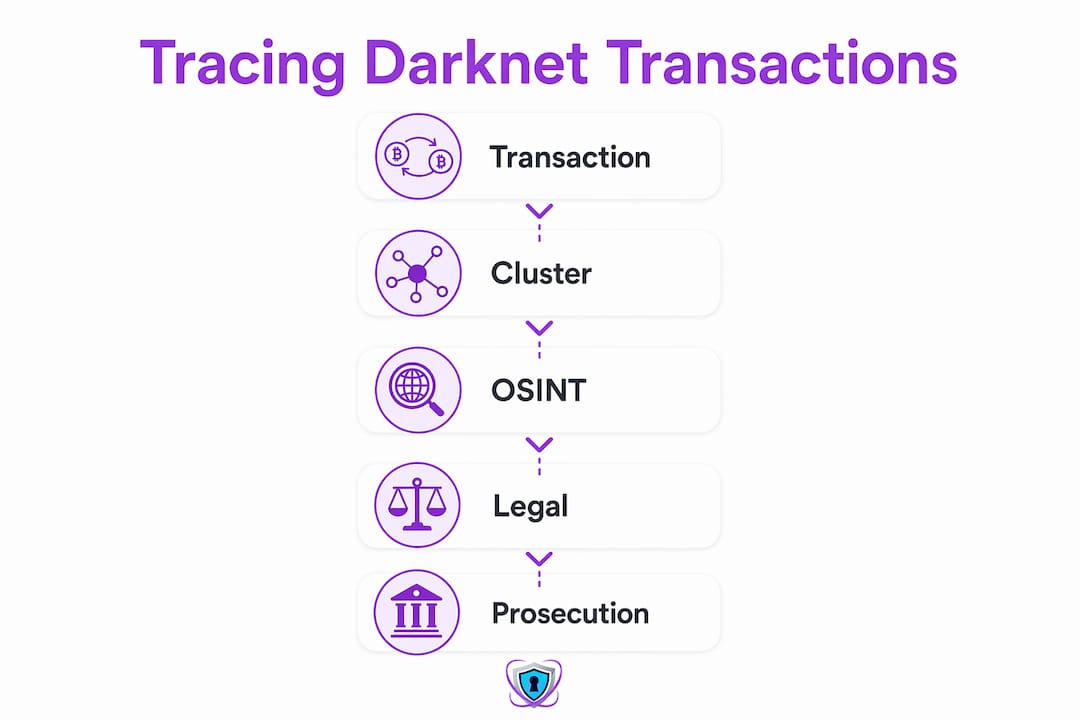
The investigative endpoint of darknet transaction tracing is the regulated exchange account. Tracing does not require identifying every intermediate wallet. It requires reaching the exchange where funds convert to fiat and where KYC compliance mandates the collection of verified identity documents.
| Investigation stage | Method | Legal instrument |
|---|---|---|
| Wallet clustering | Common-input heuristics, peel chain analysis | Internal forensic analysis |
| Exchange identification | Transaction graph tracing to deposit address | Blockchain analytics platforms |
| Identity linkage | KYC record request | Subpoena or court order |
| Cross-border cooperation | International evidence sharing | Mutual Legal Assistance Treaty (MLAT) |
| Court admissibility | Expert witness testimony | Daubert standard review |
Regulated exchanges operating under Financial Action Task Force guidelines maintain verified identity records for every account. Once investigators trace funds to a deposit address, a subpoena compels the exchange to produce the account holder’s name, address, government ID, and IP login history. Cross-border cases use Mutual Legal Assistance Treaties to obtain records from foreign exchanges.
Blockchain forensic evidence meets the Daubert standard for scientific admissibility in US federal courts. The Bitcoin Fog case produced a landmark conviction based on forensic analytics deemed admissible under this standard. European and Commonwealth courts have similarly accepted properly documented blockchain evidence, making forensic tracing a reliable foundation for prosecution.
Operation Alice demonstrated the scale possible through structural pattern analysis. Investigators identified 370,000 dark web pages operated by a single criminal actor by following cryptocurrency flow patterns across sites. That level of attribution is only achievable when blockchain forensics, OSINT, and legal process operate as an integrated workflow.
Pro Tip: Investigators should document every analytical step in a chain-of-custody format from the moment blockchain data is collected. Courts scrutinize methodology, and gaps in documentation can render otherwise solid forensic evidence inadmissible.
The crypto fraud evidence required for prosecution includes transaction records, wallet cluster reports, exchange KYC data, and expert witness analysis. Each element must be collected and preserved according to evidentiary standards before it reaches a courtroom.
Key Takeaways
Darknet transactions are traceable through a combination of blockchain clustering heuristics, OSINT, and KYC subpoenas that together convert pseudonymous wallet addresses into verified real-world identities.
| Point | Details |
|---|---|
| Blockchain is pseudonymous, not anonymous | Every transaction is public and permanent, making forensic tracing possible from the start. |
| Clustering heuristics are the core method | Common-input ownership and peel chain analysis group addresses into prosecutable wallet clusters. |
| Obfuscation tools leave exploitable gaps | Mixers, privacy coins, and cross-chain bridges all retain timing or metadata artifacts that analysts exploit. |
| OSINT and undercover ops anchor attribution | Confirmed wallet addresses from operations like Bayonet feed directly into blockchain forensic workflows. |
| KYC subpoenas close the identity gap | Tracing funds to a regulated exchange account unlocks verified identity records under legal compulsion. |
The cat-and-mouse dynamic I’ve watched define this field
Having worked across hundreds of blockchain forensic investigations, the pattern I observe consistently is this: the gap between obfuscation technology and forensic capability is narrowing, not widening. When Helix launched in 2014, mixing services genuinely complicated investigations. By 2017, investigators had developed clustering techniques that traced Helix’s entire transaction history and produced a $400 million forfeiture. That cycle repeats.
Privacy coins represent the current frontier. Monero’s cryptographic protections are real, and I won’t minimize them. But the points of acquisition and exit remain the weakest links. Investigators who focus on those transition points, rather than attempting to break the cryptography directly, consistently achieve attribution. The adversary who converts fiat to Monero at a KYC exchange and then back to fiat at another has already created two forensic anchors.
What concerns me more than any single technology is the increasing sophistication of cross-chain laundering combined with decentralized finance protocols. These workflows fragment transaction trails across multiple blockchains and smart contract layers simultaneously. Forensic teams need on-chain analysis tools that maintain chain coverage across Bitcoin, Ethereum, and emerging networks without losing attribution continuity. The investigators who succeed in the next five years will be those who treat the entire blockchain ecosystem as a single analytical surface, not a collection of separate ledgers.
The legal framework is keeping pace. Daubert admissibility for blockchain evidence is now well-established in US federal courts, and European jurisdictions are converging on similar standards. That legal foundation makes forensic investment worthwhile. Every dollar spent on rigorous, court-admissible analysis is a dollar that survives cross-examination.
— Escareno
Aegisfinancialforensics: forensic tracing for complex darknet cases
Aegisfinancialforensics applies the same multi-layer forensic methodology described throughout this article to real-world cryptocurrency recovery and darknet transaction tracing cases. The team combines AI-driven blockchain analytics, OSINT integration, and legally compliant evidentiary workflows to trace funds across Bitcoin, Ethereum, and privacy-focused networks. With over 1,500 cases completed and more than $34 billion in illicit funds traced or recovered, Aegisfinancialforensics operates at the intersection of technical precision and legal rigor. If you are dealing with stolen or fraudulently obtained cryptocurrency, the crypto fund recovery process begins with a forensic assessment that maps the full transaction trail from the point of loss to the exchange off-ramp.
FAQ
What makes darknet transactions traceable despite anonymity tools?
Blockchain transactions are permanently recorded on a public ledger, making them pseudonymous rather than anonymous. Forensic analysts apply clustering heuristics and transaction graph analysis to link wallet addresses to regulated exchange accounts where KYC records identify real individuals.
How do investigators trace funds through mixers and privacy coins?
Investigators use timing analysis, output spending patterns, and behavioral heuristics to probabilistically attribute mixed or privacy-coin transactions. Mixers like Helix left transaction trails that led to a $400 million asset forfeiture despite their obfuscation design.
What is the Daubert standard and why does it matter for blockchain evidence?
The Daubert standard is the US federal court test for admissibility of scientific evidence. Blockchain forensic analytics have been accepted under this standard in high-profile cases, including the Bitcoin Fog conviction, establishing them as reliable prosecution tools.
How does OSINT complement blockchain forensic tracing?
OSINT platforms like DarkOwl and Intelligence X index darknet forums, breach databases, and marketplace data to link on-chain wallet addresses to off-chain identities such as usernames, PGP keys, and shipping addresses, providing context that blockchain data alone cannot supply.
How long does a darknet transaction tracing investigation typically take?
Investigation timelines vary based on the number of obfuscation layers, the jurisdictions involved, and the speed of exchange cooperation with subpoenas. Simple cases with direct exchange linkage can resolve in days. Cross-border cases involving privacy coins and multiple blockchains typically require weeks to months of sustained forensic analysis.