
Crypto Crime Timeline Reconstruction: A Complete Guide
Crypto crime timeline reconstruction is defined as an evidence-driven forensic process that integrates on-chain transactions, off-chain system data, and governance records to produce a defensible technical narrative of how and when a digital asset crime occurred. The industry term for this practice is post-incident blockchain forensic reconstruction, and it sits at the core of every serious crypto crime analysis effort. Its purpose is not simply to list transactions. It quantifies losses, identifies control failures, and generates evidence that regulators, law enforcement agencies, and insurers can act on. Aegisfinancialforensics has applied this methodology across cases involving more than $34 billion in illicit funds seized or recovered.
What is a crypto crime timeline reconstruction?
A crypto crime timeline reconstruction is an evidence-driven forensic process creating a coherent narrative across on-chain, off-chain, and governance dimensions to quantify losses and support regulatory or law enforcement actions. The reconstruction produces a technical narrative detailing how and when attackers gained unauthorized access and executed transactions. That distinction matters because courts, regulators, and insurers require a structured account of events, not a raw export of wallet activity.
The process covers three distinct dimensions. On-chain data captures the immutable record of what happened on the blockchain. Off-chain data captures the human and system context surrounding those transactions. Governance data captures the decisions, approvals, and policy exceptions that enabled or failed to prevent the attack. Only when all three dimensions are integrated does the reconstruction become defensible as evidence.
This is why timeline reconstructions are not mere transaction listings but technical narratives explaining attack vectors like price oracle manipulation or reentrancy to clarify financial impact and control weaknesses. That depth enables stakeholders to understand both the financial damage and the governance failures that allowed it to happen.

What data sources and evidence are involved?
Investigators draw from a structured set of evidence categories when building a digital asset crime timeline. Each category fills a different gap in the overall picture of attacker behavior.
On-chain evidence includes:
- Wallet addresses and their transaction histories
- Transaction hashes and block timestamps
- Smart contract call data and event logs
- Token transfer records across multiple networks
Off-chain evidence includes:
- Device logs and access records from custodial systems
- IP address logs and geolocation data
- Screenshots, communications, and support tickets
- Exchange account records and KYC documentation
Governance and human action evidence includes:
- Multisig approval records and key management changes
- Policy exception logs and access control modifications
- Internal audit trails and administrator activity
Victims must provide detailed incident documentation early, including wallet addresses, transaction hashes, and device logs, to enable effective tracing within narrow recovery windows sometimes lasting only minutes. High-value attacks demonstrate that forensic intervention must begin immediately to prevent rapid laundering or fragmentation of stolen funds.
Pro Tip: Document every wallet address, transaction hash, and system log the moment you suspect an incident. Recovery windows in high-value attacks can close within minutes, and incomplete early documentation is the single most common reason forensic tracing stalls.
How is the forensic timeline constructed from these data points?
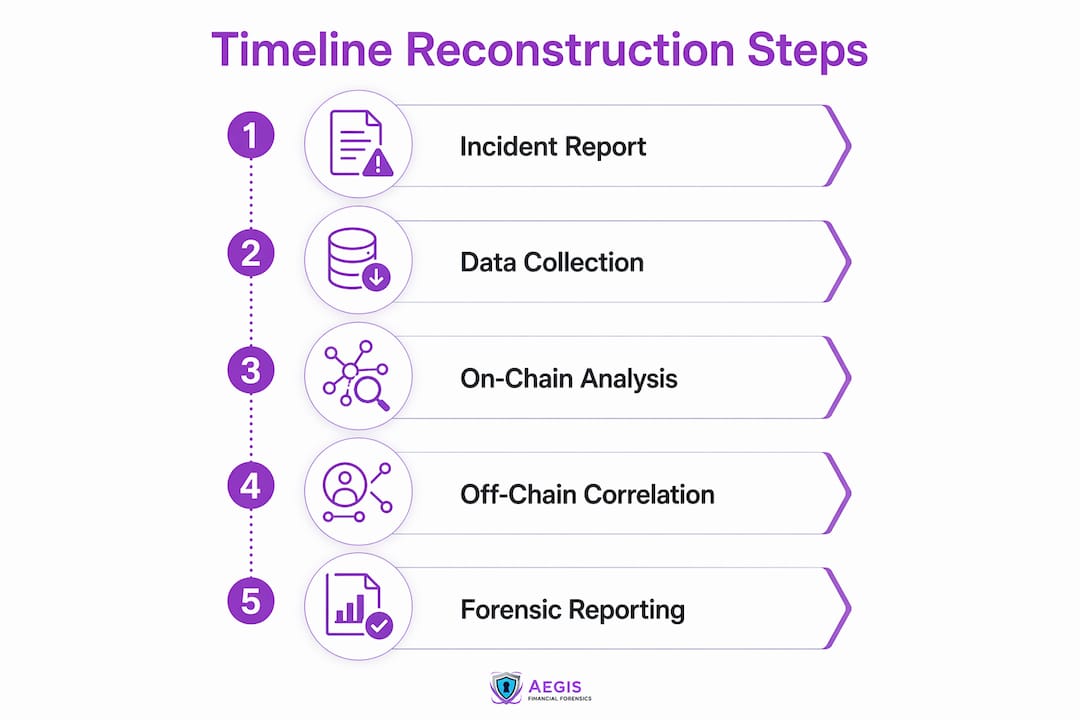
Building a coherent forensic timeline from disparate data points follows a structured analytical sequence. Each step builds on the last, moving from raw evidence to a defensible narrative.
-
Entity mapping. Investigators label all wallet addresses involved, attributing them to known entities such as exchanges, mixers, bridges, or attacker-controlled wallets. This step establishes who controlled what at each point in time.
-
Transaction flow tracing. Funds are traced through decentralized exchanges, cross-chain bridges, and custodial platforms. Investigators follow the money across every hop, including chain-hop transaction flows that fragment stolen assets across multiple networks.
-
Laundering typology identification. Investigators classify the methods used to obscure the trail. Common typologies include peel chains, where funds are split into progressively smaller amounts across many wallets, and cross-chain swaps, where assets are converted across blockchains to break traceability. Complete timeline reconstruction entails mapping these laundering typologies to decode attacker behavior beyond linear transaction flows.
-
Smart contract call decoding. For protocol exploits, investigators decode the specific contract calls that triggered the vulnerability. This step identifies whether the attack exploited a reentrancy flaw, a price oracle manipulation, or an access control failure.
-
Governance audit. Investigators review multisig approval records, key management changes, and policy exceptions to determine whether the attack required insider access or exploited a governance gap.
-
Narrative synthesis. All findings are assembled into a structured report that explains the attack vector, the sequence of events, the funds flow, and the control failures. This report serves as the technical foundation for legal filings, regulatory submissions, and insurance claims.
Pro Tip: When tracing funds through mixers or bridges, map the entry and exit points separately before attempting to link them. Trying to trace through a mixer in a single pass produces errors. Establish what went in and what came out, then build the connection from both ends.
Ransomware laundering shifted from mixers to cross-chain bridges by 2025, with enforcement shutdowns of mixing services lowering mixer volume while bridge use doubled. That shift means forensic teams must now maintain active coverage of bridge protocols to avoid losing the trail at a critical junction.
What challenges and limitations affect crypto crime timeline reconstructions?
Blockchain permanence does not guarantee recovery. The record of what happened on-chain is immutable, but converting that record into a successful asset recovery requires several conditions that are not always present.
The core challenges investigators face include:
- Exchange cooperation. Recovery success depends heavily on stolen funds reaching regulated exchanges willing and legally able to freeze assets promptly. If funds move entirely through decentralized protocols and never touch a regulated platform, legal freezing mechanisms have no point of application.
- Timing sensitivity. Sophisticated attackers move funds within minutes of an exploit. Delays in reporting, evidence collection, or exchange notification can allow complete laundering before any freeze request reaches the relevant platform.
- Cross-chain complexity. Large-scale attacks by sophisticated actors often involve complex laundering chains and multi-step cashouts requiring detailed timeline reconstructions to understand attacker methods. North Korean groups were responsible for 76% of stolen value from just two 2026 attacks, using rapid fragmentation and cross-chain swaps to obscure their trails.
- Privacy tool interference. Zero-knowledge protocols and privacy coins introduce analytical gaps that require probabilistic attribution rather than definitive tracing.
- Incomplete off-chain data. Missing device logs, deleted communications, or uncooperative third-party platforms leave gaps in the governance and human action dimensions of the reconstruction.
- Evolving illicit finance ecosystems. Cryptocurrency enables rapid financial layering in organized crime, integrating decentralized and regulated systems to facilitate laundering at global scale. Forensic methods must adapt continuously to keep pace.
Investigators who set accurate expectations with clients from the outset produce better outcomes. Forensic tracing is a necessary condition for recovery, not a sufficient one.
How is timeline reconstruction applied in real-world scenarios?
The practical application of a crypto fraud timeline spans several phases, from immediate incident response through to long-term governance improvement. The table below illustrates how reconstruction outputs map to specific recovery and enforcement actions.
| Phase | Reconstruction output | Practical application |
|---|---|---|
| Incident documentation | Wallet addresses, transaction hashes, device logs | Establishes the evidentiary foundation for all subsequent steps |
| Forensic tracing | Annotated transaction flow across all hops | Identifies where funds currently sit and which platforms hold them |
| Exchange notification | Targeted freeze requests with forensic evidence | Enables regulated platforms to freeze assets before further movement |
| Legal filing | Structured forensic report with chain of custody | Supports court orders, regulatory submissions, and insurance claims |
| Remediation planning | Governance audit findings | Identifies control failures and informs security improvements |
Incident response involves documentation collection, forensic tracing, urgent exchange notifications, legal filings for freezes, seizure, and restitution processing. Each phase depends on the quality of the preceding one, which is why early documentation is so operationally significant.
Consider a protocol exploit scenario. An attacker manipulates a price oracle to drain a liquidity pool. The forensic team maps the victim contract, decodes the malicious call sequence, and traces the extracted funds through three decentralized exchanges before they reach a centralized platform. The team submits a freeze request with a full chain of custody report to the receiving exchange within four hours of the exploit. The exchange freezes the funds pending legal process. Without the forensic timeline, the exchange has no basis to act.
Timeline reports also serve regulators and insurers. A regulator reviewing a custodial failure needs to understand whether the breach resulted from a technical exploit or a governance failure. An insurer assessing a claim needs a structured account of the loss event. Both require the same forensic narrative that investigators produce for law enforcement. The reconstruction serves multiple audiences from a single analytical effort.
Key Takeaways
A crypto crime timeline reconstruction is the foundational forensic process that converts raw blockchain and system data into a defensible narrative capable of supporting asset recovery, legal action, and governance improvement.
| Point | Details |
|---|---|
| Three-dimension coverage | Effective reconstructions integrate on-chain, off-chain, and governance data, not just transaction records. |
| Speed determines recovery | Recovery windows can close within minutes; early documentation and rapid exchange notification are decisive. |
| Narrative over transaction list | The output must explain attack vectors and control failures, not simply list wallet movements. |
| Legal cooperation is required | Forensic tracing alone cannot freeze assets; regulated exchange cooperation and legal authority are necessary. |
| Laundering methods evolve | Cross-chain bridges have replaced mixers as the primary obfuscation tool, requiring continuous forensic adaptation. |
The misconception that costs victims the most
The single most damaging misconception I encounter is the belief that blockchain’s immutability guarantees recovery. Clients arrive expecting that because every transaction is recorded permanently, getting their funds back is a matter of reading the ledger. That is not how it works.
The blockchain tells you where the money went. It does not give you the legal authority to stop it, freeze it, or compel anyone to return it. Those outcomes require speed, regulated exchange cooperation, and legal process. A forensic reconstruction is the technical instrument that makes those steps possible. Without it, you cannot file a credible freeze request or present a coherent case to law enforcement. But the reconstruction itself is not the recovery.
What I have seen work consistently is the combination of immediate documentation, rapid forensic tracing, and proactive exchange notification within the first few hours of an incident. Organizations that have practiced their incident response procedures, even once, perform dramatically better in real events. The reconstruction process should not be something you encounter for the first time after an attack. Understanding how to trace stolen crypto before an incident occurs changes the outcome when one does.
The other pattern worth noting is that sophisticated attackers, particularly state-sponsored groups, design their laundering chains specifically to exhaust investigator resources. Rapid fragmentation across dozens of wallets, immediate cross-chain swaps, and layering through multiple decentralized protocols are deliberate tactics. Forensic teams that approach these cases with a linear tracing methodology will lose the trail. The three-dimension framework, covering on-chain flows, off-chain context, and governance records simultaneously, is the only approach that holds up against that level of operational sophistication.
— Escareno
Aegisfinancialforensics and crypto crime forensic reconstruction
Aegisfinancialforensics conducts full-scope forensic timeline reconstructions for individuals and businesses affected by crypto scams, protocol exploits, and custodial failures. The firm’s methodology covers all three reconstruction dimensions: on-chain transaction analysis, off-chain system evidence, and governance audit, producing reports that meet evidentiary standards for law enforcement, regulators, and insurers.

With over 1,500 clients served and more than $34 billion in illicit funds traced, seized, or recovered, Aegisfinancialforensics brings both technical depth and legal coordination experience to every case. If you have experienced a crypto theft or fraud incident, the clock starts at the moment of the attack. Contact Aegisfinancialforensics through the crypto fund recovery investigation page to begin a forensic assessment without delay.
FAQ
What is a crypto crime timeline reconstruction?
A crypto crime timeline reconstruction is a forensic process that integrates on-chain transactions, off-chain system data, and governance records to produce a technical narrative explaining how and when a digital asset crime occurred. Its output supports asset recovery, legal filings, and regulatory submissions.
How long does a forensic reconstruction take?
The initial triage and exchange notification phase must begin within hours of an incident to preserve recovery options. Full reconstruction reports, covering all three data dimensions and laundering typology analysis, typically require days to weeks depending on case complexity.
Does blockchain tracing guarantee I will recover my funds?
Blockchain tracing is necessary but not sufficient for recovery. Asset recovery depends on stolen funds reaching regulated exchanges willing and legally able to freeze them. Forensic evidence is the instrument that enables legal action, not a direct recovery mechanism.
What laundering methods do attackers use to hide stolen crypto?
Common methods include peel chains, cross-chain swaps, and rapid fragmentation across multiple wallets. By 2025, cross-chain bridges had replaced mixers as the primary obfuscation tool, requiring forensic teams to maintain active coverage of bridge protocols.
What evidence should I collect immediately after a crypto theft?
Collect all wallet addresses involved, transaction hashes, device access logs, screenshots, and any communications related to the incident. Providing this documentation to forensic investigators early is the single most important factor in preserving the recovery window.