

Chain of Custody for Crypto Evidence: A 2026 Guide
Chain of custody for crypto evidence is defined as a fully documented, chronological record of every individual who handled or accessed digital evidence from the moment of collection through its presentation in court. This standard applies directly to cryptocurrency investigations, where blockchain data, wallet records, and exchange documents must meet the same evidentiary thresholds as physical evidence. Failure to document even a single transfer point risks evidence exclusion under Federal Rule of Evidence 901. Tools like TrueScreen, TRM Labs, and Chainalysis have built their forensic workflows around this requirement. Understanding the chain of custody process in cryptocurrency is not optional for investigators, compliance teams, or legal professionals. It is the foundation on which every prosecution, civil recovery, or regulatory action rests.
What is chain of custody for crypto evidence, legally speaking?
Chain of custody for crypto evidence is governed by a layered set of legal and forensic standards that courts apply when determining whether digital evidence is admissible. The two most relevant frameworks are ISO/IEC 27037, the international standard for digital evidence identification and preservation, and Federal Rule of Evidence 901, which requires that evidence be authenticated before it can be admitted. Together, these frameworks define what investigators must document, how they must store evidence, and what records they must produce for court.
The Daubert standard adds another layer of scrutiny. Under Daubert, expert witnesses must disclose detailed methodology, tool versions, and analysis procedures to demonstrate reproducibility and scientific validity. TRM Labs identifies this transparency as a core evidentiary requirement. A forensic analyst who cannot reproduce their findings using the same tools and methods will face serious challenges to their testimony.
Documentation requirements under these standards are specific. Every transfer, every access event, and every copy of the evidence must be recorded. Chain of custody documentation includes agency involvement, case numbers, evidence descriptions, collector identities, transfer dates, and custody signatures. These records form the basis for proving authenticity and continuous control.
- Every access event must be logged with a timestamp and the identity of the person accessing the evidence.
- Copies of digital evidence must be treated as separate items requiring their own documentation.
- Tool names and software versions used during extraction must appear in the case record.
- Any transfer between parties requires a signed custody receipt.
Pro Tip: Document your methodology in real time, not after the fact. Reconstructed logs are far more vulnerable to challenge under the Daubert standard than contemporaneous records.
How is chain of custody maintained for blockchain and crypto investigations?
Blockchain evidence presents a unique set of challenges that traditional digital forensics does not fully address. The public ledger is immutable, but the process of extracting, interpreting, and presenting that data is not. Blockchain’s immutability does not replace the need for a documented extraction process. Chainalysis experts confirm that data extraction, clustering, and interpretation are all vulnerable stages that require chain of custody safeguards.
The distinction between on-chain and off-chain evidence is critical. On-chain data includes transaction records, block numbers, timestamps, and wallet addresses. Off-chain materials include exchange records, wallet application data, IP logs, and financial institution documents. Evidence custody must extend beyond blockchain data to these off-chain materials, each requiring its own documentation trail. TRM Labs identifies off-chain data handling as a critical component of the full custody framework.
| Evidence Type | Source | Key Custody Requirement |
|---|---|---|
| On-chain transactions | Public blockchain ledger | Cryptographic hash at collection, block number, timestamp |
| Wallet data | Device or software wallet | Forensic image with hash verification |
| Exchange records | Centralized exchange | Subpoena documentation, transfer log, access record |
| IP and login logs | Internet service provider | Chain of custody receipt from provider, timestamped |
| Financial institution records | Bank or payment processor | Formal request documentation, custodian signature |
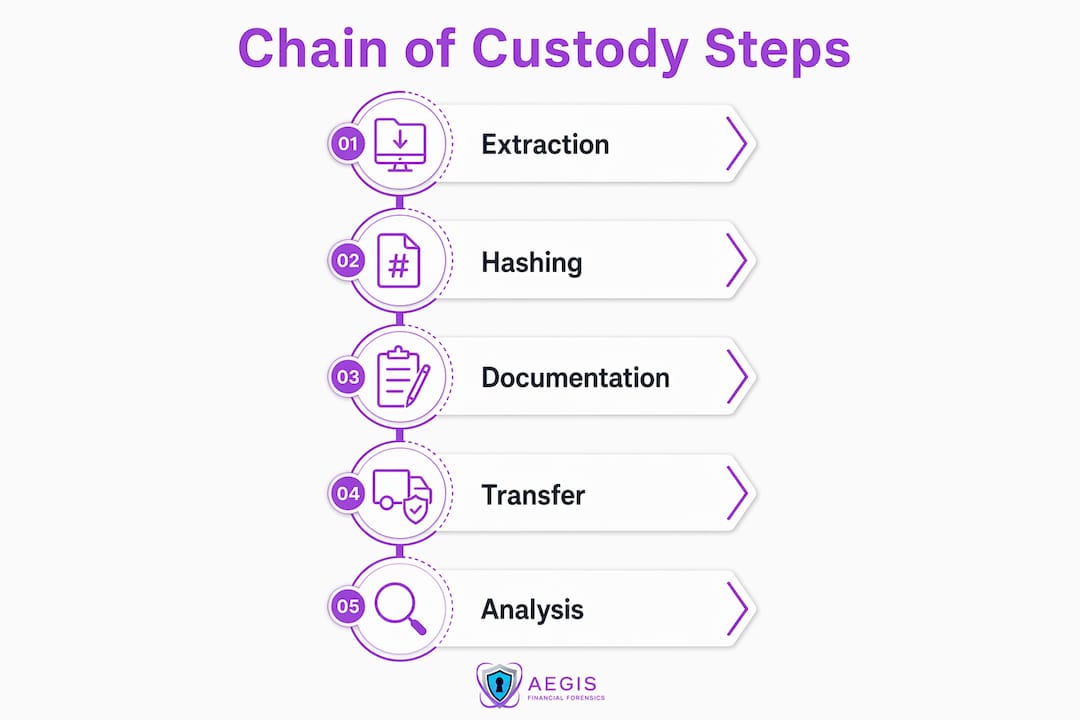
Maintaining custody of on-chain data follows a defined sequence:
- Capture the full transaction context at collection, including block number, timestamp, and all involved addresses.
- Generate a cryptographic hash of the extracted data immediately after collection.
- Record the tool name, version, and configuration used for extraction.
- Store the evidence in a controlled environment with audited access logs.
- Document every subsequent access, copy, or transfer with a signed record.
- Prepare a methodology report that a second analyst could use to reproduce the findings.
Blockchain forensics involves address clustering, transaction graph analysis, and cross-chain tracing to link pseudonymous activity to real identities. Each of these analytical steps must itself be documented as part of the custody record.
Pro Tip: Hash your evidence immediately after extraction and again before any analysis begins. A mismatch between the two hashes signals unauthorized access or data corruption and must be reported.

What are common pitfalls in preserving crypto evidence custody?
The most damaging mistakes in crypto evidence management are not technical failures. They are documentation failures. Chain of custody serves as the documentary spine of evidence packages, and minor gaps or missing links can lead to inadmissibility or credibility challenges in court. Keiser University’s forensic research confirms that an unbroken chain is decisive for prosecutorial success and equally decisive for defense challenges.
Digital evidence can be altered or duplicated without visible traces. Any undocumented access or mismatched hash compromises admissibility. This is the core risk that distinguishes digital evidence from physical evidence. A broken seal on a physical exhibit is visible. A missing log entry on a digital file is invisible until opposing counsel finds it.
Common pitfalls investigators and compliance teams encounter include:
- Missing transfer documentation. Any handoff between analysts, agencies, or jurisdictions without a signed receipt creates a gap that opposing counsel will exploit.
- Failure to hash evidence at collection. Without a baseline hash, there is no way to prove the evidence was not modified after collection.
- Insecure storage environments. Evidence stored without access controls or audit logs cannot be proven to have remained untampered.
- Misunderstanding blockchain immutability. The ledger itself cannot be altered, but extracted data files, reports, and analytical outputs can be. Investigators who conflate the two create serious evidentiary vulnerabilities.
- Inadequate cross-chain documentation. When tracing assets across multiple blockchains or through mixing services, each analytical step must be documented separately. Gaps in cross-chain tracing records are among the most common grounds for challenging forensic testimony.
The consequences of these failures extend beyond a single case. Inadmissible evidence in a criminal prosecution can result in acquittal. In civil recovery proceedings, it can mean the difference between recovering stolen assets and losing the claim entirely.
What best practices should investigators follow to preserve crypto evidence?
The best practices for crypto custody begin at the moment of collection and do not end until the case is closed. Maintaining chain of custody for on-chain data requires cryptographic hashing, full transaction context capture, and secure storage in controlled environments with audited logs. TrueScreen provides forensic certification dashboards that adhere to ISO/IEC 27037 for authenticating crypto evidence, offering investigators a structured platform for meeting these requirements.
The following workflow reflects current forensic standards for crypto evidence management:
- Identify and document the evidence source. Record the blockchain network, the specific addresses or transactions in scope, and the date and time of collection.
- Use certified tools. TrueScreen, TRM Labs, and Chainalysis each provide documented, court-tested methodologies. Record the tool name and version in the case file.
- Generate and record cryptographic hashes. Apply SHA-256 or equivalent hashing immediately after extraction. Store the hash value in the custody log.
- Secure the evidence. Use access-controlled storage with full audit trails. Cryptographic sealing, Faraday bags, and audit logs prevent data erasure and unauthorized access in digital forensics.
- Log every access and transfer. Every analyst who touches the evidence must sign in and out. Every transfer to another party requires a custody receipt.
- Prepare court-ready documentation. The final evidence package must include the methodology report, tool documentation, hash verification records, and all custody signatures.
Investigators working on behalf of law enforcement agencies face additional requirements around inter-agency transfers and jurisdictional handoffs. Each of these events requires its own documentation layer.
Pro Tip: Prepare a methodology report before analysis begins, not after. Courts are far more skeptical of documentation that appears to have been written to fit the conclusions.
Key Takeaways
Chain of custody for crypto evidence requires an unbroken, documented record of every handling event, from extraction through court presentation, governed by ISO/IEC 27037 and Federal Rule of Evidence 901.
| Point | Details |
|---|---|
| Legal standards are binding | ISO/IEC 27037 and Federal Rule of Evidence 901 define minimum documentation requirements for admissibility. |
| Blockchain immutability is not enough | The ledger cannot be altered, but extracted data and analytical outputs require their own custody documentation. |
| Hash evidence immediately | Generate a cryptographic hash at collection and again before analysis to prove the data was not modified. |
| Off-chain materials require equal rigor | Exchange records, wallet data, and IP logs each need their own documented custody trail. |
| Documentation gaps are fatal | A single missing transfer record or unsigned custody receipt can render evidence inadmissible. |
The misconception that costs investigators the most
The most persistent misconception I encounter in crypto investigations is the belief that blockchain immutability substitutes for chain of custody documentation. Investigators assume that because the ledger cannot be altered, the evidence is automatically trustworthy. Courts do not share that assumption. What courts evaluate is not the ledger itself but the process by which the data was extracted, analyzed, and presented. Every step in that process is subject to challenge.
The second misconception is that chain of custody is a paperwork formality. It is not. It is the mechanism by which a court determines whether evidence is what the presenting party claims it to be. When Chainalysis or TRM Labs produces a transaction graph, that graph is only as credible as the custody record behind it. Reproducibility is the standard. If a second analyst cannot replicate the findings using the same tools and the same methodology, the testimony is vulnerable.
The practical implication is that forensic investigators must treat documentation as a core analytical task, not an administrative afterthought. Courts are applying greater scrutiny to blockchain evidence with each passing year. The professionals who stay ahead of that scrutiny are the ones who build their custody records with the same care they apply to the analysis itself.
— Escareno
How Aegisfinancialforensics supports crypto forensic investigations
Aegisfinancialforensics brings institutional-grade blockchain forensics to individuals, compliance teams, and legal professionals who need court-ready evidence packages. The firm’s five-step recovery process integrates cryptographic evidence preservation, full custody documentation, and expert testimony preparation from the first moment of engagement.

Aegisfinancialforensics has assisted with over $34 billion in illicit funds seized or recovered, working alongside major regulators and institutions across more than 1,500 cases. The team applies cryptocurrency tracing software standards that meet Daubert and ISO/IEC 27037 requirements, producing evidentiary exports that hold up under cross-examination. For professionals who need blockchain forensics and asset tracing with a documented chain of custody, Aegisfinancialforensics provides the expertise and the methodology to support every stage of a case.
FAQ
What is chain of custody for crypto evidence?
Chain of custody for crypto evidence is a chronological, documented record of every person who handled or accessed digital evidence from collection through court presentation. It is required under Federal Rule of Evidence 901 and ISO/IEC 27037 to prove that evidence remains authentic and untampered.
Does blockchain immutability satisfy chain of custody requirements?
No. Blockchain immutability applies to the ledger itself, not to extracted data, analytical reports, or off-chain materials. Courts require documented extraction and handling procedures regardless of the underlying technology.
What happens if chain of custody is broken?
A gap in the custody record can result in evidence being ruled inadmissible. Even a single missing transfer log or unsigned custody receipt gives opposing counsel grounds to challenge the authenticity of the entire evidence package.
What tools are used to maintain chain of custody for crypto evidence?
TrueScreen, TRM Labs, and Chainalysis are among the primary tools used in blockchain forensic investigations. Each provides documented methodologies and evidentiary exports designed to meet court admissibility standards.
What is the Daubert standard and how does it apply to crypto evidence?
The Daubert standard requires expert witnesses to demonstrate that their methods are scientifically valid and reproducible. In crypto investigations, this means disclosing tool names, software versions, and analysis procedures so that a second analyst could replicate the findings.






6 Comments