

Chain-Hop Transaction Investigation Workflow Guide
A chain-hop transaction investigation workflow is a systematic process designed to trace rapid asset swaps across multiple blockchains to detect and analyze potential illicit activity. Chain hopping, the recognized industry term for this laundering technique, involves moving funds through two or more blockchain networks in quick succession to obscure the origin and destination of assets. Investigators at Aegisfinancialforensics apply this workflow across cases involving decentralized finance audits, cross-chain bridge abuse, and multi-chain fraud. The complexity of these cases demands structured methodology, purpose-built tools, and disciplined evidence handling from the first alert to the final evidentiary export.
What does a chain-hop transaction investigation workflow require?
A structured chain-hop transaction investigation workflow begins with the right tooling and organizational readiness. Without both, even experienced analysts lose the thread when funds cross three or more chains within minutes.
Multi-chain wallet trackers form the technical foundation of any credible investigation architecture. The Mimo Wallet Tracker, for example, scans 15 blockchains simultaneously using Blockscout V2 API endpoints, performing parallel chain scanning, pattern detection, and risk scoring entirely in-browser without backend dependency. That browser-based design matters operationally because it removes server-side latency and reduces data exposure during active investigations.

Unified dashboards that aggregate cross-chain data into a single interface are equally critical. Investigators need risk scores, address labels, and transaction graphs visible in one view, not scattered across five separate block explorers. Tools that integrate APIs such as Blockscout V2 allow teams to correlate activity across Ethereum, BNB Chain, Polygon, Arbitrum, and other networks without manual data reconciliation.
Organizational readiness is the non-technical prerequisite that most teams underestimate. Personnel must hold blockchain analytics expertise, understand bridge mechanics, and know how to operate incident response protocols before a live case begins. The table below summarizes key tool categories and their primary functions.
| Tool Category | Example | Primary Function |
|---|---|---|
| Multi-chain wallet tracker | Mimo Wallet Tracker | Parallel scanning across 15+ blockchains with risk scoring |
| Graph analysis platform | Nova Sentinel | Network graph tracing up to five hops from flagged addresses |
| Forensics playbook framework | CZB Chain Forensics Playbooks | Evidence organization, methodology documentation |
| API data layer | Blockscout V2 API | On-chain data retrieval across EVM-compatible networks |
| SIEM correlation layer | Organization-specific | Off-chain log aggregation and alert correlation |
Key capabilities investigators should confirm before opening a case include:
- Address labeling and entity attribution across target chains
- Bridge transaction identification and hop-count tracking
- Privacy coin detection for assets like Monero, Zcash, or Dash
- Evidentiary export formats accepted by legal and compliance teams
- Audit log generation for all investigative actions taken
How to execute a cross-chain transaction tracing investigation
The execution phase of a cryptocurrency investigation process follows a defined sequence. Skipping steps or reordering them produces gaps in the evidentiary chain that undermine downstream legal or regulatory use.
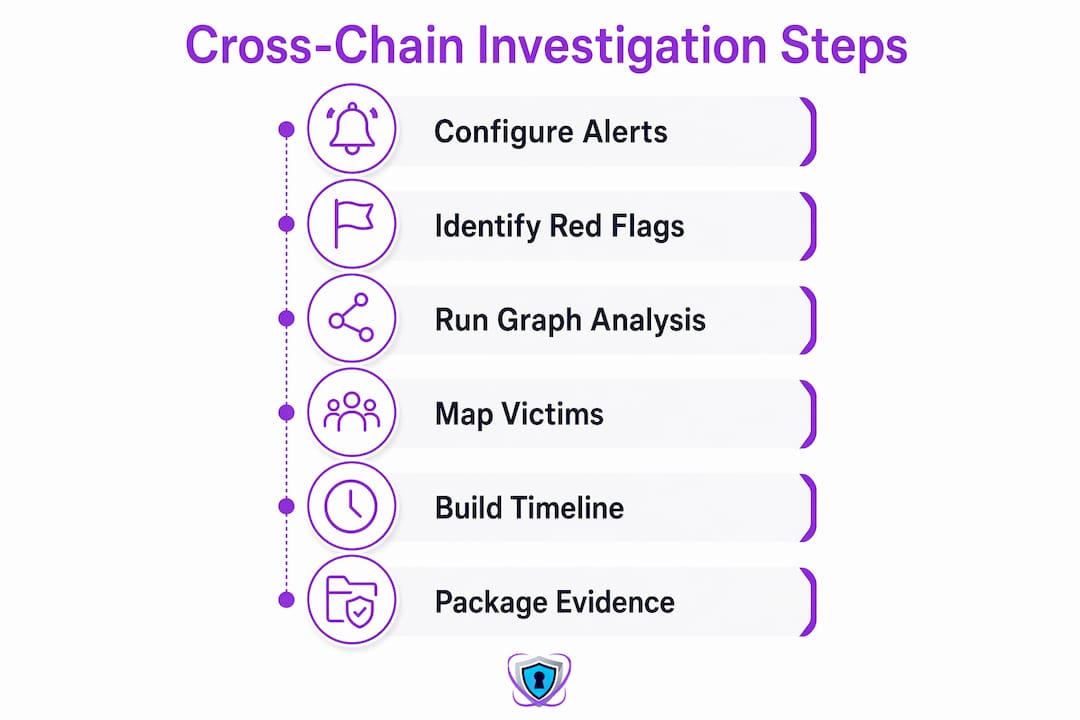
Step 1: Configure velocity checks and threshold alerts. Velocity checks and graph rules should follow fund paths up to 2–3 bridge hops from flagged clusters, since sophisticated laundering typically places one or two bridging transactions between the source and destination. Set rolling 7-day window alerts for wallets executing multiple cross-chain bridge transactions within short intervals.
Step 2: Identify red flags in the transaction pattern. Rapid cross-chain bridge transactions within minutes and the use of privacy coins at any point in the chain-hopping sequence indicate suspicious activity warranting enhanced scrutiny. Lack of market rationale in conversions, such as swapping a stablecoin to Monero with no prior trading history, is a documented red flag.
Step 3: Run network graph analysis. Tools like Nova Sentinel trace funds up to five hops from flagged addresses across chains, generating evidence packages and automated SAR drafting. Graph analysis reveals fan-out structures where a single source wallet distributes funds to dozens of intermediate addresses before consolidation.
Step 4: Map victim addresses and outbound fund flows. Incident investigation outputs should map victim addresses labeled by ownership, tracking outbound funds through decentralized exchanges, bridges, mixers, and centralized exchange deposits. This step produces the transaction map that anchors the evidentiary narrative.
Step 5: Construct a unified timeline. A comprehensive post-incident audit involves creating a single coherent timeline combining on-chain activity, off-chain systems data, and governance actions to support a technical narrative. The timeline must be reproducible, meaning another analyst following the same methodology should reach the same conclusions.
Step 6: Package and label evidence. Separate confirmed facts from analyst labels and working hypotheses at every stage. This discipline prevents misidentification of intermediate hops as primary actors, a common error in complex chain-hop cases.
Pro Tip: Never treat a bridge contract address as a suspect address. Bridge contracts are infrastructure, not actors. Label them as such in your evidence package to avoid contaminating attribution conclusions.
What are the common pitfalls in blockchain transaction analysis?
Multi-chain transaction tracking fails most often not because of tool limitations but because of analytical errors in how investigators interpret intermediate hops. Three categories of problems account for the majority of investigation failures.
Obfuscated intermediate hops occur when launderers insert one or two additional bridge transactions between the source wallet and the destination. These hops have no economic purpose. They exist solely to break automated tracing rules that follow direct fund paths. Investigators must extend graph analysis beyond the first hop and apply the 2–3 hop rule as a baseline, not a ceiling.
Privacy coin conversions represent the most technically challenging obstacle. When funds enter Monero or Zcash at any point in the chain, the on-chain trail becomes opaque. CZB Chain Forensics Playbooks emphasize operational clarity and explicit methodology precisely because investigators must document what they cannot see, not just what they can. The absence of a traceable path is itself evidentiary.
Rapid multi-chain swaps compress the investigation window. When a wallet executes five bridge transactions across four chains within 30 minutes, manual analysis cannot keep pace. Parallel batch scanning with abort timeout mechanisms prevents scanning delays and maintains data completeness during high-velocity events.
Additional pitfalls investigators should guard against:
- Treating exchange deposit addresses as final destinations without confirming withdrawal activity
- Conflating address clusters from heuristic analysis with confirmed entity attribution
- Failing to document the confidence level assigned to each analytical conclusion
- Overlooking governance transaction logs that may reveal insider involvement
Pro Tip: Assign a confidence tier (confirmed, probable, possible) to every address label before finalizing the evidence package. This practice, drawn from CZB Chain Forensics Playbooks, reduces false positives and makes the investigation defensible under cross-examination.
How do organizations integrate chain-hop workflows into audit and security processes?
A chain-hop investigation does not end when the transaction map is complete. The findings must feed back into organizational security controls, compliance reporting, and incident response frameworks to prevent recurrence.
Post-incident audit timelines require combining on-chain activity with off-chain system logs and human governance actions. Best practice frameworks align transaction tracing with organizational controls and governance events, producing evidence-backed narratives that satisfy both technical and regulatory audiences. The timeline must account for when signing infrastructure was accessed, when IAM permissions changed, and when API gateway anomalies occurred alongside the on-chain fund movements.
On-chain monitoring should include alerts for anomalous transfers, new contract approvals, and governance changes. Audit playbooks recommend monitoring across IAM systems, endpoints, signing services, and API gateways for comprehensive security coverage. SIEM correlation ties these signals together, allowing security teams to see the full attack surface rather than isolated blockchain events.
Collaboration with law enforcement and crypto recovery specialists accelerates asset recovery and strengthens evidentiary packaging for prosecution. Aegisfinancialforensics has assisted with over $34 billion in illicit funds seized or recovered, working alongside regulators and institutions that require court-ready documentation. Investigators should establish these relationships before an incident, not during one.
The table below maps workflow integration points across organizational domains.
| Organizational Domain | Integration Point | Output |
|---|---|---|
| Incident Response | Alert triage and initial fund tracing | Preliminary transaction map |
| Compliance | SAR filing and regulatory reporting | Evidence-backed narrative |
| Security Operations | SIEM correlation and IAM log review | Attack surface timeline |
| Legal | Evidence packaging and chain of custody | Court-ready documentation |
| Executive Governance | Post-incident review and control updates | Policy and procedure amendments |
Continuous alert tuning based on investigation outcomes closes the feedback loop. Each completed case reveals new laundering patterns, bridge contracts, and wallet clusters that should be added to detection rules. Organizations that treat investigation outputs as operational intelligence improve detection rates over successive cases.
Key takeaways
A structured chain-hop transaction investigation workflow, supported by multi-chain analytics tools and disciplined evidence handling, is the most reliable method for tracing illicit cross-chain fund movements.
| Point | Details |
|---|---|
| Start with velocity checks | Apply rolling 7-day window alerts on cross-chain bridge transactions to catch rapid multi-chain swaps early. |
| Use graph analysis tools | Tools like Nova Sentinel trace funds up to five hops cross-chain, generating evidence packages automatically. |
| Separate facts from hypotheses | Label every address with a confidence tier to prevent false attribution of intermediate hops. |
| Integrate into organizational audit | Combine on-chain tracing with IAM logs and SIEM data to build a complete post-incident timeline. |
| Engage specialists early | Partnering with crypto recovery experts before an incident accelerates evidence packaging and asset recovery. |
The investigative discipline that separates good cases from failed ones
The biggest gap I see in chain-hop investigations is not tool coverage. It is analytical discipline at the evidence packaging stage. Teams invest in graph platforms and multi-chain scanners, then undermine the entire case by conflating inferred conclusions with confirmed facts in their final reports.
The CZB Chain Forensics Playbooks make this point explicitly: observed data and inferred conclusions must be separated at every stage. That discipline is not bureaucratic formality. It is the difference between an investigation that holds up in court and one that collapses under cross-examination when a defense attorney points out that an intermediate bridge contract was labeled as a suspect wallet.
Tool interoperability is the second area where I see consistent failure. Investigators running Blockscout V2 data through one platform and graph analysis through another, with no automated data handoff, lose hours reconciling outputs manually. The tracing software requirements that matter most are not the ones on the marketing page. They are the ones that determine whether your evidence package is internally consistent.
The laundering tactics evolve faster than most compliance teams update their detection rules. Privacy coin on-ramps shift. New bridge contracts appear. Peel chains get longer. The only sustainable response is a feedback loop where every completed investigation updates the detection ruleset for the next one. Teams that treat each case as isolated will always be one tactic behind.
— Escareno
Professional support for complex crypto investigations
Aegisfinancialforensics brings forensic depth to cases where standard blockchain analytics tools reach their limits.

When funds move across a dozen chains through bridges, mixers, and privacy coin conversions, the investigation requires more than software. It requires experienced analysts who have traced these patterns across thousands of cases. Aegisfinancialforensics has supported over 1,500 clients, including major regulators and institutions, recovering and seizing over $34 billion in illicit funds. For organizations building or refining their crypto recovery and forensics capabilities, Aegisfinancialforensics provides multi-chain transaction tracing, fraud detection workflow design, and court-ready evidentiary documentation. Teams can also review fraud awareness resources to stay current on emerging chain-hopping tactics and scam patterns.
FAQ
What is a chain-hop transaction investigation workflow?
A chain-hop transaction investigation workflow is a structured, multi-stage process for tracing funds moved rapidly across multiple blockchains to detect illicit activity. It covers detection, graph analysis, evidence packaging, and timeline construction.
How many hops should investigators trace in a chain-hop case?
FluxForce recommends tracing fund paths up to 2–3 bridge hops from flagged clusters as a baseline, since sophisticated laundering typically inserts one or two bridging transactions between source and destination.
What tools support multi-chain transaction tracking?
Mimo Wallet Tracker scans 15 blockchains simultaneously using Blockscout V2 API endpoints, while Nova Sentinel performs network graph analysis tracing funds up to five hops cross-chain with automated evidence package generation.
How should investigators handle privacy coin conversions in chain-hop cases?
When funds enter a privacy coin like Monero or Zcash, the on-chain trail becomes opaque. Investigators should document the point of entry, note the absence of a traceable path as evidentiary, and apply the confidence tiering system recommended by CZB Chain Forensics Playbooks.
How does a chain-hop investigation integrate with organizational compliance processes?
Investigation outputs feed directly into SAR filing, SIEM correlation, IAM log review, and post-incident governance reviews. Best practice frameworks align on-chain transaction tracing with organizational controls to produce evidence-backed narratives for regulatory and legal audiences.






3 Comments