

How Law Enforcement Obtains Crypto Exchange Records: 2026 Guide
How law enforcement obtains crypto exchange records and traces transactions to real identities
Law enforcement obtains cryptocurrency exchange records primarily through grand jury subpoenas, John Doe summonses, and production orders, all of which courts have consistently upheld under the third-party doctrine. The core legal position, confirmed by both the Fifth and First Circuits, is that crypto exchange records are functionally analogous to bank records and carry no reasonable expectation of privacy. That ruling removes the warrant requirement and gives investigators a direct, legally defensible path to KYC data, transaction logs, IP addresses, and linked bank account details.
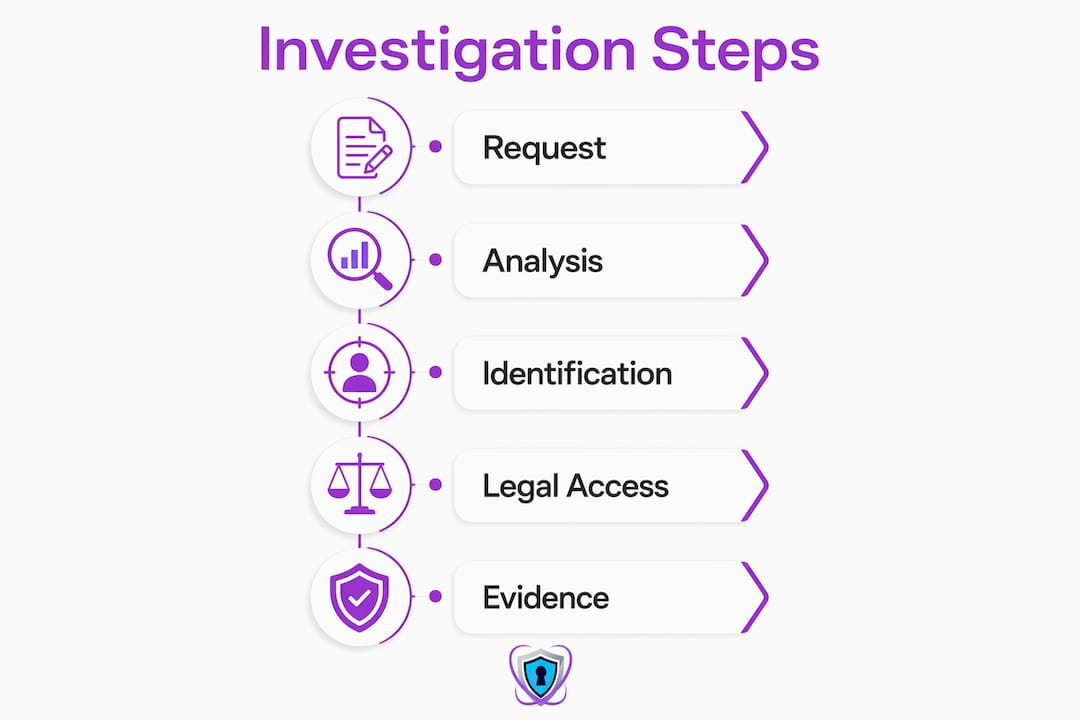
The process follows a clear operational sequence:
- Trace on-chain first. Public blockchain data requires no legal process. Investigators map fund flows from a crime address forward through intermediate hops until they reach a deposit address at a known exchange.
- Identify the exchange. Blockchain analytics platforms maintain entity databases that flag deposit addresses belonging to regulated exchanges, enabling investigators to name the target institution before issuing any legal request.
- Issue the legal instrument. A grand jury subpoena, IRS John Doe summons, or Electronic Communications Privacy Act (ECPA) production order compels the exchange to produce KYC records, account transaction history, and login logs.
- Convert pseudonymous addresses to named individuals. The exchange’s KYC database links the deposit address to a government-issued identity document, proof of address, and bank account details.
- Preserve and authenticate evidence. Chain of custody procedures, certified analytics exports, and Federal Rule of Evidence 803(6) business record treatment govern admissibility.
Courts have upheld the third-party doctrine consistently across multiple circuits, rejecting Fourth Amendment challenges on the grounds that users voluntarily share their data with exchanges. The Bank Secrecy Act (BSA) reinforces this by requiring regulated Virtual Asset Service Providers (VASPs) to maintain KYC records and file Suspicious Activity Reports (SARs), creating a compliance infrastructure that law enforcement can access through standard legal process. Challenges remain where suspects use self-custody wallets, decentralized exchanges, or privacy coins, but for the majority of investigations involving regulated platforms, the legal framework is settled and operationally effective.
What investigators need to understand about how Bitcoin and crypto transactions actually work
1. Every transaction is permanently recorded on a public ledger
Bitcoin and most major cryptocurrencies write every transaction to a public blockchain that anyone can query without restriction. Each record contains the sending address, the receiving address, the amount transferred, and a timestamp anchored to a specific block. Nothing is deleted. Nothing is hidden from the ledger itself. The public nature of blockchain records is the investigator’s primary structural advantage over traditional financial systems, where bank records require a separate court order to each institution.
2. Addresses are pseudonymous, not anonymous
A blockchain address is a string of alphanumeric characters, not a name. Observers can see every transaction associated with that address, but the address itself carries no identity information. The pseudonymity breaks down at two points: when an address interacts with a regulated exchange that holds KYC data, and when address clustering reveals that multiple addresses are controlled by the same entity.

3. Address clustering connects wallets to a single actor
Address clustering, also called common-input ownership heuristics, identifies groups of addresses that have co-signed transactions, indicating shared control. When an investigator clusters a suspect’s addresses and one of those addresses deposits to a known exchange, the entire cluster becomes attributable to the same account holder. This technique is foundational to how law enforcement traces crypto wallets across complex transaction graphs.
4. Transaction graph analysis maps fund flows across hops
Illicit actors rarely send funds directly from a crime address to a cash-out point. They route funds through intermediate wallets, peel chains (a series of transactions that progressively reduce the balance to obscure the trail), and fan-out structures (splitting funds across many addresses simultaneously). Transaction graph analysis follows each hop, forward or backward, until the trail terminates at an identifiable entity such as an exchange, an over-the-counter (OTC) desk, or a Bitcoin ATM.
5. KYC at exchanges is the identity bridge
Regulated exchanges are legally required under AML laws to collect government-issued identity documents, proof of address, and bank account details before allowing deposits or withdrawals. When an investigator identifies a deposit address belonging to a regulated exchange, that single legal process request converts a pseudonymous address into a named individual with a physical address and a linked financial account.
6. Block confirmations and timestamps matter for evidence
Each block is timestamped and sequentially numbered. Investigators can establish precise timelines of fund movement, correlating blockchain timestamps with off-chain events such as a ransom payment, a fraud complaint, or a known exchange login. This temporal precision supports both the investigative narrative and the evidentiary record.
Which blockchain analytics tools and techniques do investigators use?
Blockchain analytics platforms are the operational layer between raw public ledger data and actionable investigative intelligence. They automate address clustering, entity attribution, and transaction graph visualization at a scale that manual analysis cannot match.
Chainalysis is the most widely deployed platform among U.S. federal agencies. It maintains a continuously updated entity database that maps deposit addresses to named exchanges, darknet markets, mixers, and other services. Its Reactor product visualizes transaction graphs and flags high-risk counterparties, while its KYT (Know Your Transaction) module supports real-time compliance monitoring. Chainalysis tools use clustering algorithms and mixer detection to trace funds even when suspects attempt obfuscation.
Merkle Science provides cross-chain tracing and risk scoring across a broad range of blockchain networks, including Ethereum, Binance Smart Chain, and several layer-2 protocols. Its Compass product is used by law enforcement and compliance teams to identify wallet risk levels and trace funds across chains where assets have been bridged or swapped to evade single-chain analysis.
Beyond these platforms, investigators apply several specific techniques:
- Forward tracing: Following funds from a known crime address toward a cash-out point, identifying each intermediate wallet and the entity controlling it.
- Backward tracing: Starting from a known suspect address and tracing inbound funds to their origin, useful in money laundering investigations where the source of funds is the central question.
- De-mixing analysis: Identifying funds that passed through coin mixers or tumblers by analyzing timing patterns, output amounts, and subsequent transaction behavior.
- Cross-chain tracing: Following assets that have been bridged from one blockchain to another, a technique that requires platform support for multiple networks and an understanding of bridge contract mechanics.
- Privacy coin detection: Monero and Zcash use cryptographic techniques that obscure sender, recipient, and amount. While full tracing is not always possible, investigators can often identify the on-ramp and off-ramp exchanges where funds converted to or from privacy coins.
- Entity attribution: Matching deposit addresses to named entities using the platform’s attribution database, which is updated as exchanges register new deposit address ranges with analytics providers or as investigators contribute intelligence.
Analytics platforms complement legal requests rather than replace them. The blockchain analysis handles all fund-flow mapping on the public ledger, and a single production order to the exchange converts the terminal deposit address into a named account holder. Investigators should document the software version, attribution database version, and analysis date in every certified export, because attribution databases update continuously and a query run months later may produce different results.
Pro Tip: Always capture raw transaction data via API with timestamped JSON responses in addition to platform-generated reports. If the analytics vendor updates its attribution database before trial, the raw data provides an independent, immutable record of what the ledger showed at the time of the investigation.
Decentralized exchanges (DEXs) and self-custody wallets present the most significant operational challenge. DEXs do not hold KYC data, so there is no exchange to subpoena. In these cases, investigators must trace funds until they reach a centralized off-ramp, or rely on IP data captured at the protocol level, on-chain behavioral analysis, or cooperation from other parties who interacted with the suspect wallet.
What legal frameworks govern obtaining crypto exchange records in the United States?
The third-party doctrine is the controlling legal principle
The third-party doctrine holds that a person has no reasonable expectation of privacy in information voluntarily shared with a third party. Applied to crypto exchanges, this means that account holders who register with an exchange, submit KYC documents, and conduct transactions through that platform have voluntarily exposed their data to the exchange, and by extension, to lawful government process. No search warrant is required. A grand jury subpoena or administrative summons is sufficient.
U.S. v. Gratkowski established the foundational precedent
In United States v. Gratkowski, 964 F.3d 307 (5th Cir. 2020), the Fifth Circuit held that no privacy interest exists in Bitcoin blockchain data or in transaction records held by a virtual currency exchange. The court found that Coinbase, as a regulated financial institution subject to the BSA, is analogous to a traditional bank, and that exchange records are analogous to bank records, which have never received Fourth Amendment protection under United States v. Miller (1976). The defendant’s argument that crypto records resemble cell-site location information (CSLI), which does require a warrant under Carpenter v. United States (2018), was rejected on the grounds that blockchain data is voluntarily and publicly exposed, not passively collected by a third party.
Harper v. Werfel extended the precedent to IRS John Doe summonses
In Harper v. Werfel, 118 F.4th 100 (1st Cir. 2024), the First Circuit affirmed that the IRS has authority to issue John Doe summonses to crypto exchanges without violating the Fourth Amendment. The court noted that Coinbase’s own terms of service explicitly warn account holders that their information may be disclosed to law enforcement, further undermining any claimed expectation of privacy. The First Circuit’s opinion drew directly on Gratkowski and Miller, treating crypto exchange records as squarely within established bank-record precedent.
Legal instruments available to investigators
| Instrument | Authority | Scope | Warrant required? |
|---|---|---|---|
| Grand jury subpoena | Federal prosecutors | KYC records, transaction history, IP logs | No |
| IRS John Doe summons | IRS Criminal Investigation | Mass account data without named target | No |
| ECPA production order | Federal law enforcement | Electronic communications and account records | No (for stored records) |
| Search warrant | All law enforcement | Devices, wallets, private keys | Yes |
| MLAT request | DOJ Office of International Affairs | Foreign exchange records | Varies by treaty |
Bank Secrecy Act obligations on exchanges
Regulated exchanges registered with FinCEN as Money Services Businesses (MSBs) must collect and retain KYC records, file SARs for suspicious transactions, and respond to lawful legal process. This compliance infrastructure means that obtaining cryptocurrency records from a regulated U.S. exchange is procedurally straightforward once the legal instrument is properly drafted and served.
Privacy law limitations and user consent disclosures
Courts have consistently rejected Fourth and Fifth Amendment challenges to crypto exchange subpoenas, but investigators should be aware of two practical constraints. First, the scope of a John Doe summons must be reasonably tailored. When the IRS issued its 2016 Coinbase summons seeking all U.S. account holders, the court directed the IRS to narrow the request to accounts with transactions exceeding $20,000 in a calendar year. Second, self-custody wallets fall outside the third-party doctrine entirely. A suspect who holds private keys without using an exchange has not voluntarily shared data with any third party, and accessing that wallet requires a search warrant or voluntary disclosure.
International and cross-jurisdictional considerations
Foreign exchanges present the most significant jurisdictional obstacle. Mutual Legal Assistance Treaty (MLAT) requests through the DOJ Office of International Affairs are the formal mechanism, but timelines can extend to several months, during which assets may be moved. Some major exchanges maintain dedicated law enforcement portals and cooperate proactively. Informal channels through the 24/7 G8 High-Tech Crime Network can accelerate urgent requests. The FATF Travel Rule, which requires VASPs to transmit originator and beneficiary information with transfers above threshold amounts, is creating additional data trails across jurisdictions as more countries implement it.
Case studies that show how crypto exchange records drive successful investigations
1. The IRS Coinbase John Doe summons (2016 onward)
The IRS issued a John Doe summons to Coinbase in 2016, initially seeking records for all U.S. account holders who transacted between 2013 and 2015. After Coinbase challenged the breadth of the request, the court directed the IRS to narrow the summons to accounts with transactions exceeding $20,000 in a calendar year. The resulting production covered thousands of accounts and included account IDs, transaction logs, and linked bank account details spanning multiple years. This case established the operational template for mass data requests to crypto exchanges and demonstrated both the scale of records available and the court’s willingness to calibrate scope rather than reject the instrument outright.
2. U.S. v. Gratkowski: blockchain tracing leads to a search warrant
Federal agents investigating a child exploitation website identified a cluster of Bitcoin addresses controlled by the site by analyzing the publicly viewable blockchain. They then served a grand jury subpoena on Coinbase for all accounts that had sent Bitcoin to any address in that cluster. Gratkowski was identified as one of those account holders, and the information from the subpoena supported a search warrant for his residence, where additional incriminating evidence was recovered. The Fifth Circuit’s subsequent ruling affirmed the entire chain of investigative steps, from public blockchain analysis through subpoena to physical search, as constitutionally sound.
3. Ransomware recovery and the Colonial Pipeline seizure
Law enforcement’s ability to seize crypto assets depends on controlling the private keys associated with the relevant wallets, not just obtaining exchange records. In the Colonial Pipeline ransomware case, the DOJ’s National Cryptocurrency Enforcement Team (NCET) traced ransom payments across the blockchain, identified a wallet holding a portion of the funds, and obtained a seizure warrant for the private keys. The blockchain transaction history served as evidence of ownership and provided the factual basis for the warrant. This case illustrates that exchange records and blockchain tracing are complementary: records establish identity, while on-chain evidence establishes the movement and current location of funds.
4. AML cooperation and exchange-initiated SARs
Regulated exchanges file SARs when they detect suspicious transaction patterns, and those reports frequently initiate law enforcement investigations rather than respond to them. An exchange’s compliance team may flag a cluster of accounts exhibiting layering behavior, file a SAR with FinCEN, and simultaneously preserve the relevant records. When investigators receive the SAR lead, the exchange’s internal records are already documented and available through a targeted subpoena. This cooperation model, driven by BSA obligations, has become a standard investigative entry point for money laundering cases involving crypto.
5. Chain of custody and evidence admissibility lessons
Cases involving blockchain evidence have clarified several evidentiary best practices. Blockchain records produced from an exchange’s systems are generally treated as business records under Federal Rule of Evidence 803(6), which exempts them from the hearsay rule when accompanied by a custodian’s certification. Analytics platform exports must identify the software version and attribution database version used, because courts have scrutinized whether the analysis accurately reflected the state of the ledger at the time of the alleged offense. Investigators should also capture raw transaction data via API with timestamped responses, take hash-verified screenshots, and produce certified reports to create a defensible chain of custody record that withstands cross-examination.
Statistic callout: The IRS Criminal Investigation division has reported hundreds of active crypto-related cases in its enforcement pipeline, with John Doe summonses now covering exchanges beyond Coinbase as the IRS has expanded its knowledge of digital asset tax evasion methods.
6. Decentralized exchange investigations and their limits
Cases where suspects route funds entirely through decentralized exchanges and self-custody wallets expose the limits of the subpoena model. Without a regulated intermediary holding KYC data, investigators must rely on IP data captured at the node level, behavioral analysis of on-chain patterns, or cooperation from counterparties who interacted with the suspect. Some DEX protocols log IP addresses of transaction broadcasters, and those logs can be obtained through legal process served on the protocol’s infrastructure providers. These cases are more resource-intensive and often require specialized blockchain forensics support to build a sufficient evidentiary record.
How Aegisfinancialforensics supports law enforcement investigations
Aegisfinancialforensics brings specialized blockchain forensics capabilities to investigations where the technical complexity or cross-jurisdictional scope exceeds in-house capacity. The firm’s analysts have supported cases involving crypto fund recovery across multiple blockchain networks, producing court-ready evidentiary exports and certified transaction graph analyses that meet Federal Rule of Evidence 803(6) standards.

For investigators handling active cases, Aegisfinancialforensics offers rapid-response analysis, including forward and backward transaction tracing, de-mixing analysis, cross-chain attribution, and preparation of certified reports suitable for use in subpoena applications and trial proceedings. The firm’s five-step recovery process covers everything from initial address identification through final evidentiary packaging, and its team has contributed to cases involving over $34 billion in illicit funds seized or recovered. When the investigation requires a forensic partner with documented methodology and court-tested outputs, Aegisfinancialforensics provides that capability directly.
Key Takeaways
Law enforcement obtains crypto exchange records through legally authorized subpoenas and summonses, with courts consistently affirming that the third-party doctrine removes any warrant requirement for data held by regulated exchanges.
| Point | Details |
|---|---|
| Third-party doctrine controls | Courts in the Fifth and First Circuits have ruled that crypto exchange records carry no Fourth Amendment protection, making subpoenas sufficient. |
| Blockchain tracing precedes legal process | Public ledger analysis maps fund flows to an exchange deposit address before any legal instrument is issued. |
| KYC data is the identity bridge | Regulated exchanges hold government-issued identity documents, IP logs, and bank account details that convert pseudonymous addresses into named individuals. |
| Chain of custody governs admissibility | Analytics exports must document software version and attribution database version; raw API data with timestamps provides an independent evidentiary baseline. |
| Decentralized exchanges limit subpoena reach | Self-custody wallets and DEXs fall outside the third-party doctrine, requiring warrants, IP-level legal process, or specialized forensic analysis. |