

Financial Crime Blockchain Mapping: A 2026 Compliance Guide
Financial crime blockchain mapping is defined as the systematic identification, tracing, and visualization of cryptocurrency movements across public ledgers to detect fraud, money laundering, and other illicit financial activity. The industry term for this practice is on-chain forensics, and understanding what is financial crime blockchain mapping requires grasping both its technical foundations and its regulatory weight. Leading forensic platforms now track over 1,100 blockchains and maintain databases with approximately 2 billion labeled addresses. That scale reflects how deeply blockchain mapping has moved from a niche investigative tool to a core compliance function for regulated entities, law enforcement agencies, and financial institutions worldwide.
What is financial crime blockchain mapping and how does it work?
Financial crime blockchain mapping is the process of constructing a transaction graph from raw on-chain data, then attributing nodes in that graph to real-world entities such as exchanges, mixers, darknet markets, and individual wallets. The public ledger records every transaction permanently, giving investigators an immutable data trail that traditional banking rarely provides. The challenge is not data availability. It is interpretation at scale.
The technical process begins with four core methods:
- On-chain data ingestion: Investigators pull transaction records directly from public nodes, smart contracts, and block explorers across multiple networks simultaneously.
- Address clustering: Heuristics such as common-input-ownership analysis group addresses likely controlled by the same entity, reducing thousands of pseudonymous addresses to a manageable set of actor clusters.
- Entity attribution: Clusters are matched against labeled databases. An address cluster sending funds to a known exchange deposit address, for example, gets attributed to that exchange with a documented confidence level.
- Risk scoring: Each entity and transaction receives a risk score based on exposure to high-risk categories including sanctions, darknet markets, and fraud schemes. AI-driven tools reduce false alerts and provide specific reasons for flagged transactions, improving investigative efficiency over static rule-based systems.
Privacy-enhancing technologies such as coin mixers and cross-chain bridges add complexity. They do not make illicit activity untraceable. Advanced heuristics and multi-chain tracing reconstruct fund trajectories to meet evidentiary standards for courts and regulators.
Pro Tip: When building a transaction graph, document the confidence level assigned to each entity attribution step. Courts and regulators require that distinction between high-confidence and probabilistic findings to evaluate evidentiary weight.

How do regulatory frameworks shape blockchain mapping for compliance?
Regulatory bodies have moved decisively to require crypto-native audit depth from regulated entities. The European Banking Authority and the UK’s National Crime Agency both mandate that crypto asset service providers undergo independent annual AML audits. EBA and NCA guidelines require these audits to cover blockchain analytics, transaction monitoring, sanctions screening, and Travel Rule compliance as of mid-2026. That requirement eliminates the option of treating blockchain mapping as optional or supplementary.
Compliance teams must address five specific control areas in a financial crime blockchain audit:
- Transaction monitoring: Automated systems must flag unusual volume, velocity, and counterparty risk in real time across all supported chains.
- Wallet screening: Every incoming and outgoing address must be checked against OFAC sanctions lists, politically exposed person databases, and known fraud registries before settlement.
- Travel Rule implementation: Virtual asset service providers must transmit originator and beneficiary information for qualifying transfers, consistent with FATF Recommendation 16.
- Mixer and bridge exposure testing: AML audits for crypto firms must explicitly test for mixer activity, cross-chain bridge usage, and self-hosted wallet interactions. Ignoring these risks is a documented audit pitfall that draws regulatory scrutiny.
- Tamper-evident evidence management: On-chain forensic findings must be reproducible and logged with an auditable chain of custody. Investigators working with Aegisfinancialforensics follow an on-chain analysis checklist that supports this evidentiary standard.
Traditional audit approaches built for bank ledgers fail in the crypto context because they cannot interrogate smart contract states, trace cross-chain value transfers, or assess DeFi protocol exposure. Crypto-native audit depth is the regulatory baseline, not a differentiator.
What challenges affect blockchain mapping investigations?
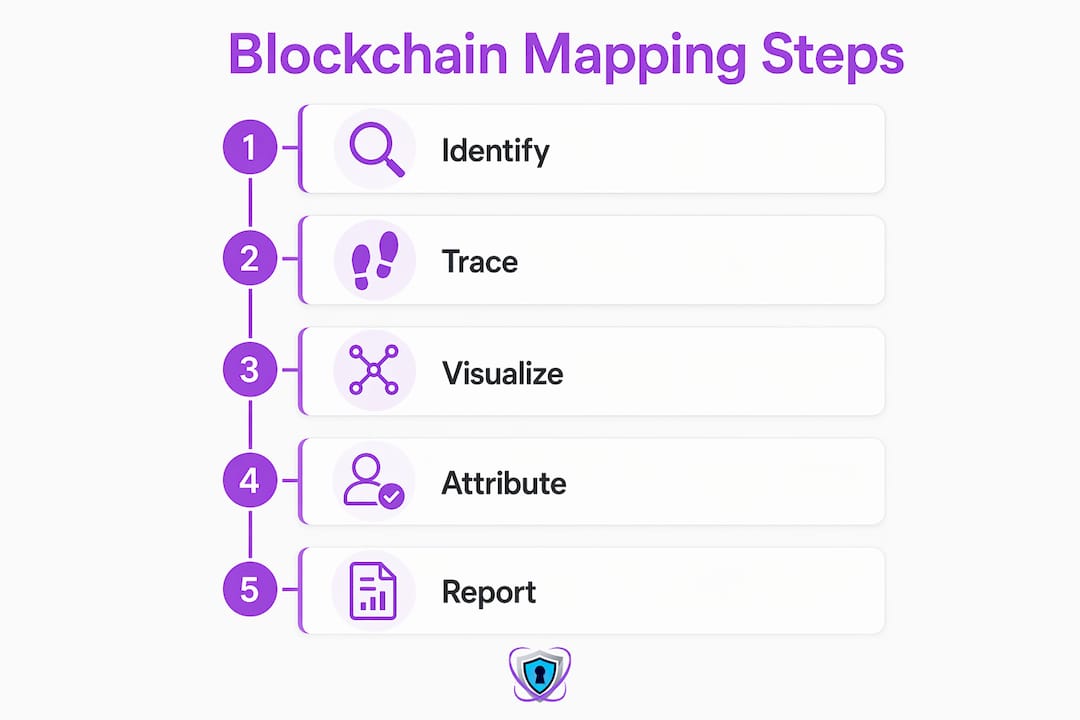
Blockchain mapping investigations face a structural tension: the data is public, but attribution is probabilistic. Every finding requires combining on-chain flow analysis with off-chain KYC data and investigative context. Forensic findings succeed based on confidence documentation rather than binary conclusions. That distinction matters enormously when presenting evidence to a court or regulator.
Investigators encounter several recurring obstacles:
- Pseudonymity at scale: Blockchain addresses carry no identity by default. Attribution depends on external data sources including exchange KYC records, IP logs, and open-source intelligence.
- Mixer and bridge obfuscation: Peel chains, fan-out structures, and cross-chain swaps are designed to break the transaction trail. Each hop requires a separate analytical step with its own confidence assessment.
- Fragmented organizational data: Siloed AML, fraud, and KYC functions within organizations create blind spots. Integrated intelligence-led workflows combining these data streams significantly improve detection and reduce duplicate investigative effort.
- DeFi protocol complexity: Decentralized exchanges and lending protocols execute transactions through smart contracts, not custodial accounts, making entity attribution structurally different from centralized exchange tracing.
Blockchain forensic findings are not binary verdicts. They are probabilistic assessments that gain legal weight through documented methodology, layered evidence, and reproducible on-chain tracing combined with off-chain attribution. Investigators who present findings without confidence levels undermine their own evidentiary case.
Pro Tip: Use a chain-hop investigation workflow that documents each cross-chain transfer separately, assigns a confidence score to each attribution step, and logs the data sources used. That structure is what regulators and courts expect.
How is blockchain mapping applied to prevent and investigate crypto fraud?
Blockchain mapping translates directly into four operational use cases that compliance teams and investigators deploy regularly.
| Use Case | Method | Outcome |
|---|---|---|
| Theft and scam tracing | Follow fund flow hop-by-hop from victim wallet through exchanges, DeFi, and darknet markets | Identifies cash-out points and responsible entities for legal action |
| Wash trading detection | Analyze circular transaction patterns and self-referential address clusters | Flags market manipulation for regulatory reporting |
| Sanctions screening | Screen wallet addresses against OFAC and global sanctions lists before transaction settlement | Prevents prohibited transactions and regulatory penalties |
| Asset recovery support | Map fund trajectory to identify exchange accounts holding stolen assets | Provides evidence for court orders and law enforcement cooperation |
Tracing stolen crypto begins from a known address, typically the victim’s wallet or the last confirmed legitimate transaction, and follows value hop-by-hop across networks. Each exchange, DeFi protocol, or darknet market encountered in the chain becomes a potential point for legal cooperation or asset freezing. Aegisfinancialforensics has assisted with over $34 billion in illicit funds seized or recovered using this methodology across more than 1,500 cases.
Wallet address tracing integrates directly into compliance workflows as a pre-transaction screening step, not just a post-incident investigation. Organizations that embed continuous blockchain monitoring into their governance structure catch fraud patterns earlier and produce cleaner audit trails. On-chain forensics is evolving from a post-incident investigation to a repeatable control function embedded in financial governance. That shift is the most significant operational change in crypto compliance over the past three years.
The practical implication is clear. Compliance teams that treat blockchain mapping as a one-time audit exercise miss the continuous intelligence value the data provides. Fraud patterns evolve. Monitoring must evolve with them.
Key Takeaways
Financial crime blockchain mapping is most effective when treated as a continuous governance function, not a one-time audit, combining on-chain tracing with off-chain attribution and documented confidence levels.
| Point | Details |
|---|---|
| Core definition | Blockchain mapping traces and visualizes crypto movements across public ledgers to detect fraud and money laundering. |
| Regulatory requirement | EBA and NCA guidelines mandate annual crypto-native AML audits covering transaction monitoring, sanctions screening, and Travel Rule compliance. |
| Probabilistic findings | Forensic conclusions require documented confidence levels, not binary verdicts, to hold evidentiary weight in court. |
| Privacy tech is not a barrier | Mixers and cross-chain bridges complicate tracing but do not make illicit flows untraceable with advanced heuristics. |
| Continuous monitoring wins | Teams that embed blockchain mapping as a repeatable compliance control detect fraud earlier and build stronger audit trails. |
The case for treating blockchain mapping as governance, not investigation
The field has a persistent blind spot: organizations deploy blockchain mapping reactively, after a fraud event or regulatory inquiry, rather than as a standing governance function. That sequencing is backwards. By the time an incident triggers an investigation, funds have moved through multiple hops, privacy layers, and jurisdictions. The investigative window narrows with every block confirmed.
What I have observed across complex crypto fraud cases is that the organizations with the strongest outcomes are not necessarily those with the most sophisticated tools. They are the ones with the clearest data ownership and the most connected decision-making structures. Siloed AML, fraud, and KYC teams working from separate data sets consistently miss the cross-functional signals that reveal sophisticated laundering schemes. Integrated governance frameworks, where on-chain forensic data feeds directly into AML and fraud review queues, close those gaps before they become regulatory findings.
There is also a tendency to over-rely on deterministic blockchain analytics, treating a high-confidence attribution as a proven fact rather than a well-supported inference. That distinction matters legally and operationally. The most credible forensic work documents its methodology, states its confidence levels explicitly, and pairs on-chain findings with corroborating off-chain evidence. Organizations that build that discipline into their standard operating procedures produce audit-ready evidence as a byproduct of normal compliance activity.
The regulatory direction is unambiguous. Crypto-native audit depth is the floor, not the ceiling. Teams that build blockchain mapping into their governance architecture now will be better positioned as FATF, EBA, and national regulators continue to raise the bar.
— Escareno
How Aegisfinancialforensics supports blockchain mapping and crypto recovery
Aegisfinancialforensics provides end-to-end blockchain forensic services for individuals and organizations that need to trace, document, and recover stolen or fraudulently obtained cryptocurrency.
The firm’s five-step recovery process covers on-chain fund tracing, entity attribution, chain of custody management, and direct support for legal cooperation with regulators and law enforcement. Aegisfinancialforensics uses AI-driven intelligence to trace assets across more than 1,100 networks, producing tamper-evident evidentiary exports that meet court and regulatory standards. For organizations facing compliance gaps or active fraud incidents, the crypto fund recovery investigation service provides forensic-grade analysis with a fast turnaround. Contact Aegisfinancialforensics to begin a case assessment and put experienced blockchain forensic investigators to work on your situation.
FAQ
What is financial crime blockchain mapping?
Financial crime blockchain mapping is the process of identifying, tracing, and visualizing cryptocurrency transactions across public ledgers to detect money laundering, fraud, and other illicit financial activity. It combines on-chain data analysis with off-chain attribution to produce forensic-grade findings.
What is a financial crime blockchain audit?
A financial crime blockchain audit is an independent review of a crypto asset service provider’s AML controls, including transaction monitoring, sanctions screening, Travel Rule compliance, and exposure to high-risk entities such as mixers and darknet markets. EBA and NCA guidelines require these audits annually for regulated firms.
How do investigators map blockchain transactions?
Investigators start from a known address, build a transaction graph using clustering and entity attribution techniques, and follow value hop-by-hop across exchanges, DeFi protocols, and darknet markets. Each step is assigned a confidence level and documented with the data sources used.
Can mixers and bridges stop blockchain mapping?
Mixers and cross-chain bridges complicate tracing but do not make illicit flows untraceable. Advanced heuristics and multi-chain analysis reconstruct fund trajectories to evidentiary standards accepted by courts and regulators.
How does AI improve financial crime detection in blockchain mapping?
AI-powered behavioral analytics analyze transaction patterns beyond static rules, reducing false positives and providing specific reasons for flagged activity. This makes investigations faster and produces more defensible findings for compliance and legal purposes.