

How Hacked Funds Are Tracked On-Chain: 2026 Guide
On-chain tracking of hacked funds is the process of following stolen cryptocurrency through immutable, publicly visible blockchain records to map where stolen assets move after a breach. Every transaction on networks like Ethereum, Solana, and Arbitrum leaves a permanent, auditable trail. That trail is the foundation of blockchain forensics, the recognized industry term for this discipline. Investigators use blockchain explorers, forensic platforms, and open-source intelligence to convert raw ledger data into actionable case files. Understanding how hacked funds are tracked on-chain is the first step toward initiating a credible recovery effort.
What tools and methods are used to track hacked cryptocurrency funds on-chain?
Basic on-chain tracing starts with a transaction hash. A transaction hash is a unique identifier for every transfer recorded on a blockchain. Victims enter that hash into a blockchain explorer such as Etherscan for Ethereum-based networks, Solscan for Solana, or HyperEVMScan for HyperEVM-compatible chains. The explorer displays the sending address, receiving address, token amount, timestamp, and network fee, all without requiring a wallet connection.

Blockchain explorers show raw transaction data useful for verification, but they lack the structured analytics and visualization that forensic reports provide. Forensic platforms convert public blockchain data into labeled fund-flow graphs, verification checklists, and share-safe briefs that victims can submit to exchanges or law enforcement. Professional forensic reports cost $5–$20 depending on scope, making entry-level tracing accessible to individual victims as well as institutional teams.
The core methods investigators apply include:
- Transaction hash tracing: Following each transfer from the compromised wallet through successive addresses to identify destination clusters.
- Address monitoring: Flagging wallet addresses associated with the theft and watching for new outbound activity in real time.
- Entity attribution: Matching destination addresses to known exchange deposit wallets, custodians, or labeled entities using proprietary databases.
- OSINT integration: Combining on-chain data with open-source intelligence such as social media accounts, forum posts, and domain registration records to build identity leads.
- KYC cross-referencing: Submitting flagged addresses to regulated exchanges that hold Know Your Customer records, which can link anonymous addresses to verified identities.
- Fund-flow graphing: Generating visual maps of asset movement across multiple hops to support legal filings and law enforcement referrals.
Pro Tip: Save the full URL of every blockchain explorer page you visit during initial tracing. Those URLs contain the transaction hash and serve as timestamped evidence if you later engage a forensic investigator or file a police report.
Which blockchain networks present special challenges in tracking stolen funds?
Not all blockchains are equally traceable. The architecture of each network, and the tools available for it, directly determines how far investigators can follow stolen assets.
- Ethereum: The most documented network for forensic tracing. Etherscan provides detailed token transfer logs, internal transaction data, and smart contract interactions. Entity attribution databases for Ethereum are the most mature in the industry.
- Solana: Solscan and similar explorers cover Solana’s high-throughput transaction structure, but the volume of transactions per second makes manual tracing labor-intensive. Automated clustering tools are required for effective analysis.
- Arbitrum: As a Layer-2 network, Arbitrum inherits Ethereum’s data transparency but adds governance complexity. The Arbitrum Security Council demonstrated on april 21, 2026 that governance-controlled contracts can seize stolen tokens via atomic transactions without the attacker’s private key. That capability is unique to networks with active on-chain governance.
- Base and Monad: Emerging networks with growing forensic tool coverage. Tracing on these chains often requires manual analysis because labeled entity databases are less developed.
- HyperEVM: Supported by HyperEVMScan, this network is traceable at the transaction level but lacks the deep attribution layers available on Ethereum mainnet.
Three technical mechanisms create the greatest obstacles for investigators tracing stolen funds across any network:
Mixers aggregate funds from multiple sources and redistribute them to obscure origins. Peel chains split stolen assets into dozens of micro-transactions across sequential addresses. Cross-chain bridges transfer assets between entirely separate ledgers, breaking the continuous transaction trail that forensic tools depend on.
The Kelp DAO exploit illustrates how governance and legal complexity compound technical challenges. Court orders restricted the Arbitrum DAO from moving $70 million in recovered ETH because plaintiffs from prior terrorism judgments asserted competing restitution claims over the frozen assets. Technical recovery and legal recovery are separate problems. Solving one does not automatically resolve the other.
How do professional forensic investigations combine on-chain data with off-chain intelligence?
Successful tracing depends on merging blockchain analytics with KYC records and public intelligence to build actionable leads, not raw data alone. On-chain data tells investigators where funds moved. Off-chain intelligence tells them who moved them.
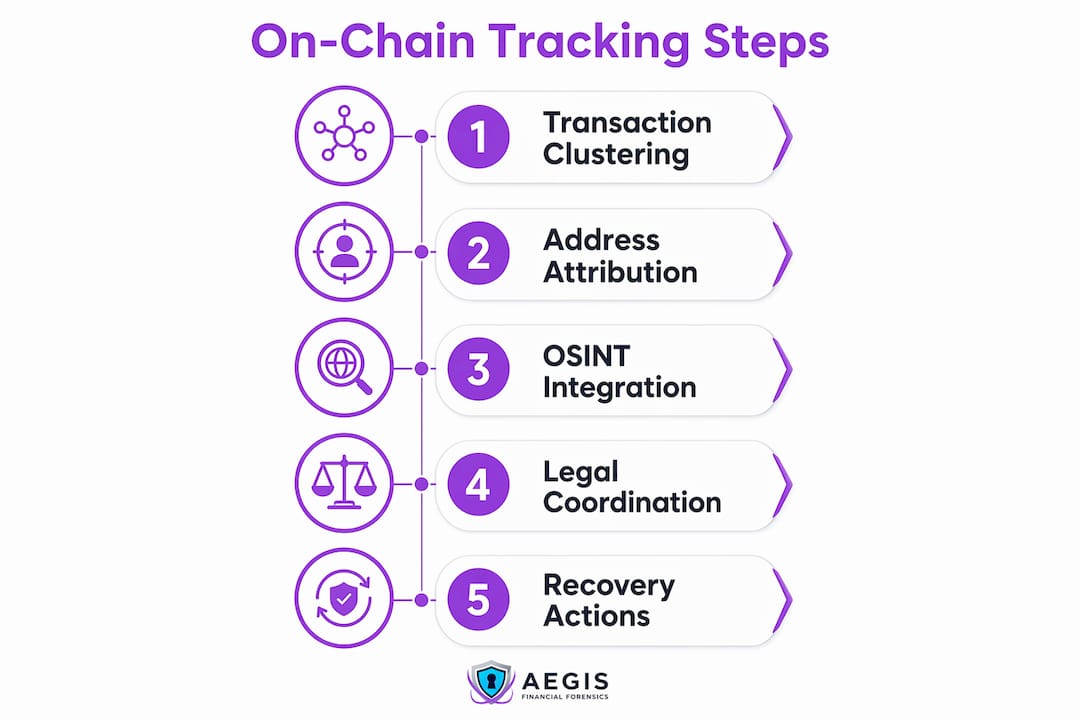
Forensic investigators build case files that combine transaction graphs with OSINT findings, exchange correspondence, and timing analysis. Pattern analysis identifies behavioral signatures: the time of day transfers occur, the gas fee levels chosen, and the sequence of hops used. Sophisticated actors often reuse operational patterns across multiple exploits, which creates attribution opportunities even when they rotate wallet addresses.
| Investigation layer | Data sources used | Output for legal action |
|---|---|---|
| On-chain analytics | Blockchain explorers, transaction logs, smart contract events | Fund-flow graph, address cluster map |
| OSINT | Social media, domain records, forum activity, IP leak data | Identity leads, behavioral profile |
| KYC cross-reference | Regulated exchange records, AML databases | Verified identity link to flagged address |
| Legal coordination | Law enforcement referrals, court orders, exchange freeze requests | Asset freeze, custodial hold, restitution filing |
The limits of tracing become clear when funds enter privacy-enhanced services or when custodians refuse to cooperate without a court order. Investigators can document the path to a mixer or bridge with high confidence. Documenting what happens inside those services requires either legal compulsion or a technical vulnerability in the service itself.
Pro Tip: When contacting a regulated exchange about a flagged address, submit your forensic report alongside the request. Exchanges respond faster to structured evidence than to informal complaints, and a documented fund-flow graph significantly increases the likelihood of a voluntary account freeze.
What practical steps can victims and businesses take after a crypto hack?
The clock starts immediately after a hack. Immediate documentation of wallet addresses, suspicious transaction hashes, timestamps in UTC, token names, and network information is critical within the first minutes. Forensic assistance is only as effective as the data victims preserve at the outset.
The sequence of steps that produces the best outcomes for victims is:
- Secure remaining assets first. Transfer any funds still in compromised wallets to a new, unconnected wallet before doing anything else. Do not reuse seed phrases.
- Record all transaction hashes. Copy every suspicious transaction hash from your wallet history. These are the primary identifiers for forensic tracing.
- Use a blockchain explorer for initial tracing. Enter each hash into Etherscan, Solscan, or the relevant network explorer to identify destination addresses and follow the first few hops manually.
- Obtain a professional forensic report. Entry-level forensic tracing reports identify fund paths to regulated exchanges and provide structured evidence suitable for law enforcement submission.
- Contact destination exchanges directly. Submit the forensic report and flagged addresses to the compliance teams of any exchanges where funds appear to have landed. Request a voluntary freeze pending investigation.
- File a report with law enforcement. In the United States, reports go to the FBI’s Internet Crime Complaint Center (IC3) and, for securities-related fraud, the SEC. Attach your forensic documentation.
- Avoid secondary scams. Any service requesting private keys or upfront fees via social media direct messages is almost certainly a secondary recovery scam. Legitimate forensic firms do not require seed phrases or recovery phrases under any circumstances.
Tracing establishes where funds went and, in favorable cases, who received them. Tracing alone does not return funds. Recovery requires legal action, exchange cooperation, or governance intervention, and outcomes depend heavily on how quickly victims act and how thoroughly they document the incident.
Key Takeaways
On-chain tracking of hacked funds requires combining immutable blockchain records with OSINT, KYC data, and legal coordination to build a case strong enough to support asset recovery.
| Point | Details |
|---|---|
| Blockchain records are permanent | Every transaction on Ethereum, Solana, and Arbitrum leaves an auditable trail investigators can follow. |
| Forensic reports add structure | Professional reports convert raw explorer data into fund-flow graphs and evidence packages for $5–$20. |
| Mixers and bridges complicate tracing | Peel chains, cross-chain bridges, and mixers break the transaction trail and require advanced de-mixing techniques. |
| Off-chain intelligence is required | KYC records and OSINT are necessary to link anonymous addresses to real-world identities. |
| Legal action drives recovery | Tracing documents the path; court orders, exchange freezes, and governance interventions recover the funds. |
Governance interventions are changing what recovery looks like
The Arbitrum Security Council’s april 2026 action in the Kelp DAO case changed my understanding of what on-chain recovery can actually accomplish. For years, the standard position was that funds sent to an attacker’s address were gone unless the attacker cooperated or law enforcement compelled an exchange. The Arbitrum intervention proved that Layer-2 networks with active governance can move frozen funds without the attacker’s private key. That is a structural shift, not an edge case.
What concerns me more than the technical challenge is the legal complexity that follows a successful technical recovery. The Kelp DAO situation showed that recovering funds on-chain does not mean victims receive them. Competing legal claims, court-ordered divestiture hearings, and jurisdictional disputes can freeze recovered assets for months or years. Victims who assume that a governance intervention or exchange freeze means their funds are coming back are setting themselves up for a difficult wait.
The practical lesson is that documentation and timing matter more than most victims realize. Investigators who receive a well-documented incident report within hours of a hack have materially better outcomes than those working from incomplete records weeks later. Technology can follow the money. Law and governance determine whether it comes back. Both require preparation, and neither works well without the other.
— Escareno
How Aegisfinancialforensics supports on-chain fund tracing and recovery
Victims of cryptocurrency hacks need more than a blockchain explorer. They need structured forensic analysis, documented fund-flow graphs, and coordinated outreach to exchanges and law enforcement.
Aegisfinancialforensics delivers professional crypto fund recovery investigations that combine on-chain transaction analysis with OSINT and KYC cross-referencing across Ethereum, Solana, Arbitrum, and other major networks. The firm has assisted with over $34 billion in illicit funds seized or recovered, serving more than 1,500 clients including regulators and institutional teams. Reports are structured for direct submission to law enforcement and exchange compliance teams. Victims and businesses can also review the full range of asset tracing services to identify the right level of forensic support for their situation.
FAQ
What is on-chain tracking of stolen cryptocurrency?
On-chain tracking, formally called blockchain forensics, is the process of following stolen cryptocurrency through publicly recorded transaction data on a blockchain to map where assets moved after a theft.
How do investigators trace hacked funds across multiple wallets?
Investigators use transaction hash analysis, address clustering, and entity attribution to follow funds hop by hop, matching destination addresses to known exchange wallets or labeled entities in forensic databases.
Can stolen crypto be recovered after it passes through a mixer?
Mixers significantly complicate tracing by redistributing aggregated funds to obscure origins, but advanced de-mixing techniques and OSINT can sometimes reconstruct the transaction path and identify destination addresses.
What should victims do immediately after a crypto hack?
Victims should document all transaction hashes, wallet addresses, timestamps in UTC, and token names within minutes of the incident, then secure remaining assets in a new wallet before beginning any tracing effort.
Are governance interventions a reliable recovery method?
Governance interventions on Layer-2 networks like Arbitrum can freeze and move stolen funds without the attacker’s private key, but recovered assets may face competing legal claims that delay or complicate distribution to victims.