
Blockchain Transaction Analysis: What You Need to Know
Blockchain transaction analysis is defined as the systematic examination of on-chain records to trace asset flows, identify financial irregularities, and link wallet addresses to real-world entities. For individuals and businesses affected by crypto fraud, this process is the foundation of any credible recovery effort. It draws on forensic methodologies including address clustering, contract call decoding, and entity attribution to convert raw blockchain data into actionable intelligence. Aegisfinancialforensics has applied these methods across cases involving over $34 billion in illicit funds seized or recovered, serving more than 1,500 clients including regulators and financial institutions.
What is blockchain transaction analysis and how does it work?
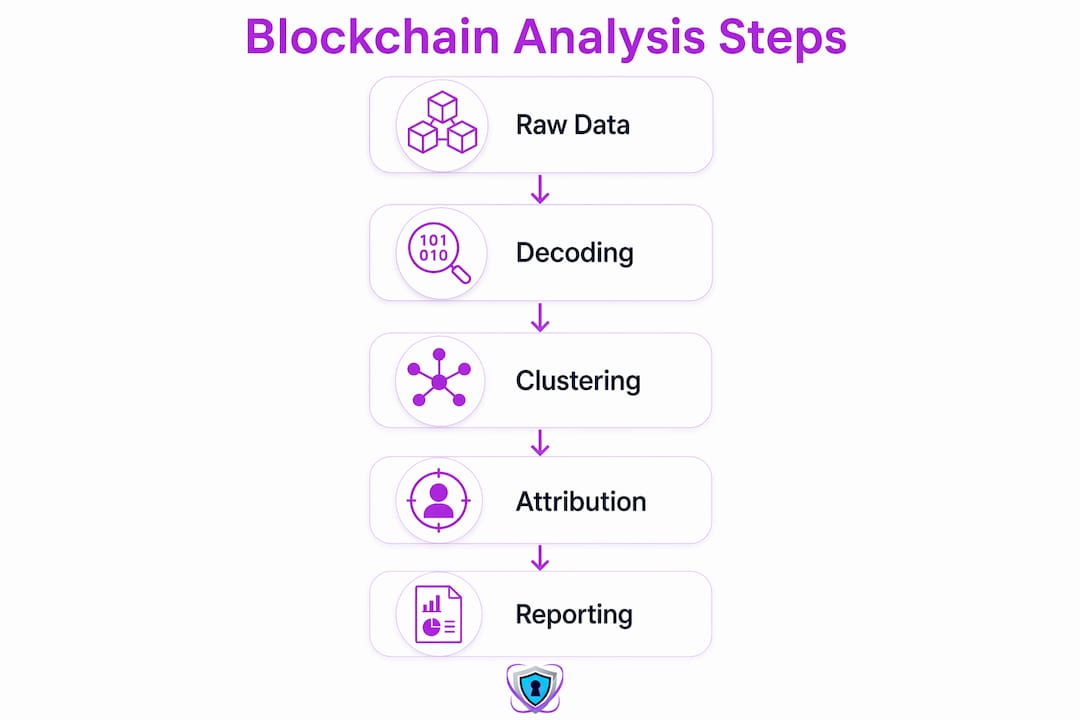
Blockchain transaction analysis begins with raw on-chain data: blocks, transaction hashes, wallet addresses, input and output values, and event logs generated by smart contracts. Each transaction is a verifiable record on a public ledger, but that record alone does not identify who sent funds or why. Raw blockchain data shows address involvement at a specific block but does not label participants or prove intent. That gap between fact and meaning is where forensic analysis begins.
The first analytical step is decoding. Smart contract interactions produce encoded data that must be parsed against the contract’s application binary interface (ABI) to reveal the actual operation performed, such as a token swap, a deposit into a lending protocol, or a withdrawal to an external wallet. Contract interface mismatches and protocol schema misalignments can cause decoding errors, making exact network state awareness a non-negotiable requirement for accurate forensic work.
The second step is address clustering. A single individual or organization typically controls many wallet addresses. Forensic analysts cluster addresses manually or algorithmically to group wallets that share behavioral patterns, common inputs, or co-spending signatures. This clustering is the primary method for linking on-chain activity to a real-world entity. Without it, tracing stolen funds across dozens of wallets becomes operationally impossible.
- Blocks and transactions: The base layer of raw data, recording every transfer on the network.
- Event logs: Smart contract outputs that record specific actions like token mints or liquidity additions.
- Address clustering: Grouping wallets by shared control signals to identify a single controlling entity.
- Contract decoding: Parsing encoded call data to reveal the human-readable action performed.
- Entity attribution: Assigning a real-world label (exchange, individual, protocol) to a cluster with documented confidence.
Pro Tip: Always preserve raw blockchain data in its original encoded state before any decoding step. This protects chain of custody and keeps forensic findings admissible in legal proceedings.
Key tools and methods used in blockchain transaction monitoring
Blockchain transaction monitoring is the continuous, real-time layer of analysis that sits above historical forensic investigation. Centralized exchanges use automated rule-based alerts and case management platforms to flag high-risk activity as it occurs. This infrastructure forms the operational backbone of compliance programs at regulated crypto businesses.

Know Your Transaction (KYT) systems are the primary tool in this category. KYT assigns a risk score to each transaction by cross-referencing the counterparty wallet against databases of known illicit addresses, sanctioned entities, and high-risk services. Sanction screening runs in parallel, checking wallet addresses against lists maintained by bodies such as the U.S. Office of Foreign Assets Control (OFAC). Together, KYT and sanction screening give compliance teams a real-time view of transaction risk.
Decentralized finance (DeFi) presents a distinct monitoring challenge. The structural absence of KYT in DeFi creates significant gaps in detecting suspicious activity, because DeFi protocols do not collect user identity data and often lack the compliance infrastructure present at centralized exchanges. Investigators working DeFi cases must rely more heavily on graph analysis and off-chain intelligence to reconstruct fund flows.
| Method | Primary use | Key limitation |
|---|---|---|
| KYT (Know Your Transaction) | Real-time risk scoring of counterparty wallets | Requires up-to-date address databases |
| Sanction screening | Matching wallets to OFAC and similar lists | Misses newly created illicit wallets |
| Graph analysis | Mapping fund flows across multiple hops | Labor-intensive without automation |
| Entity labeling | Assigning exchange or protocol tags to clusters | Confidence levels vary by provider |
Analytics platforms add entity labels such as “exchange,” “bridge,” or “treasury” to clustered wallet groups. These labels require confidence assessment because methodology and accuracy vary significantly across providers. Investigators should document the source and confidence level of every label used in a formal report.
Why combining on-chain and off-chain data is critical for investigations
The transparency of a public blockchain is real but incomplete. Blockchain transparency requires indexing and careful judgment to avoid misinterpretation. A wallet address is pseudonymous, not anonymous. Knowing that address X sent funds to address Y is a fact. Knowing that a specific person controls address X requires off-chain evidence.
Off-chain data sources include exchange compliance records, court-ordered disclosures, public corporate registries, IP address logs from service providers, and open-source intelligence gathered from social media or forums. Effective investigations combine on-chain data with off-chain context such as exchange disclosures and public entity registers. Using on-chain data alone risks misidentifying an innocent party or failing to establish the legal standard of proof required for asset recovery.
The concept of “evidence engineering” captures this discipline precisely. Blockchain records are raw data; meaningful interpretation requires separating transaction logs (raw facts) from decoded actions (swaps, deposits) and economic interpretations (whale behavior, scam pattern). Each layer of interpretation must be documented separately, with the underlying data preserved to allow independent verification.
Pro Tip: Build your investigation in three documented layers: raw facts, decoded actions, and attributed interpretations. Mixing these layers in a single report is the most common cause of investigative errors that undermine legal proceedings.
Investigators who skip off-chain corroboration frequently reach conclusions that collapse under legal scrutiny. A fund flow that appears to terminate at a known exchange wallet may actually reflect a shared deposit address used by thousands of customers. Without exchange records confirming the specific account holder, the on-chain evidence alone proves nothing actionable.
Practical applications: how businesses and individuals use blockchain transaction analysis
The real-world applications of blockchain data analysis tools span law enforcement, corporate compliance, and individual fraud recovery. Each use case demands a different combination of the methods described above, but all share the same forensic foundation.
Tracing stolen or fraudulent crypto funds
When funds are stolen through a scam or exchange breach, tracing stolen crypto requires mapping every hop the funds take across wallets, bridges, and mixing services. Investigators use graph analysis to follow peel chains (where funds are split into smaller amounts across many wallets) and fan-out structures (where a single wallet distributes funds to dozens of recipients simultaneously). Aegisfinancialforensics applies this methodology as part of a structured five-step recovery process, enabling asset tracing across multiple networks.
Compliance monitoring for businesses
Regulated crypto businesses use blockchain transaction monitoring to meet Anti-Money Laundering (AML) obligations. Automated KYT systems flag transactions above defined risk thresholds and route them to compliance analysts for review. Businesses that fail to implement adequate monitoring face regulatory penalties and reputational damage.
Detecting money laundering and scam activity
Money laundering on-chain typically follows recognizable structural patterns: layering through multiple wallets, conversion between asset types, and eventual withdrawal through a fiat off-ramp. Analysts trained in crypto transaction graph analysis can identify these patterns even when perpetrators use privacy-enhancing techniques.
Supporting law enforcement and forensic investigations
Law enforcement agencies rely on forensic blockchain reports to build prosecutable cases. These reports must document the chain of custody for all evidence, separate factual findings from interpretive conclusions, and cite the confidence level of every entity attribution. Maintaining chain of custody for raw blockchain data before decoding is critical to preserving evidence admissibility in court.
- Fraud victims use blockchain analysis to identify where their funds went and which services received them.
- Compliance teams use it to screen counterparties and meet OFAC and Financial Action Task Force (FATF) obligations.
- Law enforcement uses forensic reports as primary evidence in criminal prosecutions.
- Businesses use it to assess the risk profile of incoming transactions before processing them.
Key Takeaways
Blockchain transaction analysis produces reliable forensic findings only when raw on-chain data is combined with off-chain intelligence and documented through a rigorous evidence engineering process.
| Point | Details |
|---|---|
| Definition and scope | Blockchain transaction analysis examines on-chain records to trace fund flows and attribute activity to real-world entities. |
| Address clustering | Grouping multiple wallets by shared control signals is the primary method for identifying a single controlling entity. |
| On-chain and off-chain integration | On-chain data alone risks misidentification; off-chain sources like exchange records are required for legal-grade conclusions. |
| DeFi monitoring gaps | The absence of KYT in DeFi protocols forces investigators to rely on graph analysis and external intelligence. |
| Chain of custody | Raw blockchain data must be preserved unchanged before decoding to keep forensic evidence admissible in legal proceedings. |
The discipline most investigators underestimate
Working in blockchain forensics for years has made one thing clear: the technical tools are rarely the limiting factor. The limiting factor is discipline in how analysts handle the data they collect.
The most common failure I observe is the collapse of the three-layer evidence structure. Investigators decode a contract call, assign an entity label, and write a conclusion in the same breath, without documenting which step produced which claim. That approach may produce a compelling narrative, but it does not produce admissible evidence. Courts and regulators require that each layer of interpretation be traceable back to a verifiable raw fact.
The second failure is ignoring off-chain data because it is harder to obtain. On-chain data is free, indexed, and immediately available. Off-chain data requires legal process, relationship-building with exchanges, and time. Investigators who skip that step consistently overstate the certainty of their conclusions. The blockchain shows you where funds went. It does not show you who was sitting at the keyboard.
The ethical dimension matters too. Entity attribution carries real consequences for real people. Labeling a wallet cluster as belonging to a specific individual without adequate confidence documentation can cause serious harm. The standard should always be: would this attribution hold up to independent expert review?
— Escareno
How Aegisfinancialforensics applies forensic analysis to crypto recovery
Aegisfinancialforensics delivers structured blockchain forensic investigations for fraud victims and businesses that need legally defensible findings, not just transaction maps.
The firm’s five-step recovery process covers initial evidence preservation, on-chain graph analysis, entity attribution with documented confidence levels, off-chain corroboration, and formal forensic reporting. Aegisfinancialforensics has assisted with over $34 billion in illicit funds seized or recovered, working alongside regulators and institutional clients who require findings that meet evidentiary standards. For individuals who have lost funds to scams or exchange breaches, the crypto fund recovery investigation service provides a clear starting point. Businesses seeking to understand the full scope of blockchain asset tracing benefits can review the firm’s detailed guidance on forensic methods and compliance applications.
FAQ
What is blockchain transaction analysis in simple terms?
Blockchain transaction analysis is the process of examining public ledger records to trace how funds moved between wallets, identify suspicious patterns, and link addresses to real-world entities. It combines on-chain data with off-chain intelligence to produce forensic findings.
How does address clustering work in blockchain forensics?
Address clustering groups multiple wallet addresses that share behavioral signals, such as common transaction inputs or co-spending patterns, to identify a single controlling entity. This method is the primary technique for tracing funds across complex multi-wallet structures.
Why is off-chain data necessary for blockchain investigations?
On-chain data confirms that a transaction occurred but cannot identify who controlled the sending wallet. Off-chain sources such as exchange compliance records and public registries provide the identity evidence needed to reach legally defensible conclusions.
What is KYT and why does it matter for compliance?
Know Your Transaction (KYT) is a real-time monitoring system that assigns risk scores to crypto transactions by cross-referencing counterparty wallets against databases of illicit addresses and sanctioned entities. Regulated exchanges use KYT to meet AML obligations and detect high-risk activity as it occurs.
Can blockchain transaction analysis recover stolen crypto funds?
Blockchain transaction analysis identifies where stolen funds traveled and which services received them, creating the evidentiary foundation for asset recovery. Recovery itself depends on legal action, exchange cooperation, and jurisdiction, but the forensic trace is the required first step.