
Wallet Address Tracing: What It Is and How It Works
Wallet address tracing is defined as the forensic process of monitoring cryptocurrency wallet activity by examining on-chain transaction data to follow the flow of digital assets across blockchain ledgers. Known formally as blockchain tracing, this discipline uses specialized tools to overcome pseudonymity and identify real-world actors behind suspicious activity. Every public blockchain transaction is permanently recorded and accessible to anyone without authorization, creating a transparent ledger that investigators can analyze freely and legally. For individuals and businesses dealing with stolen funds or suspected fraud, understanding what is wallet address tracing is the first step toward building a credible recovery case.
What is wallet address tracing and how does it work?
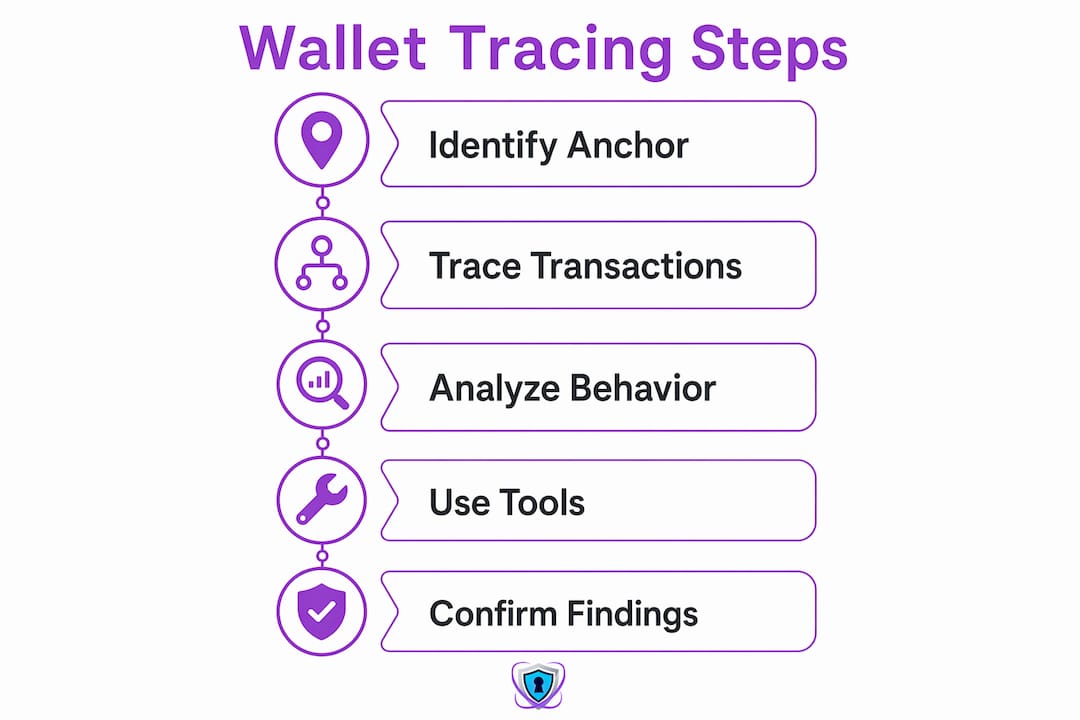
Wallet address tracing begins with a confirmed anchor point. That anchor is typically a wallet address or a transaction ID (TXID) provided by the victim or identified through exchange records. Without this starting point, investigators have no thread to pull.
Once the anchor is established, the process follows a structured sequence:
- Identify the blockchain. Determine whether the funds moved on Bitcoin, Ethereum, Tron, or another network. This matters because chain-specific explorers are required. Querying a Bitcoin address on an Ethereum explorer returns no results.
- Query a blockchain explorer. Tools like Etherscan for Ethereum or Blockchain.com for Bitcoin display all inflows, outflows, timestamps, and counterparty addresses associated with a given wallet.
- Map transaction flows. Investigators trace funds forward and backward through the chain, identifying clusters of addresses controlled by the same entity using techniques like UTXO input analysis on Bitcoin.
- Locate off-ramps. The critical breakthrough occurs when funds reach a regulated exchange subject to KYC and AML rules. At that point, wallet addresses link to real-world identities, enabling law enforcement or legal counsel to compel disclosure.
- Document the chain of custody. Every finding must be preserved in a format admissible in legal proceedings.
Pro Tip: Always record the exact block height and timestamp for each transaction you document. Courts and regulators require timestamped evidence, and blockchain data can be reorganized or re-indexed by some explorers without notice.
The process is methodical, not automatic. Investigators must interpret each hop, assess whether a transfer represents a genuine third-party recipient or an internal wallet move, and corroborate on-chain data with off-chain signals such as exchange communications or IP logs.
What tools and technologies enable wallet address tracing?
The right tool depends entirely on the blockchain under investigation. Selecting the wrong explorer is not a minor inconvenience. It produces zero results and wastes critical time.
Blockchain explorers
Blockchain explorers are the foundation of any tracing effort. Etherscan covers Ethereum and ERC-20 tokens. Blockchain.com and Blockstream.info serve Bitcoin investigations. Tronscan handles Tron-based USDT transfers. Each explorer exposes raw transaction data, including sender and receiver addresses, amounts, fees, and block confirmations.

Forensic analytic platforms
Beyond basic explorers, professional investigations require platforms that perform address clustering, entity attribution, and labeling. These platforms group addresses likely controlled by the same entity and tag known wallets belonging to exchanges, darknet markets, or sanctioned entities. The labeling function is what converts raw address strings into meaningful investigative leads.
Wallet trackers vs. portfolio trackers
A wallet tracker focuses on address-level behavior, monitoring transaction patterns, counterparty relationships, and fund flows. A portfolio tracker, by contrast, aggregates personal holdings for financial management. The distinction matters for investigations. Portfolio trackers are built for asset owners. Wallet trackers are built for investigators.
Key features to evaluate when selecting a tracing tool:
- Multi-chain support. A single investigation often spans Bitcoin, Ethereum, and Tron. Tools that cover only one chain force investigators to switch platforms and risk losing continuity.
- Transaction visualization. Graph-based views of fund flows make it far easier to identify fan-out structures, peel chains, and consolidation patterns.
- Address labeling and alerts. Real-time alerts notify investigators when a traced wallet interacts with a known exchange or flagged entity.
- Evidentiary exports. Reports must be exportable in formats accepted by courts and regulators.
Investigators working complex cases should also consult the crypto fraud investigation tools that forensic specialists rely on, since consumer-grade explorers lack the attribution depth required for legal proceedings.
What are the practical benefits and use cases of wallet address tracing?
Wallet address tracking delivers concrete outcomes across four distinct use cases, each with direct financial or legal consequences.
Recovering stolen or lost cryptocurrency. By mapping fund flows from the victim’s wallet forward through the chain, investigators identify where assets were consolidated, converted, or deposited. This on-chain transaction analysis provides the evidentiary foundation for exchange subpoenas and legal freezing orders.
Detecting fraudulent wallet behavior. Pattern analysis reveals anomalies such as rapid fund dispersal across dozens of wallets, circular transactions designed to obscure origin, or sudden large withdrawals following a deposit spike. These patterns are consistent with rug pulls, Ponzi schemes, and pig butchering scams.
Supporting regulatory compliance. Businesses operating in regulated markets use address tracing to screen counterparty wallets before processing transactions. Linking a wallet to a sanctioned entity before a transfer occurs prevents regulatory penalties that can reach into the millions.
Market intelligence. Institutional investors monitor large wallet addresses, commonly called “whales,” to anticipate significant market moves. When a whale wallet begins distributing holdings across multiple addresses, it often precedes a large sell event.
The scale of what address-level analysis can reveal is significant. In april 2026, 96% of a $3 billion USDT issuance, totaling $2.89 billion, was traced to a single entity through wallet address analysis in one week. That finding demonstrates that even large-scale fund movements leave traceable signatures on public ledgers when the right methodology is applied.
What challenges and nuances exist in wallet address tracing?
Tracing is not a linear process, and several technical and operational factors reduce accuracy when investigators lack chain-specific expertise.
Change address misidentification
Bitcoin’s UTXO model creates a specific trap for inexperienced analysts. When a Bitcoin transaction is broadcast, the sender often receives change back to a new address they control. Misidentifying change addresses as third-party recipients is a common novice error. Change addresses typically have no prior transaction history and receive irregular amounts. Treating them as external recipients corrupts the entire transaction graph.
Privacy-enhancing techniques
CoinJoin and stealth addresses complicate forensic analysis by mixing inputs from multiple senders into a single transaction, obscuring the direct link between sender and receiver. These techniques do not make tracing impossible, but they require corroboration with off-chain data, such as IP addresses, exchange records, or communications metadata, to achieve reliable attribution.
Chain fragmentation
Funds frequently move across multiple blockchains through bridges or cross-chain swaps. Each chain requires its own explorer and methodology. An investigator who loses the thread at a bridge crossing may incorrectly conclude the funds disappeared. Successful tracing across chains requires chain-specific knowledge and specialized explorers for each network involved.
Tracing does not guarantee recovery
Tracing establishes where funds went. Recovery requires legal action, exchange cooperation, and often jurisdictional coordination. Investigators who conflate the two create unrealistic expectations for clients. The forensic report is the instrument. Recovery is the outcome of what legal and regulatory processes do with that instrument.
Pro Tip: Always corroborate on-chain findings with at least one off-chain data source before presenting conclusions. A transaction graph alone is not attribution. Attribution requires connecting a wallet address to a person or entity through verifiable external evidence.
Key Takeaways
Wallet address tracing is the forensic foundation of every credible cryptocurrency recovery and fraud investigation, requiring chain-specific tools, structured methodology, and corroborating off-chain evidence to produce legally actionable results.
| Point | Details |
|---|---|
| Start with a confirmed anchor | Every trace begins with a verified wallet address or TXID before any analysis proceeds. |
| Match tools to the blockchain | Using the wrong explorer for a given chain produces no results and delays investigations. |
| Off-ramps are the breakthrough | Funds reaching regulated exchanges create the identity linkage that enables legal action. |
| Change addresses mislead novices | Bitcoin change addresses must be distinguished from third-party recipients to avoid corrupting the transaction graph. |
| Tracing supports but does not replace legal action | Forensic findings are evidence. Recovery depends on exchange cooperation and legal process. |
Why most tracing efforts fail before they start
Most tracing failures I have encountered share a common root cause: investigators begin without a clean anchor. They start with a suspected wallet address that has not been verified against actual transaction records, or they work from a screenshot rather than a confirmed TXID. The entire graph built from that starting point is then unreliable, regardless of how sophisticated the tools used downstream are.
The second pattern I see consistently is chain blindness. Investigators familiar with Ethereum apply Ethereum logic to Bitcoin transactions and miss the UTXO clustering signals that would have connected a dozen addresses to a single actor. Bitcoin’s UTXO input clustering is one of the most powerful attribution techniques available, but only if the investigator knows to look for it.
The third failure mode is stopping at the on-chain data. Blockchain evidence is necessary but rarely sufficient for legal attribution. The cases that result in actual fund recovery are the ones where on-chain findings are paired with exchange subpoenas, IP logs, or communications records. Investigators who treat the transaction graph as the final product, rather than the starting point for legal action, consistently underdeliver for their clients.
The practical implication for individuals and businesses is clear: understanding the fundamentals of address tracing helps you ask better questions of the professionals you engage and evaluate whether their methodology is credible. Knowing what a change address is, why chain selection matters, and what an off-ramp means in investigative terms puts you in a position to hold your forensic team accountable.
— Escareno
How Aegisfinancialforensics supports wallet tracing and crypto recovery
Aegisfinancialforensics specializes in crypto fund recovery investigations for individuals and businesses who have lost digital assets to scams, fraud, or theft. With a proven five-step recovery process and AI-driven intelligence applied across multiple blockchain networks, Aegisfinancialforensics has assisted in tracing over $34 billion in illicit funds seized or recovered, serving more than 1,500 clients including major regulators and institutions.
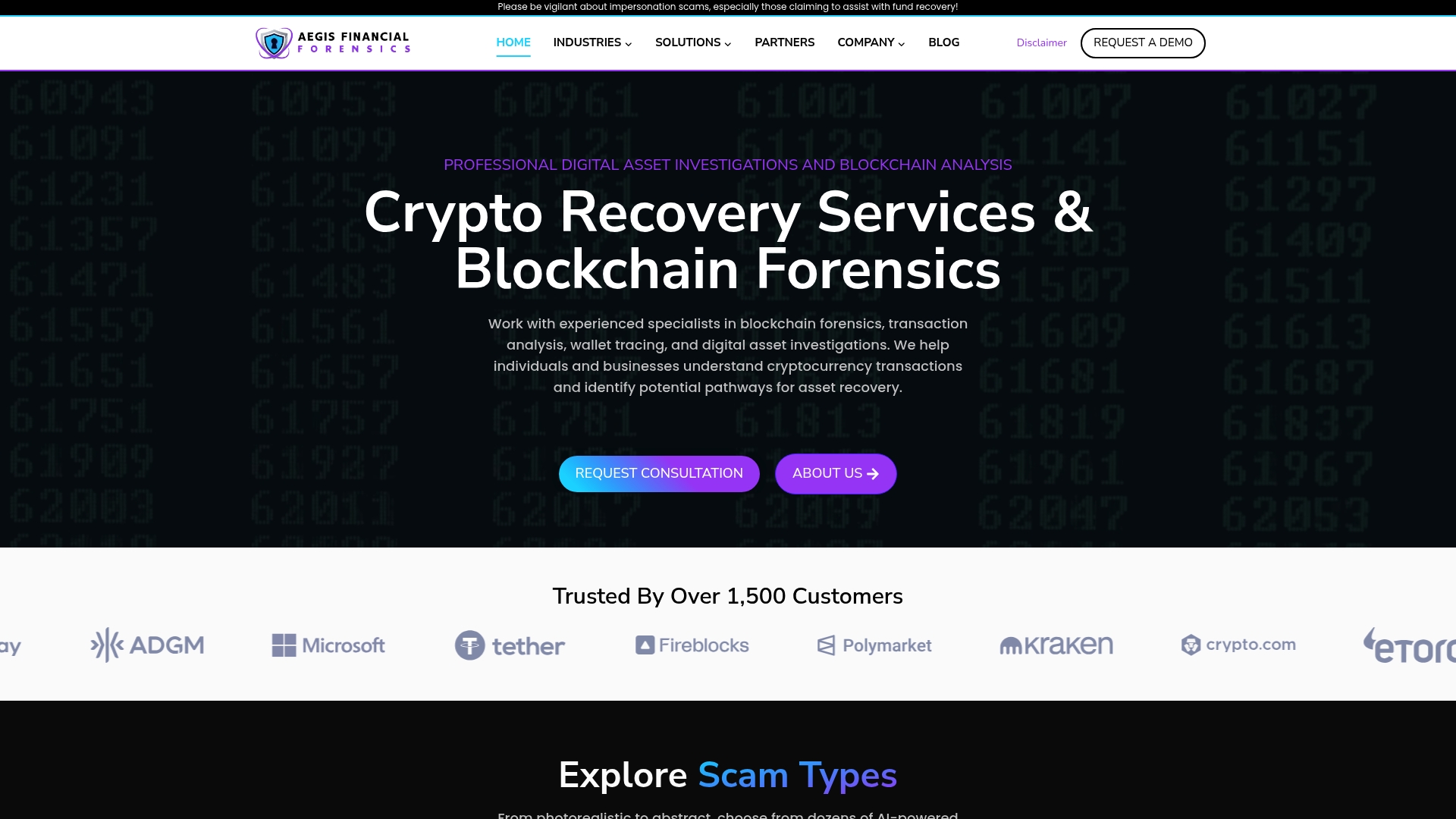
When a case requires tracing funds across Bitcoin, Ethereum, Tron, or other networks, Aegisfinancialforensics applies chain-specific forensic methodology and produces evidentiary-grade reports suitable for legal proceedings. Investigators who need to understand what tracing software must do to meet professional standards will find detailed guidance across the Aegisfinancialforensics resource library. For complex cases involving cross-chain movements or privacy-enhancing techniques, professional forensic support significantly improves the probability of a successful outcome.
FAQ
What is wallet address tracing in simple terms?
Wallet address tracing is the process of following cryptocurrency transactions across a blockchain to identify where funds came from, where they went, and who may control the receiving wallets. It uses publicly available on-chain data combined with specialized forensic tools.
Can you track a crypto wallet without the owner’s permission?
Yes. Every transaction on a public blockchain is permanently visible to anyone. No permission is required to query a wallet address using a blockchain explorer, because the data is publicly recorded by design.
How do investigators link a wallet address to a real person?
The linkage occurs when traced funds reach a regulated exchange that enforces KYC and AML rules. At that point, legal process can compel the exchange to disclose the identity associated with the wallet account.
What makes Bitcoin tracing different from Ethereum tracing?
Bitcoin uses a UTXO model that allows address clustering based on shared transaction inputs, a technique that does not apply to Ethereum’s account-based model. Each blockchain requires chain-specific explorers and methodology for accurate results.
Does tracing a wallet guarantee fund recovery?
Tracing establishes the forensic record of where funds moved. Actual recovery depends on legal action, exchange cooperation, and jurisdictional factors. The forensic report is the foundation; recovery is the outcome of the legal process that follows.